

Originally posted in The Business Standard on 13 November 2025
Speakers: Democracy cannot survive without a change in political culture
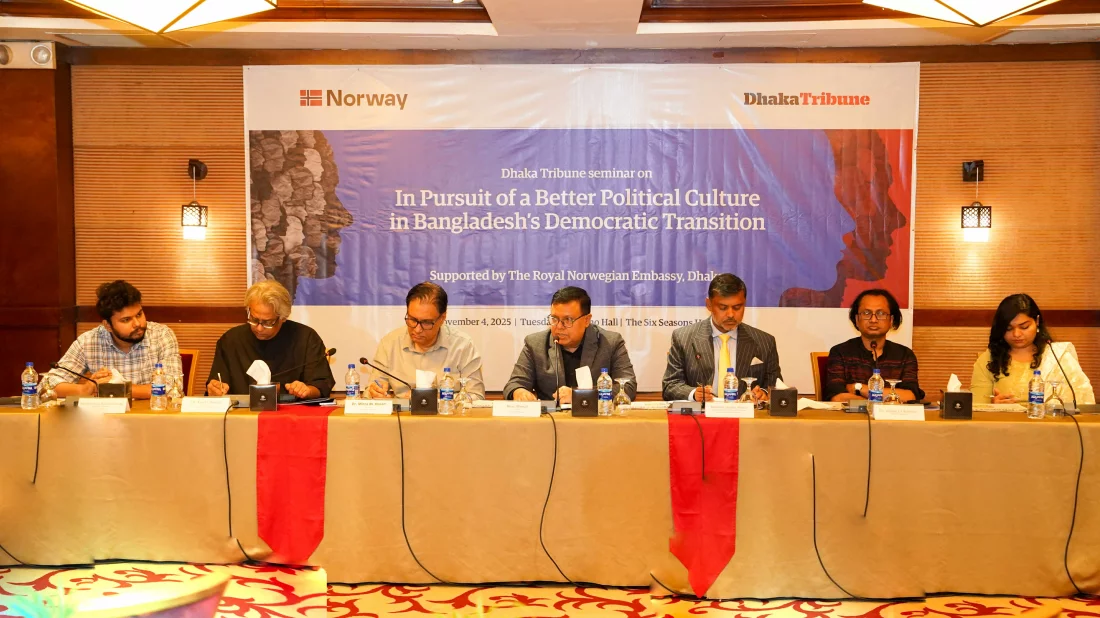
Politics in Bangladesh has turned into a means of livelihood rather than public service, speakers observed at a Dhaka Tribune seminar. They called for moral renewal, institutional reform, and a return to civic ethics to restore faith in democracy
A seminar titled `In Pursuit of a Better Political Culture in Bangladesh’s Democratic Transition` was held at a hotel in Dhaka, organized by Dhaka Tribune with support from the Embassy of Norway in Dhaka on Tuesday, November 4, 2025.
Politics in Bangladesh has increasingly turned into a means of livelihood rather than a platform for public service, observed speakers at a high-profile seminar titled “In Pursuit of a Better Political Culture in Bangladesh’s Democratic Transition.”
Organized by the Dhaka Tribune, supported by the Royal Norwegian Embassy, Dhaka, the event was held on November 4, at a hotel in Gulshan.
The seminar brought together leading political scientists and commentators, diplomats, civil society representatives, youth, politicians and academics for an open discussion on Bangladesh’s democratic transition and the challenges of reforming its political culture.
The session was moderated by Reaz Ahmad, Editor of the Dhaka Tribune, who noted that it was part of a broader series aimed at sparking dialogue on democratic reform, governance, and civic renewal.
Norwegian Ambassador Håkon Arald Gulbrandsen said that while Bangladesh’s interim government has initiated significant structural reforms, the country’s democratic renewal depends on the conduct of its politicians.
Special guest of the event, political scientist and CPD Distinguished Fellow Dr Rounaq Jahan said that behavioral change and institutional integrity must go hand in hand.
As the discussion concluded, participants agreed that Bangladesh’s democratic renewal depends less on charters, commissions, or constitutional amendments, and more on trust, civic responsibility, and moral leadership.
The panel’s message was clear: democracy is not sustained by procedures alone but by culture, the everyday ethics of how politics is practiced.
As Ambassador Håkon Arald Gulbrandsen reminded in his parting words: “Healthy political culture is not built by laws alone, it is built by the way people practice politics.”
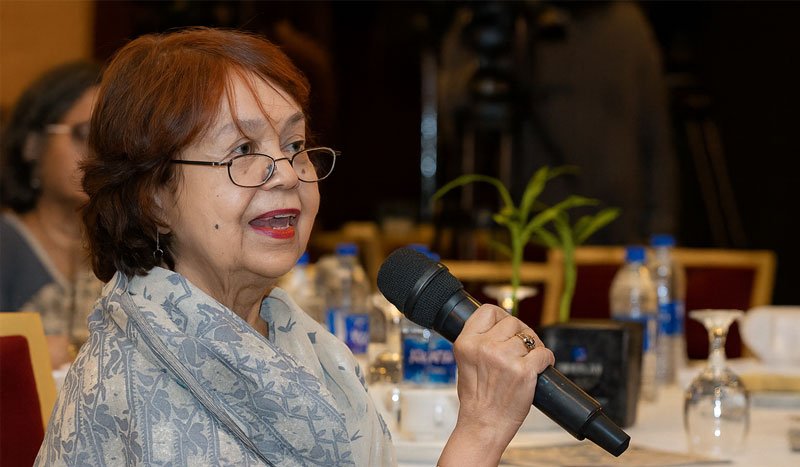
Dr Rounaq Jahan
Distinguished Fellow, Centre for Policy Dialogue (CPD)
“Citizens’ ability to hold leaders accountable cannot be limited to elections every five years. Accountability must extend to every level of governance, from policy formulation to implementation.”
Dr Jahan warned that unchecked privileges and elite capture have hollowed out institutions, eroding public faith in democracy.
“The dismantling of the caretaker government system marked a major setback for public confidence in fair elections. Elite capture has turned institutions into instruments of control.”
She urged political parties to move from personality-driven rivalries to policy-based competition.
“Parties must shift from personal attacks to policy debates. Equal access for women, minorities, and less-resourced candidates is not charity, it is democracy.”
Ending on a hopeful note, she added: “Despite everything, people’s faith in democracy endures. That is our greatest strength and our reason to keep striving for reform.”