

Publications
CPD’s current publication list contains more than 500 titles including Books, Monographs, Working Papers, Dialogue Briefs and Policy Briefs. If you want to collect the hard copies of the publications, please contact with CPD. You can find the soft copies of the book in the CPD website.
In the proposed budget for FY2027, the social safety net budget allocation, excluding pension and agricultural subsidy, stood at 8.7 per cent of the budget and 1.20 per cent of the GDP. Read more
Gender-relevant budget allocation reached BDT 326,059.8 crore in FY2027—34.8 per cent of the total national budget and 4.8 per cent of GDP—but the 23 per cent year-on-year nominal increase masks a fundamental restructuring around a single flagship programme rather than broad-based growth across women's priorities. Read more
Health budget allocation in FY2027 is 6.70 per cent of the total budget and 0.92 per cent of the GDP, nearing the long-standing target of 1 per cent of GDP after remaining below this threshold for nearly two decades. Read more
The proposed education budget allocation for FY2027 accounts for 13.06 per cent of the total proposed budget and 1.79 per cent of the GDP. Read more
Bangladesh’s external debt-servicing record has historically been stellar for a least developed country. The country has comfortably met its external debt servicing obligations, largely thanks to its strong export performance. Read more
For more than two decades, the Infrastructure Development Company Limited (IDCOL) has built an almost unrivalled position in green energy finance, backed by sovereign support that few private lenders can match. Read more
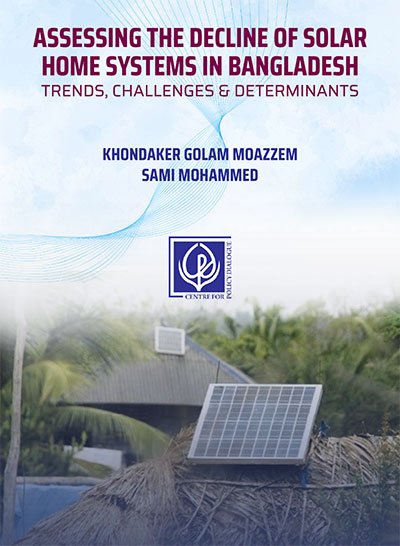
For two decades, the Solar Home System was rural Bangladesh's answer to electricity access. Millions of households once relied on it for light, for charging a phone, for keeping a small business running after dark. Read more
Bangladesh's evolving constitutional and political landscape has renewed attention to the institutional rules that govern parliamentary democracy. Read more
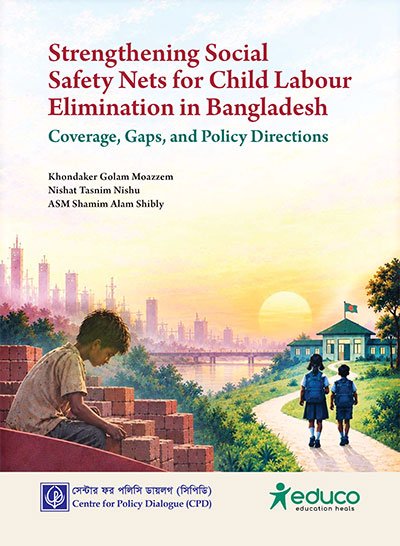
The social safety net programmes of Bangladesh were not designed considering the factors along which child labour actually varies. Based on national survey data, key informant interviews, and regional comparisons Read more
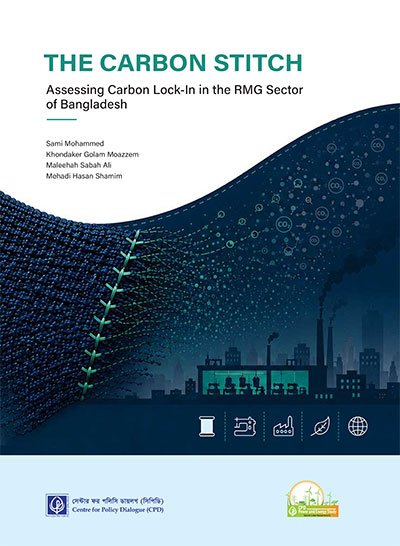
This study examines the structural determinants of carbon lock-in in Bangladesh’s RMG sector from a demand-side perspective. Despite rising decarbonisation pressures, the sector remains dependent on carbon-intensive production. Read more
Automation alone threatens up to 1.22 million readymade garment (RMG) jobs, and as much as 60 per cent of female RMG employment could be displaced by 2041. Read more
The International Monetary Fund (IMF) projected Bangladesh’s GDP growth to moderate to 3.5 per cent in FY2027 and warned that growth could fall below 3 per cent over the medium term without decisive reforms. Read more