

Originally posted in The Daily Star on 18 November 2025
 Emerging from the ruins of the war of independence in 1971 with a devastated economy, Bangladesh has gradually transformed into a vibrant lower-middle-income country, which is poised to graduate from the Least Developed Country (LDC) status in November 2026. Over the years, factors such as remittances, exports, agriculture, small enterprises, microfinance, and the increasing participation of women in the labour force have played crucial roles in poverty alleviation and improving several human development indicators of the country.
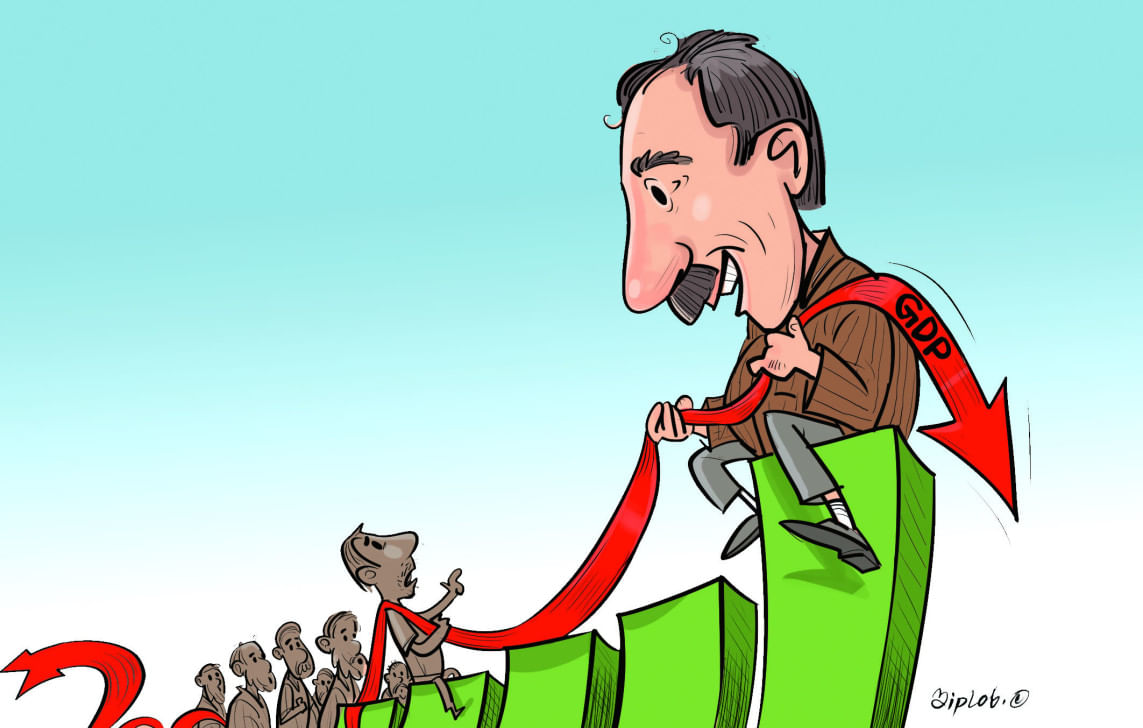
Yet, behind the success lies an emerging set of concerns. Income inequality has increased, urban poverty is becoming more complex, and a series of external shocks, including the pandemic, the Ukraine war, global price volatility, climate impacts, and persistent inflation, have revealed deep-rooted structural vulnerabilities. For Bangladesh, the issue is not about the rate of growth, but whether growth can be inclusive.
Bangladesh’s fight against poverty has indeed been one of its notable achievements. Rural households gained from expanded irrigation, the adoption of high-yielding crop varieties, better connectivity, and the growth of non-farm enterprises. Women’s employment, particularly in the ready-made garment sector, provided millions with stable incomes and greatly increased their independence. Microfinance institutions helped poor households smooth their income, invest in livestock or small shops, and send their children to school. Remittances from migrant workers offered financial stability to rural families.
However, poverty reduction faces specific limitations. Nationwide, 85 percent of workers are employed in the informal sector, characterised by limited job security and a lack of social protection, which makes households very vulnerable to shocks. High inflation, particularly food inflation, has decreased real incomes, causing many families that had escaped poverty to fall back below the poverty line or remain just above it.
Inequality, meanwhile, continues to grow in noticeable ways. According to the Household Income and Expenditure Survey (HIES) 2022, the national income Gini coefficient increased from 0.482 in 2016 to 0.499 in 2022, indicating that income distribution is becoming more unequal. The HIES 2022 shows that the richest of the rich—the top five percent of households—possess 30.04 percent of the total national income, while the poorest of the poor—the bottom five percent—hold just 0.37 percent. In 2016, the top five percent’s income share was 27.82 percent, whereas that of the bottom five percent was only 0.23 percent of the total national income.
Besides, urban–rural disparities remain significant. Cities are expanding through higher-productivity services and industries, while rural communities continue to depend on low-return agriculture and informal employment. Inequities in access to education, healthcare, technology, and financial resources are widening these gaps. Children from poorer households are more likely to attend poor-quality schools, suffer from undernutrition, and have limited chances to develop skills needed for modern labour markets. This hampers human development progress.
Meanwhile, food security shows a mix of progress and new risks. Bangladesh has more than doubled its food grain output in the past 30 years, thanks to advances in agricultural research, irrigation, and policy incentives. However, food security depends as much on access as on availability. Climate change now poses the greatest threat to that access. Agricultural land is endangered by rising salinity, coastal inundation, unpredictable rainfall, and flash floods. In recent years, while severe and prolonged flooding in rural areas has led to local food shortages and price hikes, low-income households in urban areas also struggled with high food prices, reducing their food intake or meal quality. The paradox today is that Bangladesh often has enough food supplies nationwide, but poor households cannot always afford enough food due to inflation, low incomes, and weak market governance.
Although Bangladesh has a social protection system with around 120 programmes, including old-age allowances, widow benefits, food assistance, and employment support, the effectiveness of this system remains limited. Spending on the social safety net (SSN) accounts for less than two percent of Bangladesh’s Gross Domestic Product (GDP). In fact, the SSN allocation accounts for only 1.87 percent of the national budget for the fiscal year (FY) 2026. However, this allocation includes various other components—such as pensions for government employees, interest on national savings certificates, and agricultural subsidies—not targeted at the poor and vulnerable. Excluding these, the share of the SSN allocation stands at just 1.03 percent of GDP in FY2026. In addition to the insufficient allocation relative to the needs of the poor, several limitations, such as targeting errors, overlapping programmes, outdated beneficiary lists, and limited coverage of the urban poor and informal workers, curtail the overall impact. Strengthening the system demands a unified social registry, digital identification and payment systems, improved targeting, and expanded coverage. Over time, Bangladesh will need to increase social protection spending while enhancing efficiency and transparency.
The classical Kuznets hypothesis, proposed by economist Simon Kuznets, suggests that inequality tends to rise during early development as economies shift from agriculture to industry, and then decline as more people gain access to education and modern employment opportunities. However, recent evidence indicates that inequality does not necessarily fall automatically. Since the 1980s, inequality has increased in many countries due to skill-biased technological change, financialisation, declining labour bargaining power, globalisation without adequate compensation, and the concentration of wealth among elites. Markets alone cannot address inequality. Policy decisions such as taxation, social protection, labour laws, education, and regulatory measures impact distributional outcomes.
Besides, the “capability approach” introduced by Nobel Laureate economist Professor Amartya Sen in the 1980s shifted the concept of poverty from simple income deprivation to a broader understanding encompassing health, education, empowerment, and agency. The multidimensional poverty framework, now widely adopted globally, emphasises that poverty involves multiple disadvantages, such as poor schooling, unsafe housing, malnutrition, lack of access to clean energy, and social exclusion. Factors like gender, ethnicity, geography, and social class all influence who remains in poverty.
Viewed from these perspectives, Bangladesh’s dual reality becomes evident. The country has made considerable progress, but the foundations of inclusive development remain uneven. Bangladesh must now emphasise not only the pace of growth but also its quality, inclusiveness, and resilience.
That means investing heavily in education and skills so that young people from all backgrounds can access more productive work. It involves promoting meaningful jobs in manufacturing and services across all cities and lagging regions beyond Dhaka. It also entails adopting a more progressive tax system where the wealthy pay a fairer share to fund public services. Additionally, it includes modernising food markets and employing digital tools to improve transparency in procurement, stocking, and distribution. Finally, it means incentivising private investment in climate-resilient agriculture through salt-tolerant seeds, flood-tolerant rice, efficient irrigation, storage, and insurance.
And most importantly, it involves recognising that poverty and inequality reduction, and food security cannot be tackled in isolation. These issues are interconnected and must be addressed through a coherent strategy rooted in equity, good governance, and strong institutions.
Dr Fahmida Khatun is executive director at the Centre for Policy Dialogue. Views expressed in this article are the author’s own. Views expressed in this article are the author’s own.