

The draft Energy and Power Sector Master Plan (EPSMP) 2025, which lays out the country’s energy vision from 2026 to 2050, has raised more severe concerns, critics and questions rather than answering and addressing the prevailing ones. It was expected that new master plan will address all the key challenges of IEPMP and will come up with a better and more energy transition supportive EPSMP. Experts argue that, in its current form, the plan fails to address, accommodate and answer the critics, concerns and questions raised in the IEPMP.
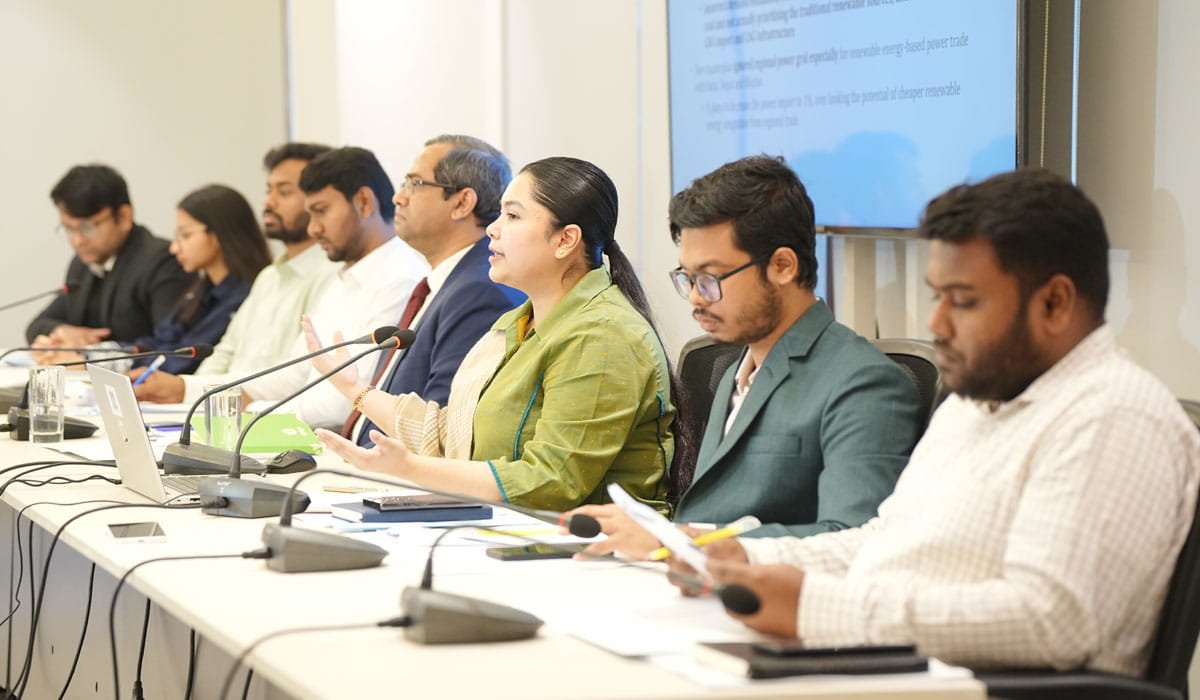
These concerns were raised by the Centre for Policy Dialogue (CPD) at a media briefing on Thursday, 15 January 2026, titled “Interim Government’s Energy & Power Sector Master Plan (EPSMP): 2026-2050.” The event was organised to offer a quick response to the draft, highlighting its gaps and shortcomings. Dr Khondaker Golam Moazzem, Research Director at CPD, moderated the session, while Ms Helen Mashiyat Preoty, Senior Research Associate at CPD, delivered the keynote presentation.
The CPD’s analysis revealed that the new EPSMP draft carries forward all the critics as the previous Integrated Energy and Power Master Plan (IEPMP). It also has somewhat alignment with the major sectoral policies and planning documents in all the wrong ways. In case of some issues, EPSMP even intensifies the existing debate.
The critic begins as early as context setting of the master plan. The whole master plan is based on the domestic coal exploration and LNG import, completely avoiding the notion of energy transition goal of Bangladesh. The discussion on the exploration of domestic coal reemerged on the shoulders of EPSMP. The proposed fuel mix outlines addition of new coal power plants to the grid. Unfortunately, this doesn’t end here, LNG expansion plan along with establishing 1 FSRU and 1 land based terminal has raised questions about interim government’s intention to overcome the debt cycle of this sector while transiting from fossil fuels.
The saga of faulty power demand projection continues as draft EPSMP overestimates future power demand. The draft forecasts a need for 40,836 MW by 2040, a figure much higher than what is estimated to be necessary. CPD estimates that the power demand in 2040 will not be more than 30,000 MW. A new aspect has been added to the peak demand estimation as it outlines the zone wise peak demand projection and generation plan. Such technical exercise should work as an added benefit, however, the mismatch and inconsistency between the zonal demand, RE potential and generation plan can create additional generation burden.
According to the EPSMP, the renewable energy share will be 20% by 2030, 30% by 2040 and 50% by 2050. But there seems to be duplicity in determining renewable energy sources and renewable energy share. RE share includes large scale utility solar, rooftop solar, onshore & offshore wind, waste to energy, geothermal, hydrogen and ammonia co-firing. However, it is not sure how much of it is from traditional renewable sources. Concerns are raised whether there is any importance given towards the expansion of solar, wind and hydro power. Because the plan talks about planning and implementing renewable energy only after 2040 from phase 3. How can possibly Bangladesh can achieve energy transition goals in 2040 if the renewable priority projects take place after 2040? Another more serious question is, why is the interim government still camouflaging false solutions (CCS, hydrogen and ammonia) as renewable energy sources?
CPD also pointed out the necessity of grid upgradation is the most under looked and under emphasised aspect of the new master plan. The EPSMP targets 50% renewable energy by 2050, yet there is little focus on modernising the grid to accommodate this change without any regional power mapping. The same issue with planning Smart Grid reappears as renewable energy expansion. The establishment of smart grid is said to start in phase 3 of the implementation plan (2040-2050) which can’t wait till 2040 as the RE target is 30% by 2040. The existing grid can only take upto 20% VRE. Hence, smart grid project must be started in phase one for gradual implementation.
Moreover, the financial strategy outlined in the EPSMP is absolutely contradictory to energy security and energy transition. It proposes an investment allocation of $25-30 billion for LNG import, $2-3 billion for hydrogen and ammonia, and $85.15 bn for electricity generation. The investment plan completely ignores renewable energy investment and allocates very insignificant amounts for domestic gas exploration and T&D modernisation.
Following the presentation, an open-floor Q&A session was held, allowing journalists from both print and electronic media to ask questions. CPD researchers responded to queries, clarifying critical issues such as repetition of the same mistakes in the consecutive plans, cost of LNG import, renewable energy integration, the need for institutional reforms, and the financial sustainability of the proposed plans.
CPD strongly recommended that the EPSMP should not be approved by the interim government before national election and the new elected political government should take charge of it. EPSMP must shift it’s core focus from coal and LNG to RE, must drop all the discussion on false solutions, advanced technology or future energy sources and immediately focus on establishing smart grid. If such as plan is passed without any major revision, Bangladesh’s energy transition journey will be backtracked by not only years but also several decades.