

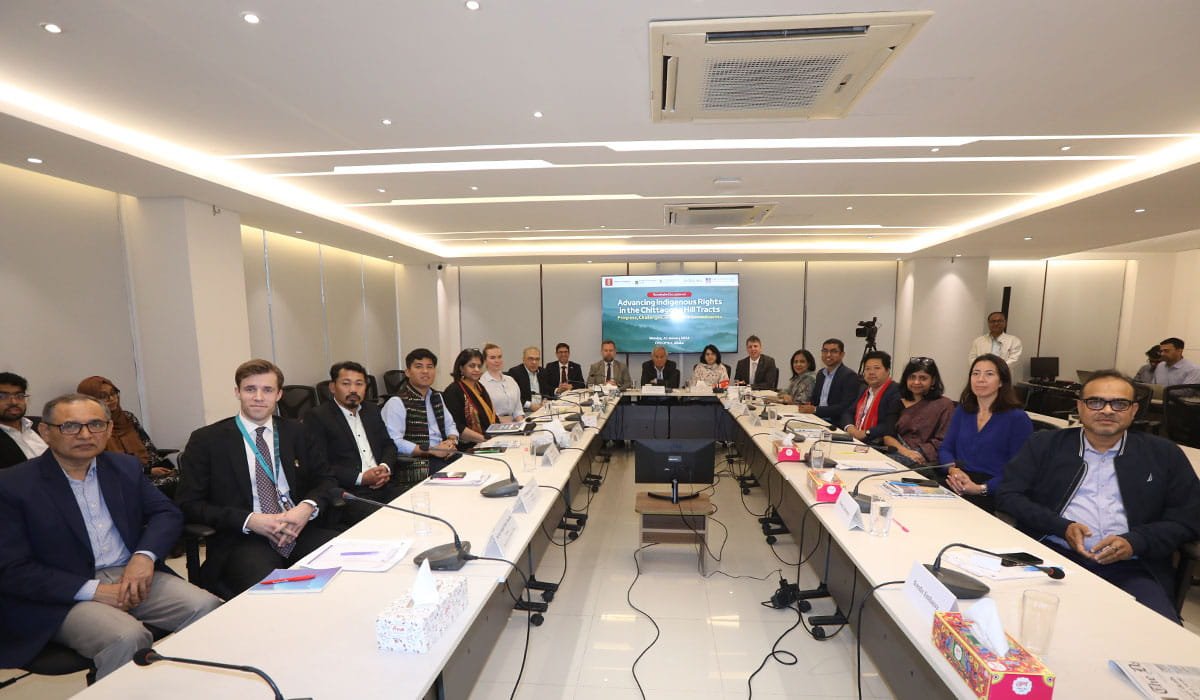
The Chittagong Hill Tracts continue to face a complex combination of challenges related to land governance, administrative arrangements, social inclusion, access to justice, and confidence in public institutions. Long-standing questions surrounding the implementation of the 1997 Peace Accord remain under discussion, while concerns persist about unresolved land disputes, the functioning of local government bodies, the situation of women and girls, and the overall relationship between citizens and the state. As Bangladesh moves through a broader period of political transition, many speakers at a recent policy dialogue noted that progress in the hills will depend on practical, coordinated, and rights-based political and administrative measures that can translate commitments into outcomes on the ground.
These issues were examined at a roundtable discussion organised by the Centre for Policy Dialogue (CPD), in partnership with the Nordic embassies in Bangladesh and The Daily Star, on Monday, 26 January 2026, at the CPD premises. Titled ‘Advancing Indigenous Rights in the Chittagong Hill Tracts: Progress, Challenges, and Political Commitments’, the event brought together policymakers, researchers, legal experts, development partners, journalists, and representatives from the region to reflect on current realities and possible ways forward ahead of the upcoming national election.
The Chief Guest, Hon’ble Adviser Mr Supradip Chakma, placed emphasis on dignity, equity, and the responsibilities of the state. He observed that questions of development and governance in the Hill Tracts cannot be separated from their political context and noted that the Peace Accord remains the central framework for addressing these issues. At the same time, he spoke about the importance of strengthening institutional performance, improving leadership capacity, and ensuring that public resources translate into tangible improvements in people’s lives, particularly through quality education and livelihood development.
Setting out the policy perspective for the day, Dr Fahmida Khatun, Executive Director of CPD and Chair of the session, outlined three priority areas that, in her view, should guide future action. These were land and resource governance, effective and participatory local administration, and confidence-building in the areas of security and justice so that citizens experience protection and fairness in their daily lives. She also highlighted two cross-cutting concerns that emerged repeatedly during the discussion: the rehabilitation of displaced populations and the protection of Indigenous women and girls, noting that both require sustained attention if peace is to become durable.
H E Mr Christian Brix Møller, Ambassador of Denmark to Bangladesh, said that Indigenous rights form a core part of Nordic foreign policy because human rights are universal. He referred to Denmark’s engagement in international processes, including recommendations made to Bangladesh through the Universal Periodic Review mechanism. He also observed that the Chittagong Hill Tracts have significant economic potential, including in areas such as tourism and agricultural production, but stressed that such opportunities can only be realised in a sustainable manner if they are pursued transparently and in partnership with local communities.
Joining the discussion online, Ms Lola García, Senior Adviser at the International Work Group for Indigenous Affairs (IWGIA), addressed the ongoing debate in Bangladesh about the identification of Indigenous peoples. She explained that the United Nations does not apply a rigid definition, relying instead on widely accepted criteria such as self-identification, historical continuity, and distinct social and cultural institutions. She said that recognition is not a matter of discretion but forms part of international human rights obligations, and that it is closely linked to effective access to justice, protection of land and territories, and the full implementation of the Peace Accord.
H E Mr Håkon Arald Gulbrandsen, Ambassador of Norway to Bangladesh, who referred to Norway’s own historical experience of assimilation policies and the later establishment of the Sami Parliament. He said this process had helped strengthen inclusion, constitutional protection, and democratic governance. Referring to Bangladesh, he observed that Indigenous communities exist both in the hills and in the plains, and that recognition and dialogue can contribute to building more inclusive and resilient institutions.
Turning to the perspectives from the region itself, Mr Shatish Chakma, International Affairs Secretary of the Bangladesh Indigenous Youth Forum, said that future progress would depend on resuming structured dialogue between the state and Indigenous leadership. He emphasised the importance of making the Land Disputes Resolution Commission fully operational, holding elections to the Hill District Councils and the Regional Council, and ensuring that administrative responsibilities are transferred as envisaged under the Peace Accord.
Legal dimensions of the discussion were addressed by Advocate Abdullah Al Noman, Chief Executive of Lawyers for Energy and Environment Development (LEED), who drew on his experience of providing legal aid, including in cases involving Indigenous women. He referred to continuing challenges related to unresolved land disputes, the scope of authority exercised by local councils, and barriers to equal treatment in the justice system. He also said that political parties should clarify how they intend to align domestic policy with Bangladesh’s international human rights commitments.
The Swedish Ambassador to Bangladesh, H E Mr Nicolas Linus Ragnar Weeks, emphasised that Indigenous rights are inseparable from trust between citizens and the state, and stated that strategic decisions taken without Indigenous peoples—“around them or over their heads”—risk producing permanent harm to land, livelihoods, culture, language, and identity. Drawing from Nordic experience, he said recognition and inclusive institutions should be viewed as state-strengthening measures rather than threats to national unity.
The discussion was further grounded in personal experience by Mr Pallab Chakma, Executive Director of Kapaeeng Foundation, who referred to his family’s displacement during the years of conflict. He said that framing the Hill Tracts primarily through a law and order lens has not helped resolve underlying political and land-related issues. He highlighted the importance of a functioning Land Commission, credible investigation of recent incidents, and a publicly trackable roadmap for implementation to strengthen confidence in institutions.
From the media, Mr Mong Sing Hai Marma of The Daily Star spoke about the situation in remote areas of the region and noted continuing concerns related to land, service delivery, and public confidence in institutions. He also raised questions about whether development initiatives are sufficiently inclusive when local participation remains limited.
Barrister Sara Hossain of the Bangladesh Legal Aid and Services Trust (BLAST) focused on the justice system and institutional readiness. She observed that the Peace Accord itself has faced legal challenges and remains politically sensitive. She argued that effective operation of the Land Commission requires clear recognition of community land rights and an understanding that the Hill Tracts have a distinct legal and administrative context. She also referred to the need for greater judicial orientation to customary and plural legal traditions and noted practical gaps, including the absence of family courts in the region.
Reflecting on a recent visit to the area, Dr Amena Mohsin, Professor and former Chair of the Department of International Relations at the University of Dhaka, described visible improvements in infrastructure alongside what she saw as continuing social distance and administrative complexity. She referred to the multiple legal and administrative systems operating in parallel and said that recognition of Bangladesh’s ethnic diversity is a necessary foundation for progress on land, justice, and social inclusion, including the position of women.
Dr Iftekharuzzaman, Executive Director of Transparency International Bangladesh, spoke about the historical settlement policies in the region and their long-term implications for governance and trust. He said that sustainable progress would require engagement across institutions and a shared understanding of the political dimensions of the challenges involved, rather than reliance on short-term or purely administrative responses.
The broader context of the discussion was summarised by the moderator, Mr Tanjim Ferdous, In-Charge of NGOs and Foreign Missions at The Daily Star, who noted: “Nearly three decades later, progress has been uneven. While there have been important institutional and legal developments, several core provisions of the Accord remain partially implemented or stalled.”
As the session concluded, the organisers reiterated that the purpose of the dialogue was not to revisit past disputes, but to reflect on current realities and identify what is realistically achievable in the present context. Across different perspectives, a common theme emerged: progress in the Chittagong Hill Tracts will depend on consistent, coordinated, and practical steps to strengthen land governance, improve institutional performance, ensure access to justice, and build confidence between citizens and the state.
Press Report: The Daily Star