

Supplement: Electoral Commitments on Addressing Discrimination against Women and Family Rights
Women’s rights must be prioritised in the upcoming elections, with political leaders in Bangladesh called upon to clarify their positions on key issues such as legal protections against violence, inheritance rights, and the need for greater female representation. Experts have raised concerns about the enforcement of existing laws, the legal discrimination women face within families, and the need to improve access to justice and support services. They also called for political parties to take clear action on issues such as online harassment, the rights of mothers, and the implementation of laws for marginalized groups.
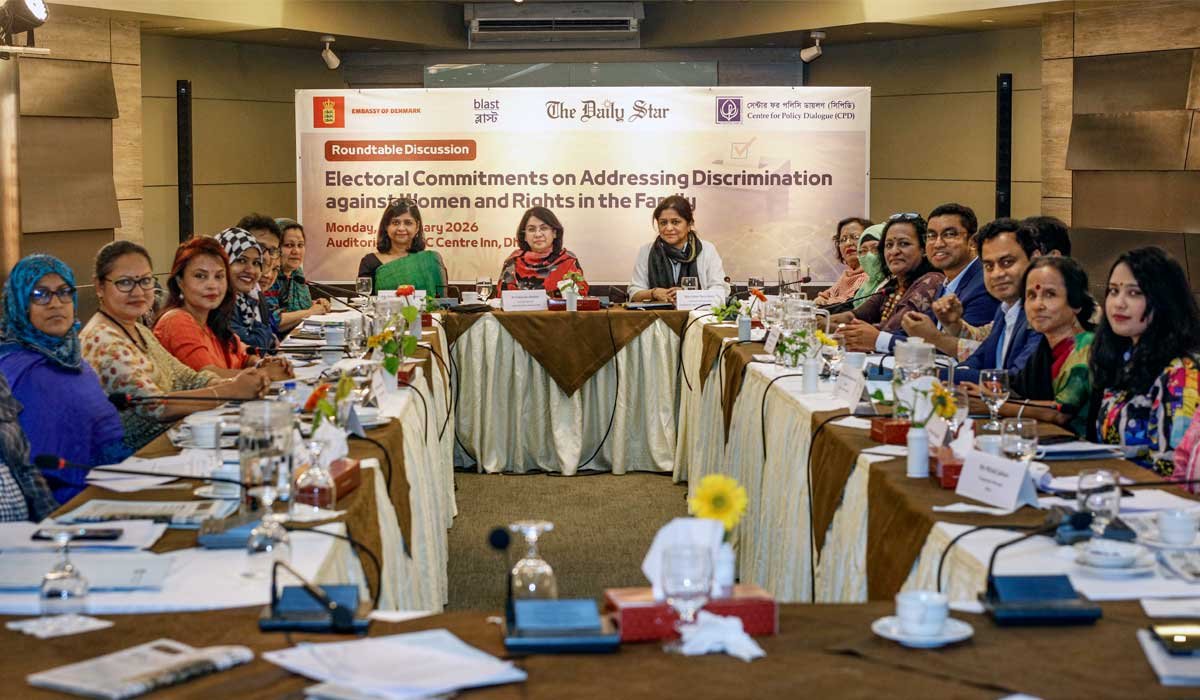
The call for change came during a roundtable discussion on ‘Electoral Commitments on Addressing Discrimination against Women and Rights in the Family’, held on Monday, 2 February 2026. Organised by the Centre for Policy Dialogue (CPD), The Daily Star, Bangladesh Legal Aid and Services Trust (BLAST), and the Danish Embassy, the event brought together political leaders, legal experts, and civil society representatives to discuss the urgent need for reforms in family law, women’s safety, and legal aid services. The session focused on how political parties plan to address these issues in their election manifestos.
One major concern raised was the implementation of laws designed to protect women from violence. Dr Fahmida Khatun, Executive Director of the Centre for Policy Dialogue (CPD), highlighted that despite the existence of laws to prevent violence against women, such as the Domestic Violence Prevention Act and the Child Marriage Restraint Act, their enforcement has been inadequate. “We need to expand Victim Support Centres and One-Stop Crisis Centres, particularly for marginalised women, such as those with disabilities or from Dalit communities,” she urged, stressing that political will is key to securing justice.
Moderating the session, Barrister Sara Hossain, Senior Advocate at the Supreme Court, questioned political party representatives on their plans to tackle violence against women and improve access to family courts. She also urged them to clarify their stances on women’s representation in the justice system. “Political parties must provide clear, actionable plans to address these issues, especially considering how deeply ingrained legal discrimination is,” she added.
The challenge of cyberbullying, particularly targeting women in politics, was raised by Advocate Humayra Noor, Member, National Citizen Party (NCP). She spoke of the trauma women face when they become targets of online harassment. “Women who enter politics are often victims of cyberbullying, and it’s difficult for them to maintain dignity in the face of such attacks,” she said, recounting her own experience of struggling to get a police complaint filed. “Police stations often refuse to take complaints, and even when they do, the women face further harassment.”
In addition, Ms Luna Noor,Central Committee Member, Communist Party of Bangladesh, emphasised the long-standing issue of legal discrimination in the family. She called for the full implementation of the CEDAW Charter and supported the proposal for a Uniform Family Code. “The laws are there, but enforcement remains a huge issue,” she stated, underlining the need for robust legal frameworks that support gender equality.
Ms Mahmuda Habiba, Member, BNP Media Cell, and Joint General Secretary, Jatiyotabadi Krishok Dol, spoke about the dual challenge of physical violence and online harassment women face. She expressed the need for strong, exemplary punishment for offenders, particularly in the digital space. “The damage caused by cyberbullying is immense, and removing harmful content isn’t enough. We need stricter penalties,” she asserted.
Professor Dr Habiba Akter Chowdhury, Central Working Council Member and Political Secretary, Bangladesh Jamaat-e-Islami pointed out the need to change societal perceptions of women. “We are half the population, yet we are often seen as weak and incapable of standing up for our rights,” she said, stressing that cultural change is as important as legal reform.
Ms Mitali Jahan, Programme Manager, BRAC raised concerns about the current legal aid system. “There is a significant gap in resources allocated to victim support services. The government needs to ensure that adequate funding is in place to support these services,” she explained. “Victim support cannot be left to donor-driven programmes alone. The government must take responsibility for funding these critical services.”
Ms Maheen Sultan, Senior Fellow at BRAC Institute of Governance and Development, argued that financial independence is key to empowering women and breaking the cycle of violence. “Women without economic independence are often forced back into abusive relationships. We need social protection and legal aid to help them escape these cycles,” she said.
Legal transparency and integrity were also discussed by Ms Fawzia Karim Firoze, Senior Advocate, who emphasised the need for an effective screening mechanism in judicial recruitment. “We must ensure that judges have the integrity to issue the necessary protective orders for women,” she said, stressing the importance of public information displays in courts and government offices.
Ms Banani Biswas, General Secretary, Bangladesh Dalit and Indigenous Women Federation, brought attention to the long-standing issue of discrimination against Dalit women. “The government must act on the Discrimination Elimination Act,” she urged, pointing out that despite years of activism, laws protecting Dalit women’s rights are not being implemented.
Ms Rina Roy from Naripokkho echoed the need for more public awareness of women’s rights. “In rural areas, many women still don’t know their rights,” she said. “Education and support are essential for empowering women to seek justice and break free from discrimination.”
Supreme Court Advocate Karishma Jahan raised the issue of custody and guardianship, asking whether political parties believe that women, particularly mothers, should have the legal right to guardianship. “In Bangladesh, mothers cannot legally be guardians of their own children. Do political parties believe this should change?” she asked, stressing the importance of recognising women’s legal rights within families.
Professor M Niaz Asadullah, Visting Professor, the University of Reading, UK, highlighted the challenges of implementing social reforms in the face of cultural resistance. “When we make legal changes, especially in areas like child marriage, we face backlash from conservative groups,” he explained. “Political parties must be ready to confront this resistance if they truly want to enact change.”
Ms Ferdous Ara Rumi, Organiser, Sampriti Jatra, pointed out the lack of strong protests from political parties on the issue of online harassment. “We’ve had to repeatedly protest as civil society, but political parties have not stood strongly against the harassment of women,” she said, urging political leaders to take action against the growing issue of cyberbullying.
Ms Sayera Younus, Senior Researcher at CPD, called out for greater economic independence for women. “Without financial independence, women are unable to make decisions for themselves and often remain in abusive situations,” she said. “We need policies that support women’s access to loans and encourage entrepreneurship.”
“Acknowledging the problem is crucial,” said Md Amirul Huq Tuhin, Advocate, Supreme Court of Bangladesh, Panel Lawyer, BLAST. “In politics, clear and transparent information is essential for understanding how the country functions. Political manifestos should be more specific, particularly on issues like inheritance, guardianship, and legal discrimination against women. With the election approaching, manifestos must be shared now with detailed plans.”
Ms Bitalie Taskeen Islam, Senior Programme Adviser at the Embassy of Denmark, was also present at the event and welcomed the speakers.
The issue of legal discrimination, particularly in family law, also came under scrutiny. Mr Tanjim Ferdous, head of Strategic Partnership at The Daily Star pointed out the gaps in the legal framework, especially in areas like divorce, inheritance, and custody. He noted that these issues impact women’s dignity and economic security. “Political parties must ensure accountability in the legal system and make sure that the laws meant to protect women are properly enforced,” he said.
As the election approaches, political parties in Bangladesh are under increasing pressure to make their positions on women’s rights clear. The roundtable discussion shed light on the need for concrete actions, not just promises, to improve the lives of women in the country. From legal reforms to greater female representation, the path to gender equality requires urgent and sustained commitment from all sectors of society.