

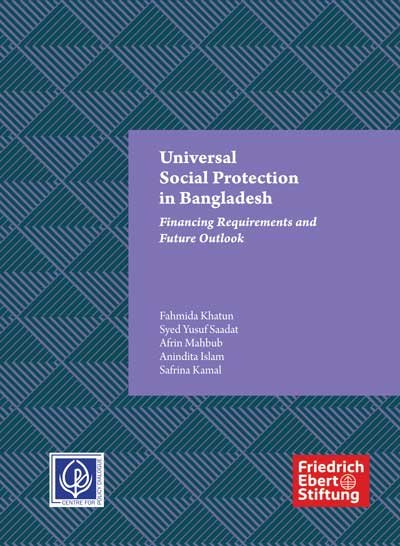
 Social protection is essential in any society to mitigate vulnerabilities. Even though Bangladesh has made great strides in addressing deprivation, a significant proportion of the population still lives in poverty or is at risk, dealing with a variety of issues relating to age, gender, disability, and climate shocks. This study evaluates budgetary needs and potential resource mobilisation to assess the feasibility of universal social protection in Bangladesh. Drawing on insights from Key Informant Interview (KII) and secondary data from the International Labour Organization (ILO), Bangladesh Bureau of Statistics (BBS), and other sources, the analysis focuses on five key programmes identified in the social safety net budget including Old Age Allowance (OAA), Allowance for Widows, Destitute, and Deserted Women, Open Market Sales (OMS), Disability Allowance and Education Stipend, and Mother and Child Benefit (MCBP). Using the ILO Social Protection Floor cost calculator, the study provides estimates of the funding requirements to scale up universal schemes for children and orphans, as well as pensions. Building on these findings, the paper proposes a framework outlining potential financing sources and provides guidelines for implementing a Universal Pension Scheme and a Universal Child Benefit. The approach emphasises a gradual, phased expansion to achieve comprehensive universal protection. The paper’s originality lies in its proposed Universal Child Benefit framework, which identifies potential financial sources and delineates implementation processes by integrating insights from previous research with the ILO’s established multi-pillar pension model.
Authors: Fahmida Khatun, Syed Yusuf Saadat, Afrin Mahbub, Anindita Islam and Safrina Kamal
Publication Period: November 2025