

Originally posted in The Financial Express on 12 March 2026
Readjust multilayer taxes on fuel imports
Economists suggest for averting price rise
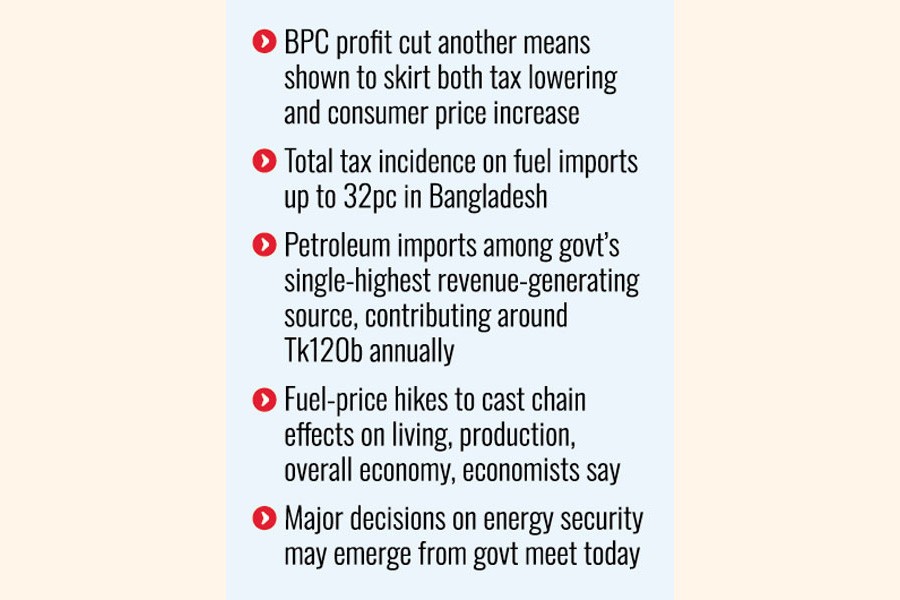
A prudent downward readjustment of multilayer import taxes on petroleum products is highly recommended by economists as an option to avoid the Mideast war-fuelled hikes in fuel prices.
Another exigent remedy shown is a cut in BPC profit to skirt both
tax lowering and price increase for consumer at this hour of income-sapping high inflation.
Global oil prices rose above $119 per barrel Monday–the sharpest increase since 2022–amid the expanding conflict involving the United States-Israel duo and Iran.
The tariff readjustment would help keep domestic fuel prices stable without hurting government revenue, economists suggest.
Some major decisions on energy security may emerge from a vital meeting discussion today (Wednesday”, energy ministry officials have said.
Regulators and economists say exploring such an option could be worthwhile as global petroleum prices surge amid escalating geopolitical tensions.
Petroleum imports are among government’s largest revenue-generating items, contributing around Tk 120 billion annually, with a total tax incidence ranging between 30 and 32 per cent in Bangladesh. However, the revenue inflow fluctuates in line with international price movements.Bangladesh market trends
Distinguished Fellow at the Centre for Policy Dialogue Professor Mustafizur Rahman says the impact of higher global energy prices on domestic retail markets could be eased by manoeuvring the relatively high import tariffs on petroleum products.
“The government has scope to adjust tariffs in a way that keeps expected revenue inflows intact while preventing the full pass-through of higher prices to retail consumers and industries,” he explains.
According to him, such a move could help ease persistent inflationary pressures in Bangladesh.
Chairman of Bangladesh Energy Regulatory Commission Jalal Ahmed says the option could be explored to minimise the impact of international price hikes.
“As an option, it is not bad, though I have not thought about it yet,” he told The Financial Express.
He notes that the government has so far refrained from raising fuel prices despite the global price surge. If an increase becomes necessary, however, consumers may be prepared to accept it as the domestic pricing mechanism is aligned with international markets.
However, he opposes offering subsidies on fuel imports or tax cuts that would significantly affect revenue mobilisation.
“If taxes are reduced, the National Board of Revenue would face difficulties, as it must finance government expenditure and tax collection is already lagging behind the target,” he points out.
A senior official at the energy ministry has said authorities have begun reviewing the pricing of diesel, octane, petrol, furnace oil and jet fuel following the escalating conflict in the Middle East.Newspaper subscription
“We are also strengthening surveillance of the demand-and-supply situation by launching an automated monitoring system,” he said, adding that fuel pricing would also be monitored online.
Bangladesh currently has adequate fuel stocks. However, if the conflict prolongs and disrupts supply routes-particularly through the Strait of Hormuz, a vital global oil-transit chokepoint-the country’s fuel imports could face disruptions, he warns.
The energy ministry has already placed several proposals before policymakers, and a key meeting on energy pricing is expected soon following a preparatory meeting at the Finance Division.
Chairman of Policy Exchange Bangladesh Dr Masrur Reaz says the government could still maintain its expected revenue even if tariffs were readjusted.
“If oil prices rise from $70 to $100 per barrel, tax receipts could increase significantly. In that case, the government may consider adjusting tax rates to cushion the impact on consumers,” he explains how the two ends could be met.
A rise in petroleum prices would have wide-ranging domino impacts on the economy, particularly at a time when inflation remains high, he adds.
Higher fuel costs would increase transportation expenses, irrigation costs in agriculture, and labour-mobility costs, while raising production expenses in industries such as the ready-made garment sector, many of which rely on diesel-powered generators during power outages.
Several economic activities operate on diesel for several hours daily, meaning higher fuel prices would directly raise operational costs and make living expenses more expensive for commuters and workers.
Chairman of the National Board of Revenue Abdur Rahman Khan says no proposal has yet been placed to adjust fuel taxes to offset possible price hikes.
“There is no supply crunch yet, but some people are hoarding fuels illegally, creating an artificial shortage,” he adds.
According to customs data, high-speed diesel imports are subject to 31.85-percent tax, including 6.0-percent customs duty, 15-percent VAT, 2.0-percent advance income tax (AIT), and 7.5-percent advance tax (AT).
Imports of octane, petrol and other petroleum oils obtained from bituminous minerals carry a 28.18-percent tax, including 3.0-percent customs duty, 15-percent VAT, 2.0-percent AIT and 7.5-percent AT.
Meanwhile, furnace-oil imports face a 36.75-percent tax, including 10- percent customs duty, 15-percent VAT, 2.0-percent AIT and 7.5-percent AT.
In FY2023-24, the government collected Tk 109.38 billion in taxes from fuel imports, followed by Tk 128.86 billion in FY2024-25.
Until January of the current financial year (FY2025-26), the government had already collected Tk 81.37 billion.Mobile financial services
However, Dr Golam Moazzem, Research Director at the Centre for Policy Dialogue, suggests another option: reducing the profits of Bangladesh Petroleum Corporation rather than cutting taxes.
“Instead of reducing taxes, the government may compromise BPC’s profit margin to absorb part of the price shock,” he says.