

The leather and footwear industry stands as Bangladesh’s second-largest export sector, contributing significantly to the national economy with over USD 1.2 billion in annual foreign currency earnings. However, as global supply chains move toward stringent environmental compliance, the sector’s transition to sustainable power is no longer optional.
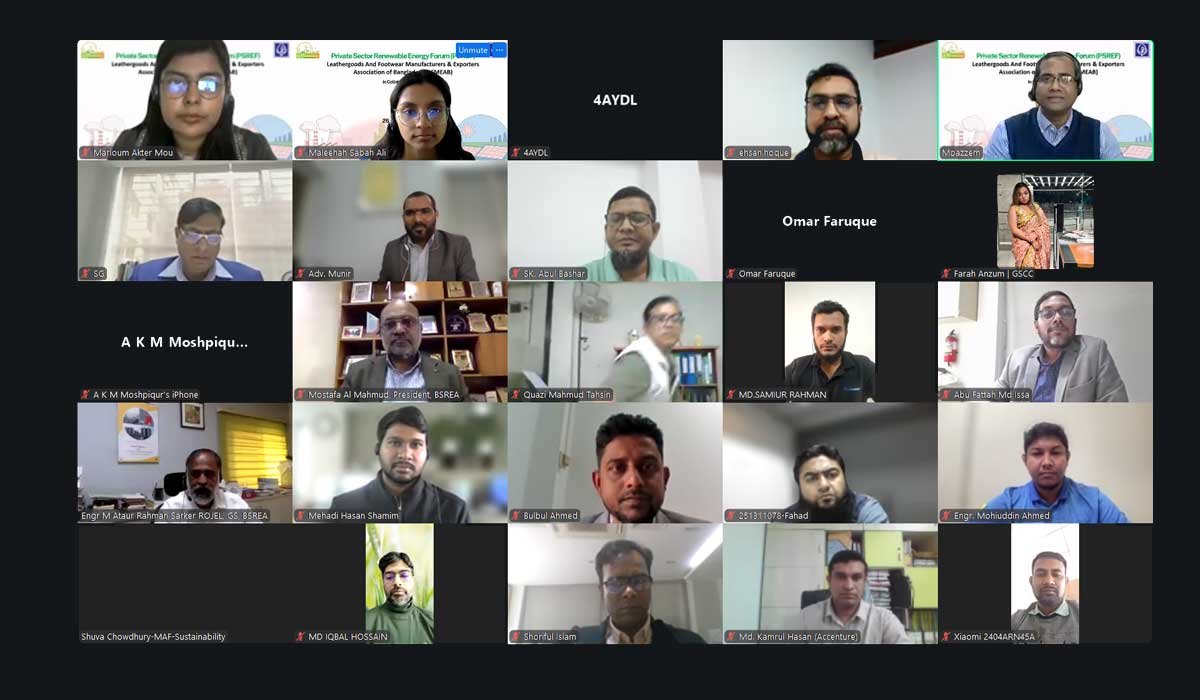
On January 26, 2026, CPD’s Power and Energy Study held a virtual discussion under the Private Sector Renewable Energy Forum (PSREF), in collaboration with the Leathergoods and Footwear Manufacturers & Exporters Association of Bangladesh (LFMEAB). The session focused on the unique energy requirements of leather manufacturing and the systemic hurdles that prevent widespread solar integration.
During the session, industry leaders highlighted the proactive steps already taken by major players to align with “green” industrial standards. Notable “changemakers” such as Apex Footwear Ltd., Picard Bangladesh Ltd., and Landmark Footwear Ltd. have initiated rooftop solar projects, demonstrating the sector’s technical readiness. These pioneers emphasise that adopting renewable energy is not only a matter of environmental responsibility but a strategic move to satisfy international brands that now demand carbon-neutral production processes.
The discussion also brought to light several structural challenges that complicate the transition for the broader industry. Major Rafiqul Islam, Secretary General of Leathergoods and Footwear Manufacturers & Exporters Association of Bangladesh (LFMEAB), underscored the technical and financial anxieties prevalent among factory owners. He noted that while there is significant interest in solar adaptation, many are deterred by the lack of clear technical guidance and the complexities of navigating green finance. Participants specifically pointed out that the high initial capital investment remains a significant barrier for medium-tier factories that lack the dedicated technical teams found in larger corporations.
To bridge these gaps, CPD and LFMEAB have outlined a collaborative roadmap through the PSREF to provide the necessary institutional support. The primary focus will be on the creation of technical knowledge products to help factory owners understand solar installation systems and financial schemes. Furthermore, CPD is committed to intensifying its advocacy with government agencies and financial institutions, including the Bangladesh Bank, to streamline the “Green Loan” application process. This ensures that factories of all tiers can access the capital required for renewable energy transitions without facing prohibitive bureaucratic delays.
The dialogue highlighted that the future of the leather sector depends on its ability to integrate sustainable practices into its core operations. By fostering a closer partnership between industry stakeholders and technical experts, PSREF aims to illustrate the transition to solar power. As the sector looks toward future growth, this collaborative effort will be essential in maintaining Bangladesh’s competitive edge in the global market while contributing to the nation’s broader renewable energy targets.