

Bangladesh’s health sector continues to face deep structural challenges despite major achievements in reducing maternal, child and neonatal mortality since independence. Recent crises, including COVID-19 and the ongoing measles outbreak, have exposed gaps in preparedness, governance, infrastructure, skilled human resources and public health planning. Higher allocation alone will not be enough unless the country strengthens its capacity to implement the health budget effectively and deliver accessible, affordable and quality services.
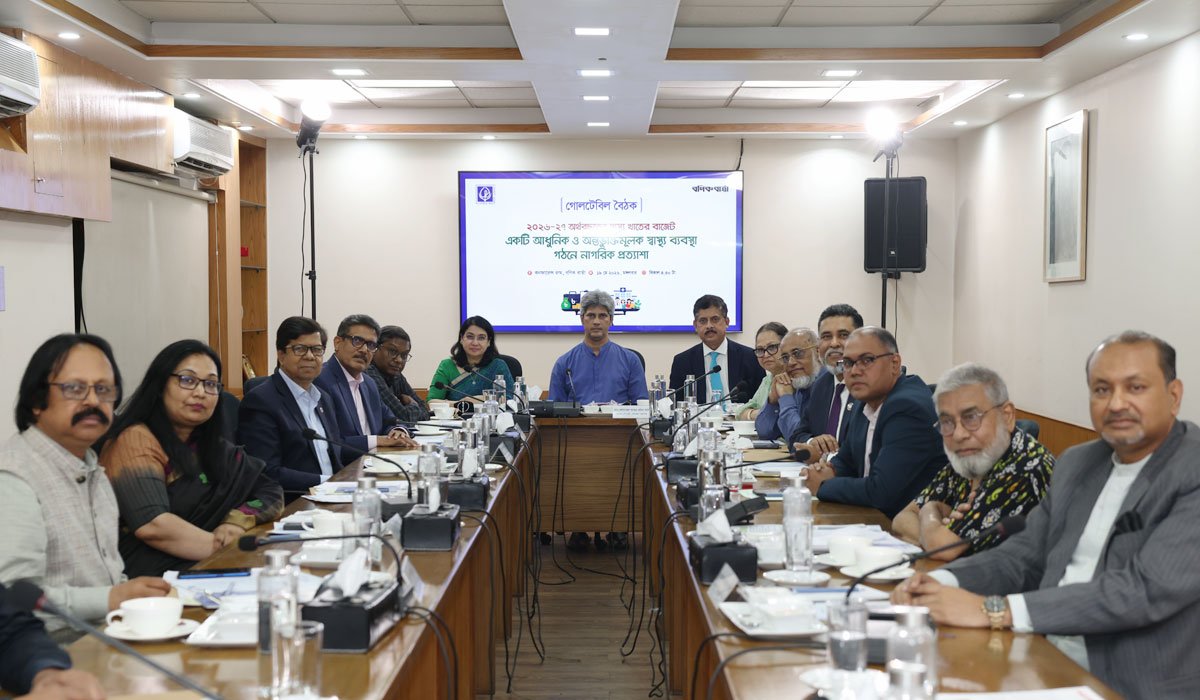
In this context, the Centre for Policy Dialogue (CPD), in partnership with Bonik Barta, organised a roundtable discussion titled ‘Health Sector Budget for FY2026-27: Citizen Expectations for Building a Modern and Inclusive Health System’ on Tuesday, 19 May 2026 at the Bonik Barta office in Karwan Bazar, Dhaka. The session was moderated by Mr Md Badrul Alam, Assistant Editor and Senior Special Correspondent, Bonik Barta, while opening remarks were delivered by Mr Dewan Hanif Mahmud, Editor, Bonik Barta.
As the chief guest, Mr Md Zonayed Abdur Rahim Saki, State Minister for Planning, said that Bangladesh’s health system is still largely operated as a treatment system, although greater attention should be given to disease prevention, public health and preventive investment. He noted that the government is considering ways to improve the existing public health structure and better coordinate public and private healthcare services.
From the government’s planning perspective, Mr Saki also highlighted that BDT 35,000 crore has been allocated for the health sector under the Annual Development Programme. Of this, BDT 23,577 crore has been kept as block allocation for health services, health education and related projects to support the implementation of the government’s 31-point programme, election commitments and sectoral priorities, including plans for a universal health card.
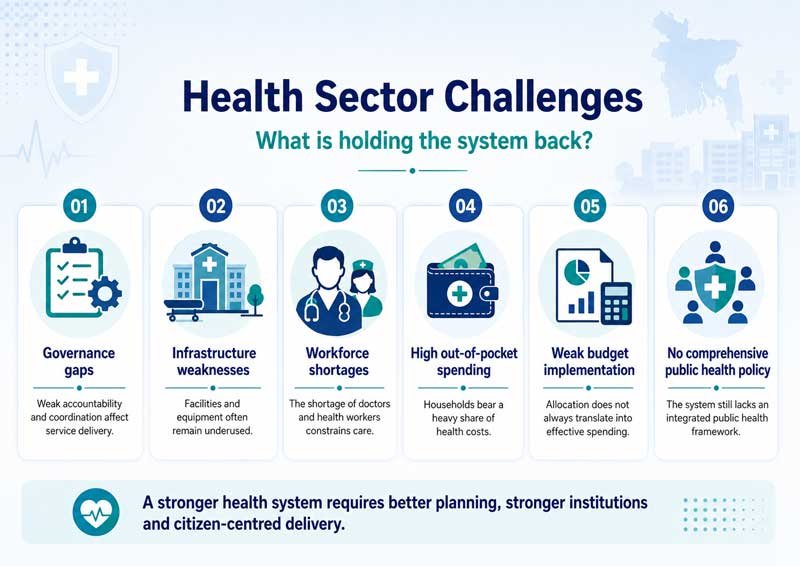
In her welcome remarks, Dr Fahmida Khatun, Executive Director of CPD, described the health sector as historically neglected. She noted that Bangladesh has the highest out-of-pocket expenditure for primary healthcare in South Asia, at around 75 per cent, which contributes to poverty. She also pointed out that while operational expenditure has increased over time, investments in infrastructure, equipment and maintenance have not delivered expected outcomes due to weak utilisation and governance.
Focusing on budget absorption, Dr Nazmul Hossain, Director General of the Directorate General of Medical Education, said that the government’s election manifesto has committed to gradually increasing health expenditure to 5 per cent of GDP. However, he cautioned that even reaching 1 per cent would require almost doubling last year’s level of financial activity, as the revised allocation had fallen below 0.5 per cent of GDP. He stressed that implementation capacity must be improved first.
Budget management and execution were also emphasised by Mr SM Humayun Kabir Sarker, Additional Secretary, Health Services Division. He said the health budget must be assessed from both the revenue side and the expenditure side, while implementation and management remain major concerns. According to him, increasing allocation will not be enough if development funds continue to remain underutilised.
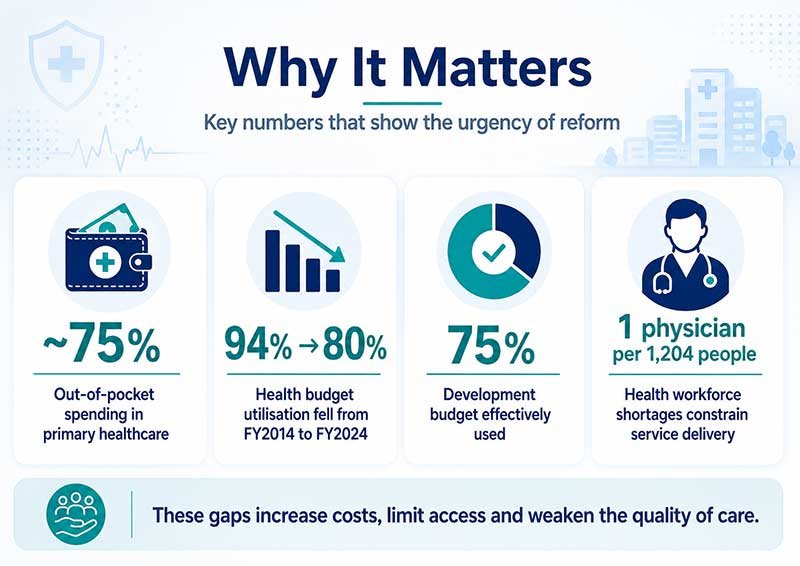
The question of capacity was further raised by Dr Syed Abdul Hamid, Professor at the Institute of Health Economics, University of Dhaka. He observed that a large share of the allocated health budget often remains unspent, and therefore Bangladesh must assess whether the system has the capacity to utilise larger allocations effectively before committing to major increases.
A broader definition of health was recommended by Dr Rumana Huque, Professor at the Department of Economics, University of Dhaka. She said that health cannot be understood only through the Ministry of Health, as local government, water and sanitation, education, agriculture and other sectors also shape health outcomes. She called for a more integrated ‘One Health’ approach involving multiple ministries.
Looking ahead to future pressures, Dr Abu Muhammad Zakir Hussain, public health expert and senior-most member of the former Health Sector Reform Commission, warned that rising poverty will increase the demand for healthcare. He said the health budget must be designed with both current gaps and future pressures in mind, with emphasis on increased allocation, proper targeting and transparent use of funds.
A modern public health policy was identified as an urgent need by Dr Abu Jamil Faisel, public health expert and former President of the Public Health Association of Bangladesh. He noted that Bangladesh has separate policies on population, nutrition, reproductive health and adolescent health, but still lacks a comprehensive and effective public health policy.
Despite major health achievements, Dr Nizam Uddin Ahmed, Chair of the Gavi CSO Steering Committee, cautioned that progress has slowed in several areas. He noted that child malnutrition remains high, neonatal mortality has not declined significantly over the past 12 years, immunisation coverage has remained stuck at 80–82 per cent, and family planning coverage has stayed around 64–65 per cent.
Equity and dignity in service delivery were highlighted by Dr Noor Mohammad, Executive Director of Population Services and Training Centre. He said a modern health system must be equitable, accessible and respectful, especially for women, adolescents, persons with disabilities and people in hard-to-reach areas. He also said citizens expect affordable services, respectful treatment, skilled providers and medicine availability at service centres.
On private healthcare governance, Dr Lelin Choudhury, Chairman of Health and Hope Hospital, said that mid-level hospitals form the backbone of Bangladesh’s private healthcare system. He recommended establishing a separate department or directorate for private healthcare to ensure monitoring, cooperation and accountability.
Investment constraints in specialised healthcare were raised by Ms Priti Chakraborty, Chairman of Universal Medical College and Hospital and Senior Vice President of Bangladesh Chamber of Industries. She said that building large tertiary hospitals requires long-term financing, bank loans and policy support. Without special financing facilities for the health sector, large-scale private investment will remain difficult.
Tax policy and human resources were highlighted by Mr Md Esam Ebne Yousuf Siddique, Chief Executive Officer of Square Hospital. He said healthcare should be treated as a basic humanitarian service, not as an ordinary commercial enterprise. He argued that reducing the tax burden on the health sector could lower healthcare costs for patients, while national health insurance and better training for allied health professionals are also essential.
Quality assurance was identified as a major missing element by Dr Arif Mahmud, Group Medical Director of Evercare Hospitals, Bangladesh. He noted that Bangladesh lacks a national framework for measuring healthcare quality and recommended establishing an independent accreditation body for hospitals and laboratories. He also warned that quality cannot be ensured in either the public or private sector without addressing the shortage of health workers.
From the hospital sector, Mr Ahmad Dawood, CEO of Labaid Hospital, said private healthcare institutions should not be taxed at the same rate as ordinary businesses. He recommended reducing the current corporate tax rate and reviewing VAT-related costs on imported medical equipment, as this would send a positive signal to private health investors.
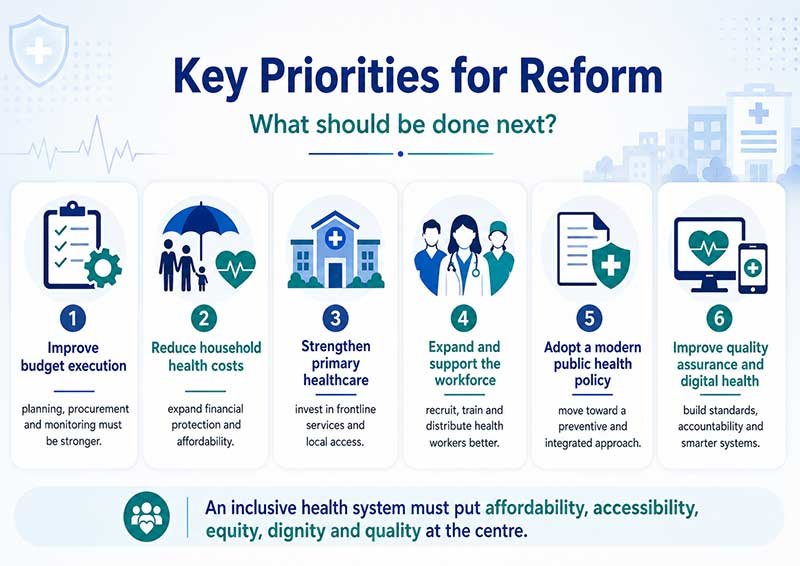
The discussion concluded that Bangladesh needs not only higher health allocations, but also stronger implementation capacity, better governance, a comprehensive public health policy, improved coordination across ministries, reduced out-of-pocket expenditure, stronger human resources, effective quality assurance and a more balanced public-private health system. Speakers stressed that a modern and inclusive health system must place citizens’ needs, affordability, equity and dignity at the centre of budget planning.