

Originally posted in New Age on 3 November 2026
Pvt sector credit growth hits 23-year low
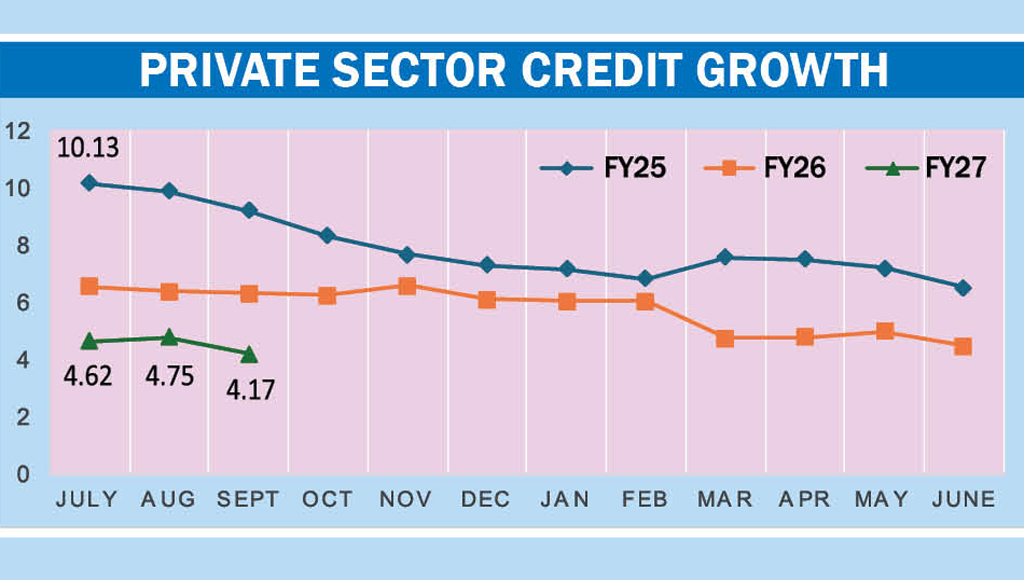
Private sector credit growth in Bangladesh fell to a record low of 4.17 per cent in September, reflecting a prolonged slowdown in business activity and investment as high borrowing costs, energy shortages, weak demand and uncertainty continue to hold back the economy.
The latest figure, the lowest since Bangladesh Bank began compiling the data in 2003, indicates that businesses are borrowing far less for new investment, factory expansion and working capital, BB officials said.
It also suggests that the economy is struggling to generate enough private-sector activity to drive growth, create jobs and sustain demand, they said.
Bangladesh Bank data show that private sector credit growth declined from 4.75 per cent in August to 4.17 per cent in September.
It was 4.62 per cent in July, 4.47 per cent in June and 4.98 per cent in May. The rate was above 6 per cent before February 2026 and above 7 per cent before May 2025. In July 2024, it stood at 10.13 per cent.
Mustafizur Rahman, distinguished fellow of the Centre for Policy Dialogue, said businesses had little reason to increase investment while struggling with energy shortages, high inflation and expensive borrowing.
Persistently high inflation had prevented a meaningful reduction in interest rates, while the implementation of government and central bank initiatives to provide lower-cost loans had remained slow, he told New Age.
He warned that a prolonged Middle East crisis could add to the pressure by keeping global oil prices high and affecting employment and remittance earnings in Gulf countries, further weakening Bangladesh’s economy.
He urged the government to address domestic constraints and provide necessary support to revive private investment.
The weakness in lending comes as the banking sector faces a severe burden of distressed assets.
Defaulted loans reached Tk 6.08 lakh crore at the end of June, accounting for nearly one-third of total outstanding loans. Including other troubled assets, the volume of distressed loans is estimated at around Tk 11 lakh crore.
The high level of bad loans has forced banks to set aside more money against potential losses, reducing funds available for fresh lending and making lenders more cautious, bankers said.
Energy shortages have added to the difficulties, forcing some factories to operate below capacity and raising the cost of production, financial experts said.
Uncertainty over the duration and impact of the Middle East crisis has further encouraged businesses to adopt a wait-and-see approach. Weak imports of capital machinery also point to reduced appetite for expanding production capacity, they said.
The consequences extend beyond banks and businesses.
Lower investment can slow industrial production, limit job creation and weaken household incomes.
If factories postpone expansion or operate below capacity, workers and small suppliers are also likely to feel the effects.
A prolonged slowdown in private credit could therefore constrain economic growth even if government spending and borrowing continue to rise, experts said.
In July, the central bank cut its policy rate by 50 basis points to 9.5 per cent.
However, commercial lending rates remain around 14 per cent, keeping borrowing costs high for businesses.
The central bank has also observed that banks are increasingly placing surplus funds in government securities rather than lending to the private sector, amid weak credit demand, rising defaults and economic uncertainty.
Bangladesh Bank has set a private-sector credit growth target of 6.8 per cent by December, but September’s figure shows that lending remains well below the target.
Meanwhile, government borrowing from banks has increased sharply, creating another competing demand for funds.
The government borrowed around Tk 48,000 crore from the banking system in July-October, absorbing about 43 per cent of its Tk 1.12 lakh crore borrowing target for the entire financial year in just four months.