

As Bangladesh navigates the post-July 2024 political landscape, the question of how to protect and expand civic space has taken on renewed importance. Civil society organisations remain vital to inclusive governance, rights-based advocacy, service delivery and accountability, yet their operating space continues to be shaped by regulation, administrative practice and broader political realities.
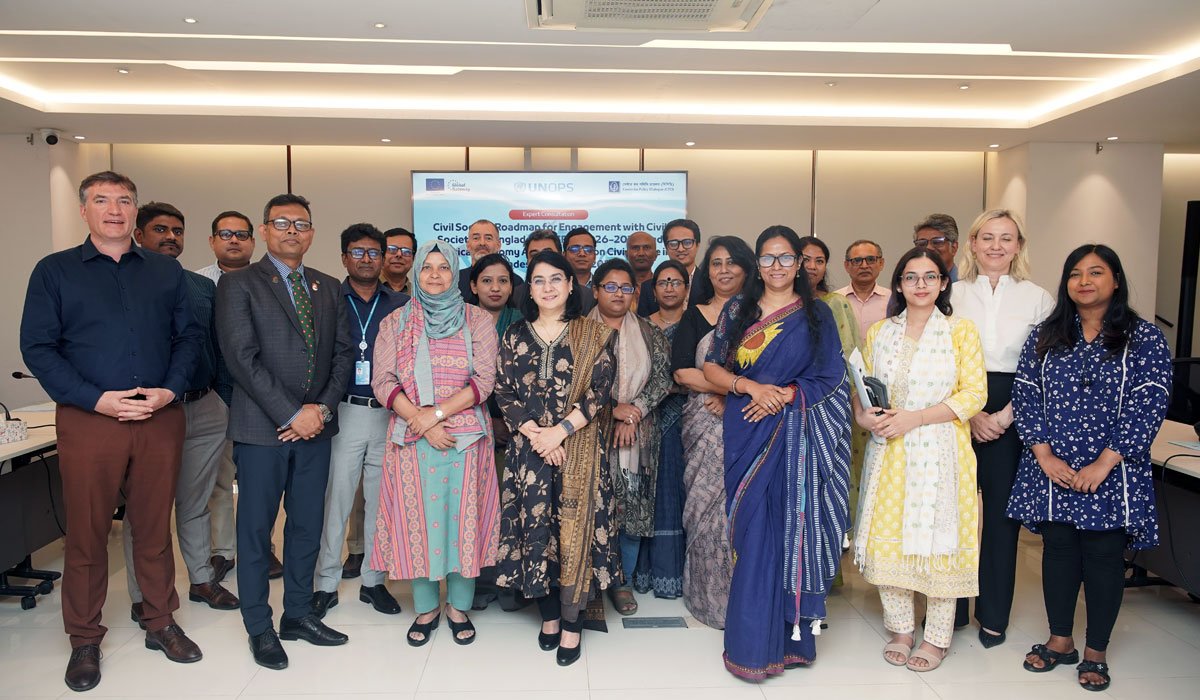
These issues were the focus of the Expert Consultation Workshop titled Civil Society Roadmap for Engagement with Civil Society in Bangladesh (CSRM) 2026–2028 and the Political Economy Analysis (PEA) on Civic Space in Bangladesh (Post–July 2024), held in Dhaka on Wednesday, 7 April 2026. The workshop was organised by the United Nations Office for Project Services (UNOPS), in collaboration with the European Union and the Centre for Policy Dialogue (CPD).
The consultation brought together key stakeholders from civil society, academia and development organisations at the CPD premises. The session aimed to gather diverse perspectives on the current state of civic space in Bangladesh, including participation dynamics, coordination mechanisms, structural barriers and opportunities for fostering inclusive and meaningful civic engagement.
Opening the session, Dr Fahmida Khatun, Executive Director of CPD, welcomed participants and emphasised the importance of evidence-based dialogue in shaping inclusive policy frameworks. Remarks were also delivered by Mr Jules Seitz, Programme Officer from the EU Delegation to Bangladesh, and Mr Sudhir Muralidharan, Country Manager of UNOPS Bangladesh and Bhutan, highlighting a shared commitment to strengthening civil society engagement and democratic participation.
Speaking at the workshop, Barrister Md. Khalilur Rahman Khan, ndc, Director General (In-Charge), NGO Affairs Bureau, Prime Minister’s Office, stated ‘In the post-July period, the NGO Affairs Bureau has taken steps to widen civic space by simplifying approval processes and reducing bureaucratic obstacles. We are ready to extend all forms of cooperation and assistance to civil society.’
Dr Fahmida Khatun, Executive Director, CPD, highlighted ‘The July 2024 rupture disrupted Bangladesh’s political equilibrium, but reform commitments remain embedded within a negotiated political settlement. EU engagement under the roadmap should strengthen institutional participation frameworks rather than rely solely on project-based consultation.’
‘A vibrant civic space is essential for accountable and inclusive development. Through this consultation, UNOPS—under the Nagorikota programme and in partnership with the European Union—is supporting evidence-based insights to strengthen meaningful civil society engagement in Bangladesh’ said Mr Sudhir Muralidharan, Country Manager, UNOPS Bangladesh.
Mr Jules Seitz, Program Officer, Governance, Civil Society, Human Rights, Delegation of the European Union to Bangladesh, said the new roadmap should respond to the changed context by placing greater emphasis on dialogue, transparency and institutional strengthening.
The consultation featured a keynote presentation by Dr Kazi Mahmudur Rahman and Mr Foqoruddin Al Kabir, who presented initial findings and analytical insights from the CSRM and PEA studies. The presentation outlined key trends in civic space, institutional challenges and potential entry points for civil society actors to contribute more effectively to policy dialogue and accountability processes.
An interactive discussion session followed, allowing participants to share practical experiences, identify constraints to engagement and propose actionable recommendations. The discussion focused on enhancing coordination among civil society actors, ensuring safe and inclusive spaces for participation, and strengthening institutional linkages with policymakers.
Participants broadly agreed that expanding civic space in Bangladesh will require structured dialogue, more responsive institutions and stronger collaboration among the state, civil society and development partners.
The insights gathered during the consultation will directly inform the EU’s Civil Society Roadmap 2026–2028 and contribute to shaping strategic engagement approaches that promote transparency, accountability and inclusive development in Bangladesh.
UNOPS reaffirmed its commitment to supporting evidence-based policy processes and facilitating multi-stakeholder dialogue to strengthen governance systems and civic participation.