

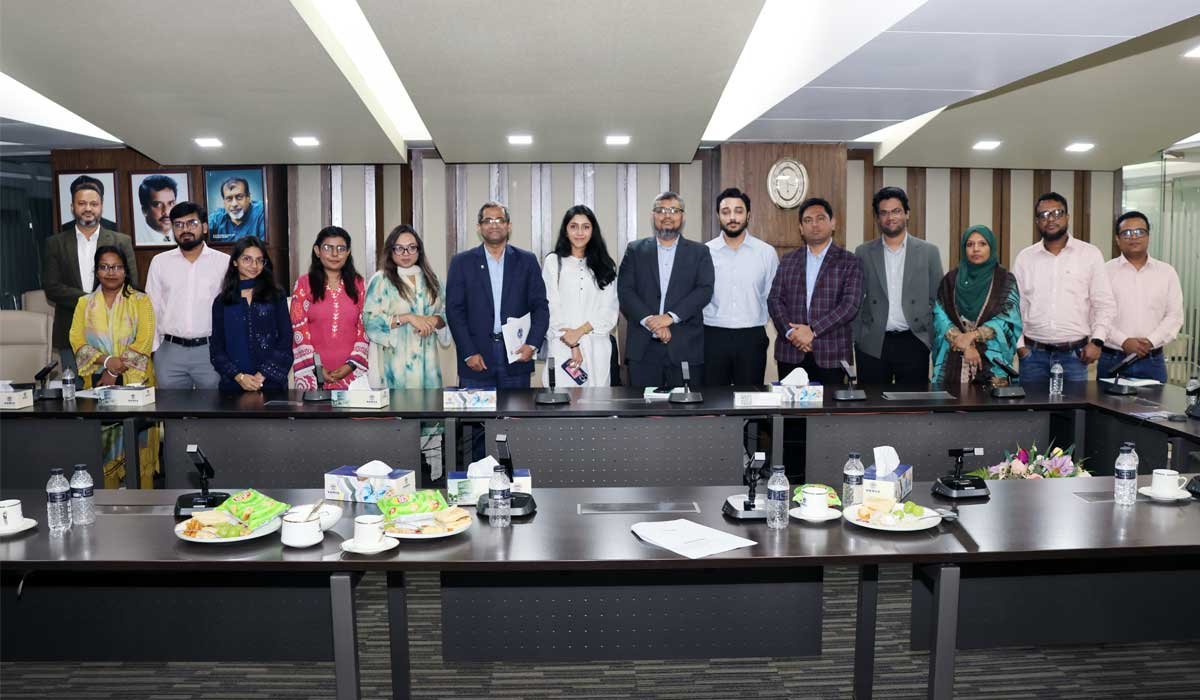
As global trade regimes increasingly prioritise environmental sustainability, the shift toward renewable energy has evolved from a corporate social responsibility goal into a fundamental economic necessity for Bangladesh’s export-oriented industries. On October 12, 2025, CPD’s Power and Energy Study, in collaboration with the Bangladesh Knitwear Manufacturers and Exporters Association (BKMEA), convened a strategic discussion at the BKMEA Dhaka office to operationalise the Private Sector Renewable Energy Forum (PSREF).
The session served as a platform to evaluate the progress of “industry changemakers” and to address systemic barriers to widespread solar adoption across the knitwear sector. Several pioneers within the RMG sector have already demonstrated that transitioning to renewables is both technically feasible and financially rewarding. Fakir Apparels Ltd., having already installed 462.44 kW of rooftop solar, aims to reach 2 MW and 100 per cent RE dependency by 2030. Similarly, Metro Knitting & Dyeing Mills Ltd. is expanding its current 2,556 kW capacity by an additional 4.5 MW.
A standout technical milestone was highlighted by Fakir Fashions Ltd., which has integrated a 1 MW Battery Energy Storage System (BESS), the first of its kind in Bangladesh’s industrial sector. By storing excess solar energy for use during peak times, they have significantly reduced their reliance on expensive and carbon-intensive diesel generators.
Despite these success stories, the dialogue revealed deep-seated challenges that deter mid-tier factories. Mr Fazlee Shamim Ehsan, Executive President of BKMEA, pointed to a critical disconnect in fiscal policy. While solar panels enjoy a 1 per cent customs duty, the tax on mounting structures and cables, some core components of the system, is as high as 58 per cent. These inconsistent duty structures significantly inflate the initial investment, making it difficult for smaller players to commit.
Financing remains another major hurdle. While green funds exist, the bureaucratic process is often prohibitive. Participants noted that securing documentation for Bangladesh Bank’s green finance schemes can take up to ten months. During this period, factories are often forced to take high-interest bridge loans, erasing the potential savings the solar transition was meant to provide.
To address these gaps, CPD and BKMEA have outlined a collaborative roadmap focused on three pillars: Awareness, Access to Finance, and Advocacy. The forum identified that many factory owners remain hesitant, not due to a lack of interest, but a lack of clarity. To counter this, CPD will produce technical knowledge products in an accessible language to demystify solar installation and maintenance.
Advocacy will also be intensified to simplify the green loan application process. The forum aims to engage directly with financial institutions and government agencies to ensure that fiscal incentives are aligned across all components of renewable energy systems.
The operationalisation of the PSREF marks a shift from theoretical discussion to actionable policy advocacy. By bridging the gap between industry needs and regulatory frameworks, CPD is working to ensure that the “green transition” is not a privilege reserved for large-scale enterprises but a standard feature of Bangladesh’s industrial landscape. As the sector moves forward, the focus will remain on making renewable energy accessible, affordable, and inclusive for all tiers of the RMG industry.