

A comprehensive package of structural reforms and a long-term transformation strategy is essential for the new government to deliver its electoral pledges and avoid policy inertia, according to a new study. The recommendations stress reorganising policy and administrative decision-making processes within the first 180 days, embedding knowledge-based decision-making across the executive and legislative branches, decentralising power, and strengthening parliamentary oversight. The study also outlines priority reforms in tax justice, business regulation, trade and investment policy, foreign direct investment facilitation, power and energy transition, and governance reforms.
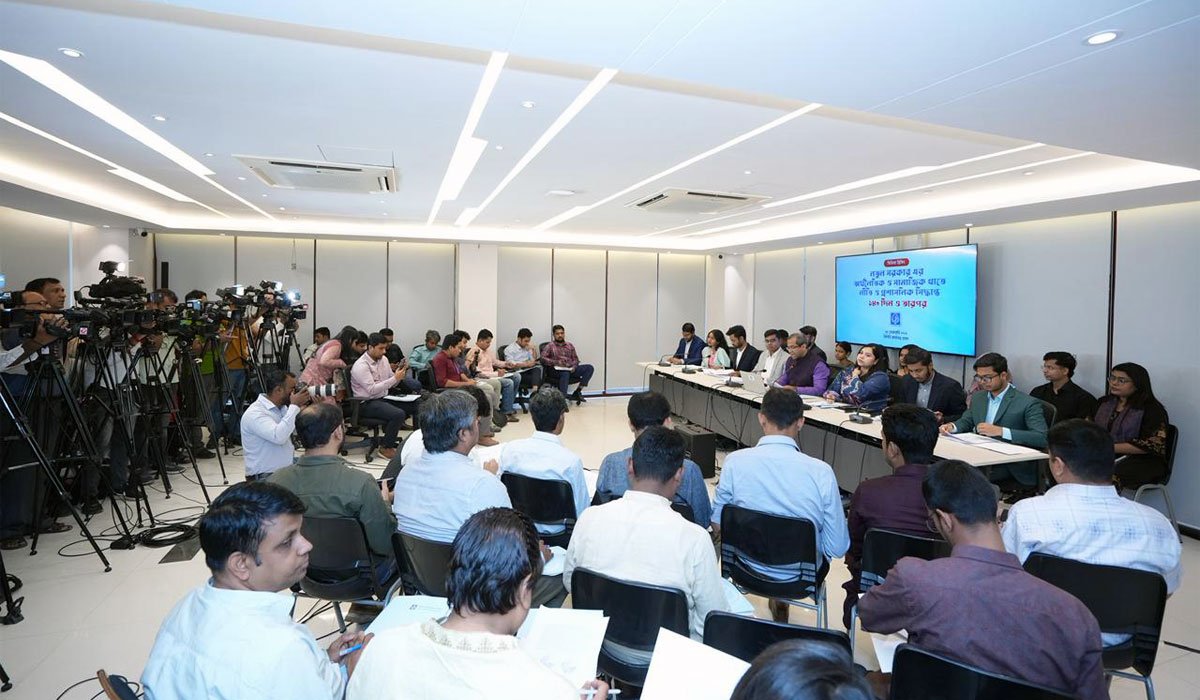
These observations emerged at the media briefing titled “New Government’s Economic and Social Sector related Policy and Administrative Decisions: 180 Days and Beyond” held on Saturday, 28 February 2026, organised by the Centre for Policy Dialogue (CPD). The keynote presentation was delivered by Dr Khondaker Golam Moazzem, Research Director, CPD.
In his presentation, Dr Moazzem highlighted advancing tax justice by simplifying the VAT structure, reducing regressivity, and broadening the tax base through removal of exemptions for non-essential services. He also suggested mandatory digital tax return submissions, reform of corporate tax incentives towards performance-based mechanisms, and stronger oversight within the National Board of Revenue. The report further recommended enhanced measures to prevent revenue leakage, recovery of laundered funds, alignment with international tax standards, and modernisation of tax data systems.
To reduce the cost of doing business, Dr Moazzem emphasised integrating licensing databases into a unified digital interface, eliminating duplication of documentation requirements, and establishing a Tax Ombudsman and Banking Ombudsman to strengthen accountability. The report urged closer coordination between education institutions and industry bodies to address skills mismatches, as well as reform of credit assessment models to improve SME access to finance. It also underscored careful management of interest rate policy to avoid inflationary pressures.
On trade and investment agreements, Dr Moazzem stressed the need to revisit recently signed bilateral arrangements that could constrain policy autonomy and undermine smooth transition strategies in the context of LDC graduation. He emphasised that future agreements must be balanced, safeguard domestic regulatory space, and support productivity upgrading alongside green transformation.
In his presentation Dr Moazzem said that, in relation to foreign direct investment, it is crucial to complete backend automation of the single-window approval system, converting administrative service commitments into legally binding standards, establishing time-bound commercial benches within the High Court, and developing a unified public FDI monitoring dashboard linked to measurable GDP targets. He also stressed conducting a national readiness audit of economic zones to ensure litigation-free land and reliable utility access prior to plot allocation.
In the power and energy sector, Dr Moazzem emphasised adopting a clear “no new fossil fuel-based power generation” policy, revising demand projections through independent validation, and incorporating a “no electricity, no pay” clause in future power purchase agreements to eliminate unconditional capacity payments. He further said that strengthening parliamentary scrutiny of generation, procurement and tariff decisions, establishing an Independent System Operator, conducting grid stress tests to absorb higher shares of renewable energy, and reassessing coal-based projects in view of fiscal and climate risks.
With regard to primary energy, Dr Moazzem urged halting expansion of LNG infrastructure, withdrawing VAT exemptions on LNG imports, intensifying domestic gas exploration through BAPEX, and shelving discussions on domestic coal extraction. He advocated prioritising domestic resource development, strengthening institutional capacity within Petrobangla, and preparing a phased coal power exit roadmap.
In the open floor, journalists pressed a range of questions on the trade agreement with the United States, which was described as “shocking” and “discriminatory” for its potential to hinder Bangladesh’s smooth LDC transition. In response, Dr Moazzem said that the government should utilise the 60-day notice clause to renegotiate or, if necessary, withdraw from the pact in order to safeguard national economic interests.
Regarding energy security amid tensions in the Middle East, it was argued that while global supply chain risks remain, the Bangladesh Petroleum Corporation should refrain from raising fuel prices and instead prioritise accelerated domestic gas exploration over further reliance on coal and LNG imports.
On political accountability, it was emphasised that the government must strengthen local administrations, empower sub-national governance structures, and ensure a more competitive and inclusive electoral environment. Such measures, it was argued, are essential to maintaining public trust, institutional credibility and the long-term effectiveness of democratic governance.