

Effective development cooperation requires more than financial support. Mutual ownership, trust, respect, participation, and long-term institutional collaboration are equally important for building balanced and sustainable partnerships.
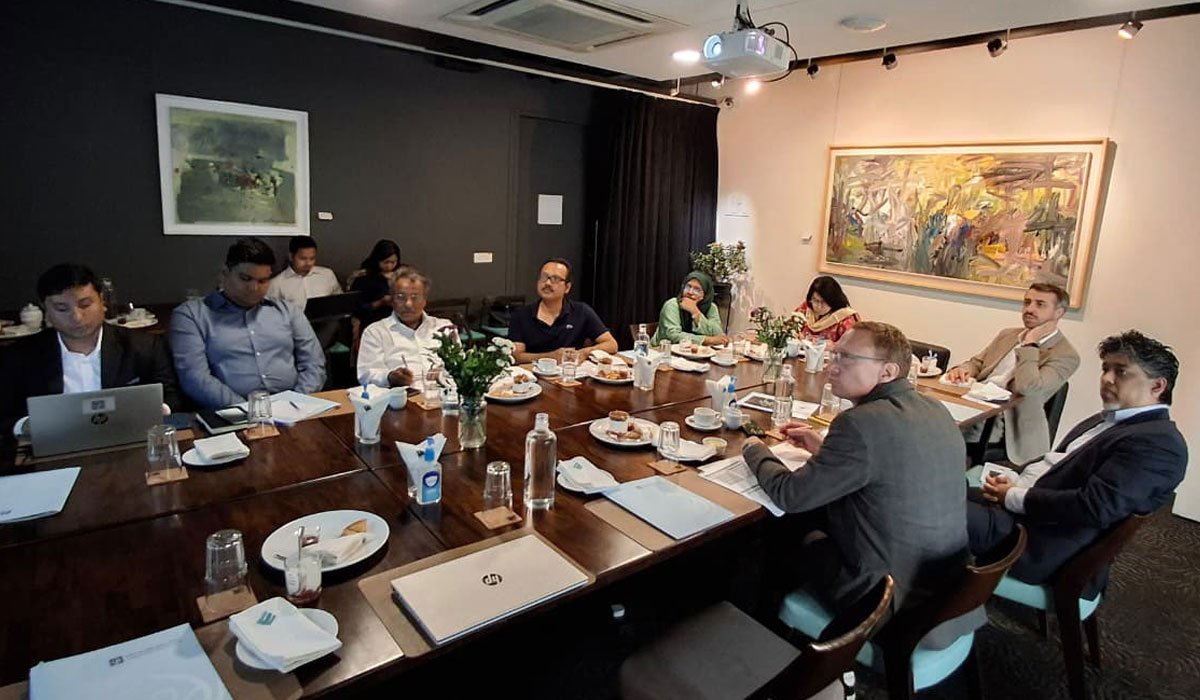
Against this backdrop, the Centre for Policy Dialogue (CPD) organised a discussion session titled “Partnering for Results: Enhancing Effectiveness of Development Cooperation” on Monday, 10 August 2026. The underlying research project was funded by the Deutsche Gesellschaft für Internationale Zusammenarbeit (GIZ) GmbH under the project “International Cooperation in Times of Postcolonial Change”.
The session presented findings from a CPD study examining how unequal power relations continue to shape development cooperation between the Global North and the Global South, with particular reference to Bangladesh and Sri Lanka. The closed-door discussion brought together policymakers, civil society representatives, academics and other key stakeholders to reflect on structural inequalities in existing aid practices and explore pathways towards more equitable and locally driven development partnerships.
One of the central questions emerging from the discussion was how the idea of “local” should be understood in development cooperation. Reflecting on this issue, Mr Mark Gombert, Country Director, Deutsche Gesellschaft für Internationale Zusammenarbeit (GIZ) GmbH, noted that governments, civil society organisations, grassroots communities and other actors within a country may have very different priorities. He also highlighted the constraints faced by development partners and stressed the importance of strengthening domestic capacity and ownership in the longer term.
Opening and moderating the discussion, Dr Fahmida Khatun, Executive Director, Centre for Policy Dialogue (CPD), placed the study within the broader context of changing development cooperation. She emphasised that effective cooperation depends not only on financial support, but also on mutual ownership, trust, respect, participation and long-term institutional collaboration. The key questions, she noted, concern not simply how much support is provided, but where it is directed and how resources are ultimately utilised.
She explained that the study uses German Development Cooperation (GDC) as a case study to explore how relationships can move beyond the conventional donor-recipient model towards more balanced and mutually beneficial partnerships. She also clarified that the research is not intended to assess German development cooperation or any individual development partner, but rather to contribute to a broader discussion on how development partnerships can be improved.
Presenting the key findings, Khaled Al Faruque, Programme Associate, CPD, highlighted a continuing tension between the language and practice of development cooperation. While terms such as partnership, ownership and participation are now widely used, historical inequalities still influence who sets priorities, allocates resources and determines whose knowledge is valued. The study therefore points to the need for stronger alignment with national and local priorities, greater continuity across programme cycles, more context-sensitive approaches and stronger ownership.
The discussion also questioned whether local ownership should always be treated as a straightforward solution. Dr. Felix Gerdes, Resident Representative, Friedrich-Ebert-Stiftung (FES) Bangladesh, argued that broader concepts such as ownership and structural inequality need to be linked more closely with specific empirical cases. Local institutions and actors, he observed, may themselves reflect competing interests or established structures, making it necessary to examine the complexities between donor influence, local priorities and the interests of different actors.
Another major theme was localisation and the role of national civil society organisations. Dr Md. Shahid Uz Zaman, Founder & Executive Director, Eco-Social Development Organisation (ESDO), observed that international organisations, UN agencies, and INGOs continue to dominate much of the aid architecture, while local organisations often play a comparatively limited role. In his view, genuine localisation should go beyond merely transferring implementation responsibilities and take into account local context, culture, needs, and meaningful community participation. He also encouraged a closer comparison of localisation practices in Bangladesh and Sri Lanka.
Similar concerns emerged around the practical meaning of partnership. Drawing on the experience of local organisations, Mr Korvi Rakshand, Executive Director, Jaago Foundation, pointed to funding requirements and regulatory constraints that can make participation difficult for non-profit organisations. He also questioned situations in which local organisations are described as partners even though programmes have already been designed and their role is largely limited to implementation or delivery.
This concern was closely linked to the need for consultation at the programme design stage. Ms Farzana Sharmin, Joint Secretary, Compliance, BKMEA, stressed that sectoral organisations and intended beneficiaries should be consulted before priorities and programme components are finalised. Greater engagement from the outset, she argued, would allow development interventions to respond more effectively to sector-specific needs and realities.
Looking beyond individual projects, the discussion also considered what development cooperation should ultimately seek to achieve. Dr Gazi M Hasan, Professor, Dept. of Economics, North South University, connected the issue with long-term national self-reliance and human capital. He argued that development should ultimately enable a country to operate without dependence on external assistance and encouraged greater attention to the retention of skilled professionals and migration policy.
The discussion generated a range of observations and recommendations for strengthening the study, while underscoring a broader challenge: moving from the language of partnership and localisation towards development cooperation that places greater weight on context, participation, domestic ownership, and more balanced relationships among development actors.