

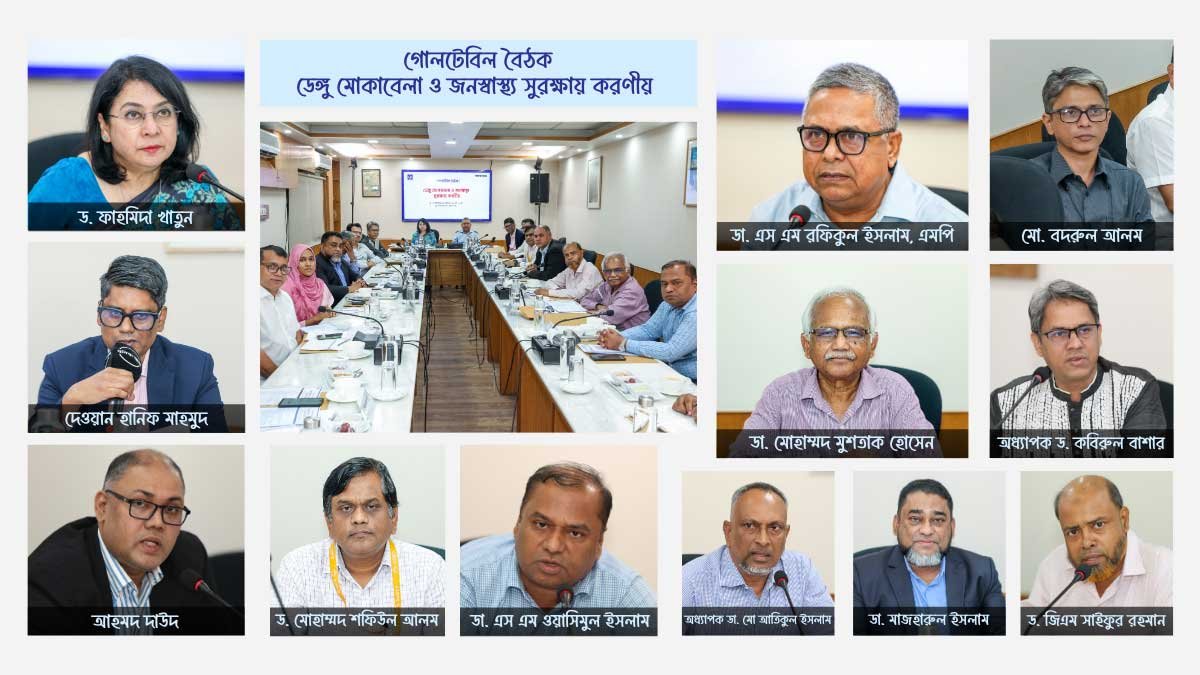
Effective dengue prevention in Bangladesh requires evidence-based Aedes mosquito control, a coordinated national surveillance system, year-round preventive measures and stronger community participation. Health experts, researchers, policymakers and healthcare professionals emphasised that isolated mosquito-control campaigns and hospital-based treatment alone cannot adequately address the growing public health challenge. They called for an integrated approach involving the government, local authorities, healthcare institutions, researchers and citizens.
These observations emerged at a roundtable discussion titled ‘Combating Dengue and Safeguarding Public Health: The Way Forward’, jointly organised by the Centre for Policy Dialogue (CPD) and Bonik Barta on 13 October 2026 at the Bonik Barta office in Dhaka.
Speaking as the Chief Guest, Dr S M Rafiqul Islam, MP, Chairman of the Parliamentary Standing Committee on the Ministry of Health and Family Welfare, emphasised the importance of collective responsibility in preventing dengue. He noted that the government’s dengue prevention and cleanliness campaign, launched on 12 September 2026, was scheduled to continue until 12 December. However, preventive activities should continue throughout the year, as dengue infections are no longer confined to a particular season. He stressed that prevention must remain the foremost priority, considering the country’s financial and healthcare constraints. Strengthening primary healthcare, improving access to treatment and involving communities were essential to reducing infections and fatalities.
In her welcome remarks, Dr Fahmida Khatun, Distinguished Fellow, CPD, highlighted the increasing intensity and duration of dengue outbreaks in Bangladesh over the past two decades. She observed that dengue has become a climate-sensitive public health challenge, with infections extending beyond the conventional monsoon period. Referring to projections of increasing dengue incidence due to climate change, she underscored the need for proactive and accountable public health policies. Dr Khatun emphasised that public awareness, early diagnosis and preventive behaviour are as important as government interventions. She also called for concrete policy recommendations that could be communicated to policymakers to strengthen the national response.
Delivering the opening remarks, Mr Dewan Hanif Mahmud, Editor and Publisher, Bonik Barta, drew attention to the economic consequences of dengue, particularly the financial burden of out-of-pocket healthcare expenditure on low-income households. He recommended identifying mosquito-breeding hotspots through systematic mapping and developing a two- to three-year master plan for dengue-prone areas. He also emphasised the importance of stronger government action alongside active citizen participation.
Professor Dr Kabirul Bashar, Entomologist and Researcher, Jahangirnagar University, and Dengue Consultant for the World Health Organization’s South-East Asia Region, called for evidence-based, target-specific Aedes mosquito control. Drawing on surveillance conducted in collaboration with Dhaka North City Corporation, he explained that a substantial proportion of Aedes mosquito breeding occurs in household water containers, basements, parking areas and other locations within or around residential premises. Conventional cleaning campaigns and indiscriminate fogging may therefore fail to address the actual breeding sources. He recommended targeting interventions based on entomological surveillance and strengthening household-level responsibility for eliminating breeding sites.
Dr G M Saifur Rahman, Associate Professor, Department of Zoology, National University, identified institutional fragmentation as a major obstacle to effective mosquito control. He proposed establishing a specialised central mosquito-control authority comprising medical entomologists, epidemiologists and other relevant experts. Such an institution could provide technical guidance and coordinate interventions across city corporations, divisions, districts, upazilas and unions. He also recommended systematic identification of transmission clusters, monitoring insecticide resistance, adopting appropriate larvicides and conducting regular serosurveillance. Public participation, he argued, should be supported through practical training and engagement with educational institutions rather than awareness messages alone.
Discussing hospital preparedness, Mr Ahmed Daud, Chief Executive Officer, Labaid Hospital, stressed the importance of timely patient triage, careful fluid management and appropriate clinical intervention. He highlighted the need to protect hospitalised dengue patients from mosquito bites, strengthen healthcare professionals’ training and improve patient counselling. He also called for accurate reporting of dengue cases and deaths and continuous preventive activities throughout the year.
Dr Mohammad Mushtuq Husain, Former Chief Scientific Officer, Institute of Epidemiology, Disease Control and Research (IEDCR), observed that disease surveillance must be accompanied by adequate capacity for treatment and outbreak response at the community, district and upazila levels. He recommended establishing a permanent inter-ministerial coordination mechanism for public health emergencies and strengthening healthcare infrastructure, including intensive care facilities, oxygen support, diagnostic services and trained personnel. He also emphasised the importance of reliable case reporting and long-term planning to reduce dengue-related mortality.
Dr Md Shafiul Alam, Senior Scientist, icddr,b, highlighted the need for a coordinated national vector-surveillance system. He noted that existing mosquito surveillance activities remain geographically limited and do not provide adequate year-round coverage. He recommended developing short-, medium- and long-term strategies integrating disease surveillance, vector control, research and vaccination-related considerations to strengthen dengue prevention and response.
Sharing the experience of local government implementation, Dr S M Wasimul Islam, Assistant Health Officer, Region 5, Dhaka North City Corporation (DNCC), outlined the corporation’s year-round mosquito-control activities across its 54 wards. These include identifying and destroying breeding sites, hospital-based monitoring and the use of mosquito traps. He emphasised that sustained progress requires cooperation from residents, particularly in ensuring that private premises remain free of Aedes breeding sites.
Dr Mazharul Islam (Sohel), Associate Professor of Medicine, Dhaka Medical College Hospital, highlighted the importance of early diagnosis and timely treatment in reducing dengue-related deaths. He observed that delayed hospital admission and pre-existing medical conditions can increase the risk of complications. He therefore called for stronger public awareness of dengue symptoms, warning signs and the appropriate timing of medical consultation and testing, alongside improved clinical management.
Professor Dr Md Atiqul Islam, Department of Paediatric Infectious Diseases and Community Paediatrics, Bangladesh Shishu Hospital & Institute, drew attention to the challenges faced by physicians in managing severe dengue cases. He expressed concern that the fear of allegations of medical negligence following patient deaths could discourage younger doctors from managing complicated cases. He urged the media to communicate the clinical complexities of dengue treatment responsibly and avoid equating every adverse outcome with medical malpractice.
The discussion was moderated by Mr Md Badrul Alam, Assistant Editor and Senior Special Correspondent, Bonik Barta.
The roundtable underscored the need to move beyond fragmented and seasonal responses towards a coordinated, evidence-based and year-round dengue prevention and management system. Participants stressed that strengthening surveillance, ensuring accountability among responsible institutions, improving clinical preparedness and engaging communities are essential to reducing the public health and economic burden of dengue in Bangladesh.