

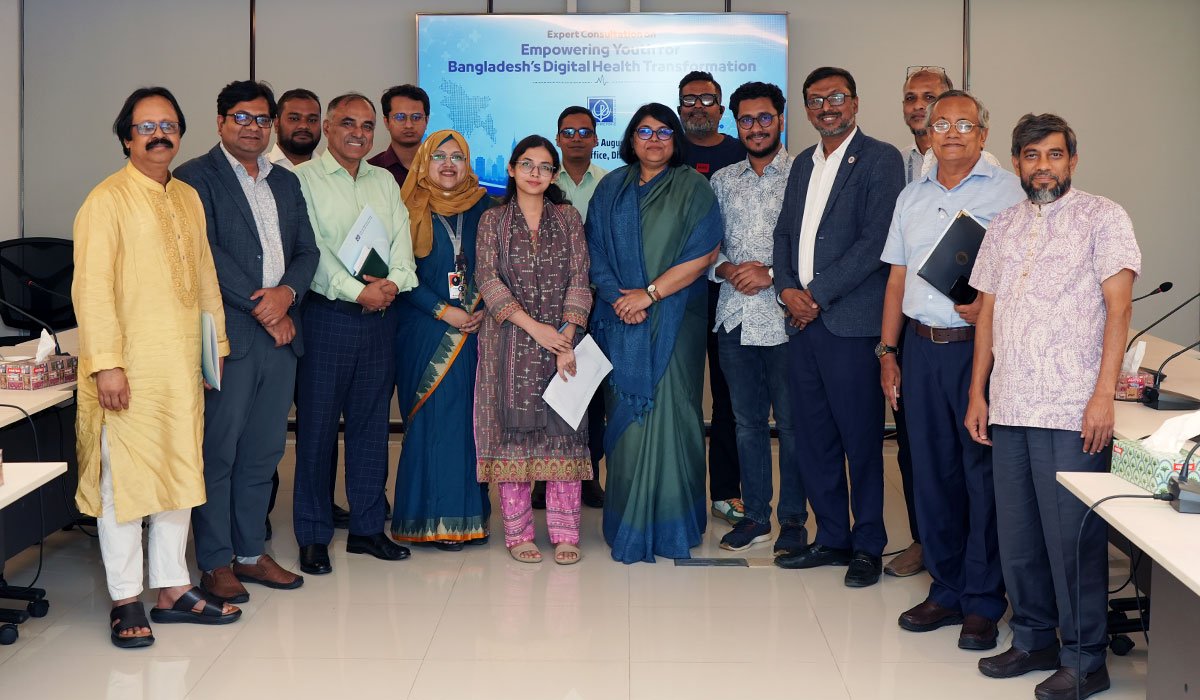
Bangladesh’s efforts to engage young people in the digital health sector need to be contextualised, aligned with existing national strategies, and linked with practical skills and employment opportunities. Experts also stressed the importance of clearly identifying target participants, understanding existing skills gaps, and ensuring that training responds to the evolving needs of the healthcare sector.
These observations emerged during an expert consultation on “Empowering Youth for Bangladesh’s Digital Health Transformation”, where participants discussed the scope, relevance and potential areas of improvement of a proposed training initiative for young people.
Drawing on his experience in the development sector, Dr Md Jahirul Alam Azad, Adjunct Faculty at East West University, noted that Bangladesh has made longstanding investments in telemedicine and digital health, although utilisation has remained limited. Based on his field experience in Satkhira, he observed that digital health interventions may struggle to gain traction when they are not sufficiently contextualised to users’ needs and perceptions. He stressed the importance of aligning the proposed training with the government’s existing digital health strategy, avoiding duplication of existing initiatives, and identifying clearer pathways for youth engagement in the health sector.
Highlighting employment opportunities, Lelin Choudhury, Chairman of Health and Hope Hospital, pointed to the potential for young people to work in non-clinical positions such as customer care, front-desk operations and call centres. He emphasised the need for training in communication, empathy, professionalism, positive attitudes, medical terminology and a non-judgemental approach to prepare young people for such roles.
Dr Khondokar Abdullah Al Mamun, Professor at United International University, stressed that academic qualifications alone are not sufficient and that graduates also require practical skills, problem-solving abilities and an entrepreneurial mindset. While noting that the draft module explains what should be taught, he called for greater attention to how the training would be delivered and translated into meaningful outcomes. He recommended incorporating implementation strategies, aligning with National Skills Development Authority (NSDA) standards where feasible, and using simulation-based learning to strengthen soft skills.
Emphasising sustainability, Dr Sohana Shafique, Project Coordinator and Lead of Urban Health System and Population Studies at icddr,b, observed that technologies such as e-health and m-health need to be contextualised and developed through co-creation. She recommended an evidence-based approach to curriculum design, clearly defined delivery methods and practical applications of emerging technologies, including augmented and virtual reality. She also highlighted antimicrobial stewardship, risk stratification, climate change and health, and heat stress as areas that could be prioritised.
The importance of ensuring equitable access was highlighted by Md Mofakker Morshed Khan Chowdhury, Programme Manager at BRAC University, who argued that youth capacity-building initiatives should also benefit underserved and remote communities with limited access to healthcare. He recommended incorporating community- and facility-based internships to provide participants with practical experience and exposure to local healthcare challenges.
Dr Mahbub E Elahi Khan Chowdhury, Consultant, called for a clearer definition of the digital health competencies that the programme intends to develop. He recommended specifying the thematic focus of the training and incorporating equity, ethics, data governance and security. He also stressed the need for measurable indicators of learning outcomes and alignment with existing national training policies to support scalability and sustainability.
Several experts emphasised the importance of designing the programme on the basis of clearly identified needs. Muhammad Zakir Hossain, Administrator at Ibn Sina Trust, recommended conducting a comprehensive training needs assessment and gap analysis before finalising the curriculum. Mezbaul Amin, Chief Executive Officer of Susthotaa, stressed careful selection of target participants so that the training responds to the aspirations and career needs of young graduates.
Reflecting on the programme’s potential added value, Dr Lamisa Rahman, Research Fellow at the BRAC James P Grant School of Public Health, pointed out that Bangladesh already has several short- and long-term health training programmes. She stressed the need to clearly demonstrate how the proposed initiative would complement existing efforts and respond to current workforce needs. She also emphasised the responsible dissemination of knowledge and skills to minimise unintended consequences and maximise positive impact.
Md Kabir Ahmed Khan, Senior Consultant at Unico Hospital, emphasised the importance of clearly defining target groups and tailoring communication skills training to different roles within healthcare facilities. He also recommended integrating patient rights, patient safety and ethical considerations into the curriculum, while ensuring that the competencies developed through the training are relevant to participants’ specific workplace responsibilities.
Overall, the consultation underscored the importance of developing a context-specific, evidence-based and practically oriented training approach that complements existing initiatives, responds to workforce needs and equips young people with relevant competencies for Bangladesh’s evolving digital health sector.