

Originally posted in The Financial Express on 9 February 2026
BNP, Jamaat vow deep reforms to boost revenue mobilisation
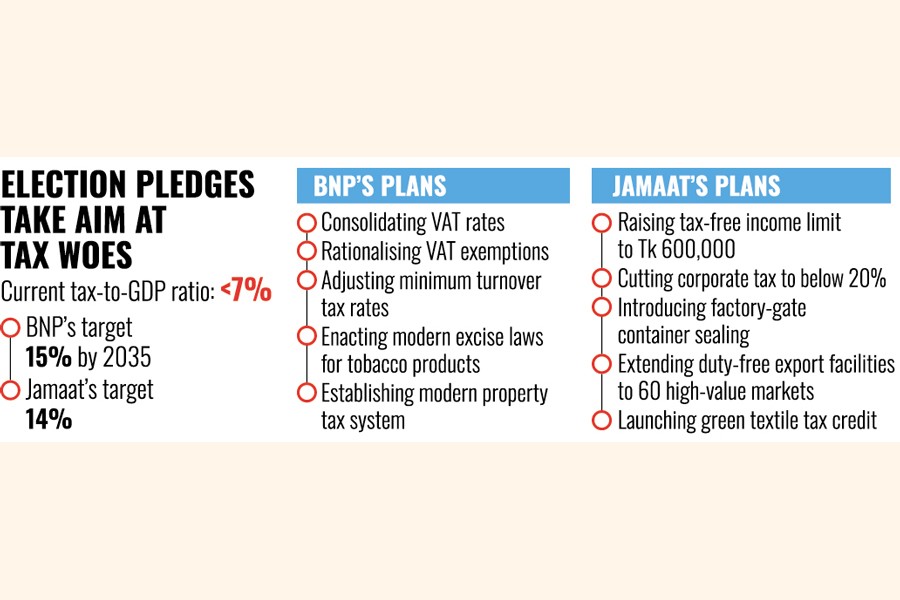
The major political parties have placed domestic revenue mobilisation at the centre of their respective economic agenda, setting specific targets to raise Bangladesh’s tax-to-gross domestic product (GDP) ratio amid shrinking fiscal space.
The Bangladesh Nationalist Party (BNP) has pledged to increase the tax-to-GDP ratio to 15 per cent by 2035, while Jamaat-e-Islami has set a target of 14 per cent, according to their manifestos for the upcoming national elections scheduled for February 12.
Currently, the tax-to-GDP ratio is among the lowest in Bangladesh, less than 7.0 per cent, which is a double-digit figure in the neighbouring country.
According to the BNP manifesto unveiled Friday, the party aims to boost the tax-to-GDP ratio by an additional 2 percentage points in the short term.
To achieve this, it plans to consolidate VAT rates, rationalise VAT exemptions, adjust the minimum turnover tax rates, enact modern excise laws for tobacco products, and impose excise duties – reflecting pollution costs – on imported motor fuels that emit greenhouse gases.
In the medium term, the BNP targets to raise the tax-to-GDP ratio to 10 per cent, in line with its medium- and long-term revenue strategy (MLTRS).
It says the MLTRS will be implemented through visible reforms in tax administration and strengthened revenue collection mechanisms.
Jamaat-e-Islami, in its manifesto, emphasises structural reforms, simplification of the tax system, and expansion of the tax base.
“Revenue collection will be increased to 14 per cent of the GDP, while dependence on borrowing will be gradually reduced,” the manifesto states.
To ease the cost of living for low- and middle-income groups, Jamaat proposes gradually increasing the tax-free income threshold to Tk 600,000 and reducing corporate tax rates to below 20 per cent.
Currently, the tax-free threshold for individual taxpayers is Tk 3,50,000 while the corporate tax rate ranges from 20 per cent to 45 per cent on the basis of the nature of business.
Jamaat also plans to fully digitise the customs system, including the introduction of factory-gate container sealing.
It says by 2027, it will extend duty-free export facilities to 60 high-value international markets.
The party also proposes introducing a green textile tax credit, offering 30 per cent incentives to production- and export-oriented entrepreneurs committed to environmentally sustainable practices.
Dr Fahmida Khatun, executive director of the Centre for Policy Dialogue (CPD), says it is encouraging that political parties have prioritised domestic revenue mobilisation in their manifestos – a subject that was less visible in previous national elections.
“Bangladesh has one of the lowest tax-to-GDP ratios in the world, which requires deep structural reforms,” she says, adding that the next government must swiftly implement institutional, administrative, and revenue collection reforms to expand fiscal space.
Separately, the BNP manifesto argues that Bangladesh’s revenue crisis stems not only from weaknesses in tax administration but also from the narrow base of economic activities.
“To achieve sustainable income growth, revenue policy must be aligned with the natural dynamics of the economy,” the manifesto reads.
“When investment increases, production increases; when production increases, employment increases; when employment and income increase, consumption increases; and when consumption increases, tax revenue increases sustainably.”
Revitalising domestic and foreign investment is described as the centrepiece of the BNP’s revenue strategy. The party attributes the recent investment stagnation to policy instability and financial sector mismanagement during what it terms the “fascist regime”.
It commits to creating a stable, predictable, and fair investment environment.
The BNP manifesto highlights job creation as a critical issue, noting that Bangladesh’s employment deficit has significantly constrained the tax base.
“When manufacturing expands, employment, wages, and working capital increase, creating greater scope for income tax and VAT collection,” it states, adding that expanding the capacity of earnings will make tax compliance a natural civic behaviour.
The BNP also stresses that the most sustainable way to increase VAT revenue is not by raising tax rates, but by expanding production and consumption through investment-friendly policies, small and medium enterprise (SME) development, and strengthening the domestic market.
The party has pledged to curb revenue erosion that particularly happens through excessive tax exemptions.
“Incentives that generate real investment, employment, and technology development will remain, while those that only inflate profits and erode revenue will be withdrawn,” its manifesto says.
The BNP further plans to establish a modern property tax system to bring growing wealth into the tax net and improve equity in the tax structure.
It also vows to reform tax administration to make it professional and technology-driven.
“Tax administration will be supportive, not punitive, so that economic momentum is not hindered and the tax base expands voluntarily,” the manifesto adds.
The party envisions a new fiscal social contract, promising fair and transparent taxation where those with the ability to pay contribute their fair share and the benefits of economic growth are visible to all.