

Make e-governance citizen-centred by ensuring that digital public services respond to people’s actual needs, can be accessed and completed with ease, and enable citizens to participate, provide feedback and seek redress. Digitalisation should go beyond transferring existing administrative procedures online; it should make local government institutions more accessible, transparent, accountable and inclusive.
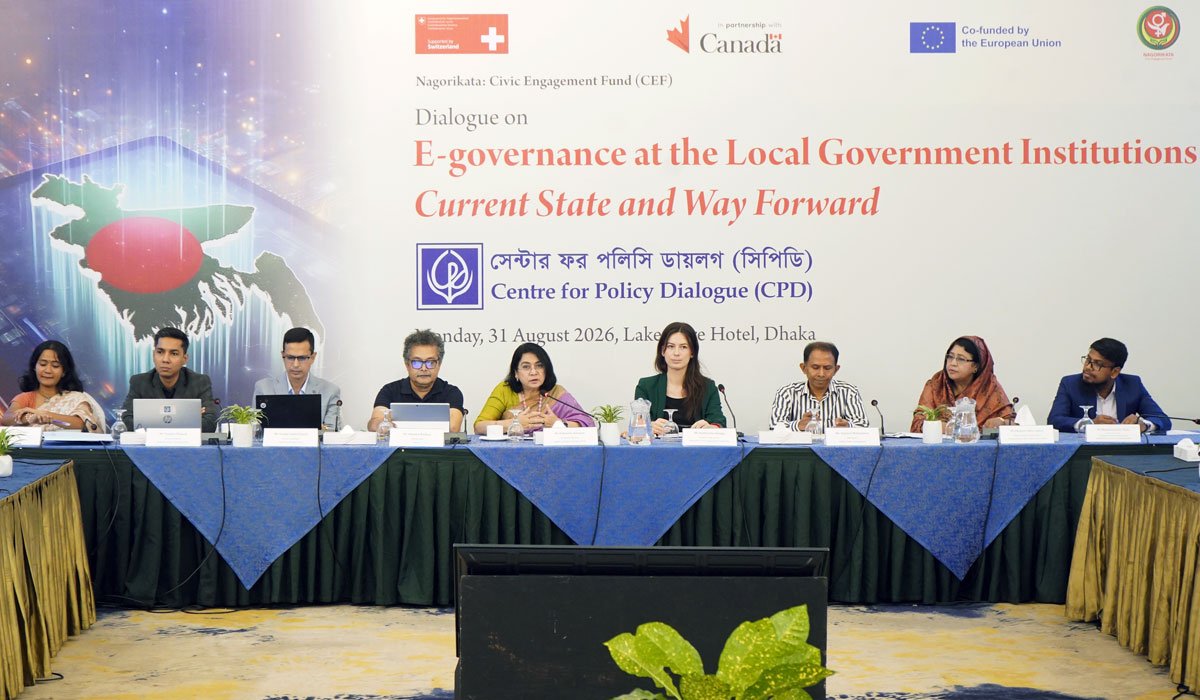
This message emerged from the dialogue titled “E-governance at the Local Government Institutions: Current State and Way Forward,” organised by the Centre for Policy Dialogue (CPD) under the Nagorikata: Civic Engagement Fund (CEF) on 31 August 2026 at Lakeshore Hotel, Dhaka. The Nagorikata Programme is jointly supported by the Embassy of Switzerland, Global Affairs Canada (GAC), and the European Union, facilitated by GFA Consulting Group, and implemented by CPD.
As implementing partners, CPD is working with Gram Unnayan Karma (GUK), Participatory Research and Action Network (PRAAN), Indigenous Peoples Development Services (IPDS), and Efforts for Rural Advancement (ERA) across Bogura, Noakhali, Sherpur and Sunamganj, respectively.
Opening the dialogue, Dr Fahmida Khatun, Executive Director, CPD, stressed that the success of e-governance should not be measured simply by the number of digital platforms introduced. Since Union Parishads, municipalities and city corporations are among the institutions closest to citizens, well-designed digital services can reduce repeated visits to government offices, save time and costs, and potentially reduce harassment. At the same time, she underscored the need to consider women’s access to technology, the inclusion of persons with disabilities and marginalised communities, citizen participation, transparency and effective grievance mechanisms.
E-governance, she emphasised, needs to create a two-way relationship between citizens and government. Reliable internet, trained officials, cybersecurity, protection of personal information and clear institutional responsibilities are all necessary; technology by itself cannot automatically deliver good governance.
The discussion then turned to the people who actually use digital services. Ms Katharina König, Deputy Team Leader, Nagorikata: Civic Engagement Fund (CEF), noted that Bangladesh has made significant progress in introducing digital public services, but making a service digital does not automatically make it citizen-centred. A system that works for a confident smartphone user may not work equally well for someone with limited digital literacy, a person with a disability or a woman without independent access to a device.
She highlighted human-centred design as an important approach—starting with users’ needs, experiences and challenges rather than with the technology itself, and listening to citizens, frontline service providers and local institutions when designing or improving services.
Evidence from CPD’s study reinforced many of these concerns. The preliminary findings of “Establishing Effective and Accountable E-Governance to Strengthen Local Government Institutions by Fulfilling the Needs of Youth, Gender, and Marginalised Communities” were presented by Mr Tamim Ahmed, Research Fellow, CPD, and Ms Sabiha Sharmin, Research Associate, CPD. The research team was led by Dr Khondaker Golam Moazzem, Research Director, CPD. The demand-side survey covered 2,611 respondents across the country, including 1,382 youth, 957 women, and respondents from indigenous communities, char and haor areas, slums and persons with disabilities.
One of the clearest findings was the gap between services being labelled “digital” and citizens being able to complete them digitally. Many still have to submit physical documents, collect documents in person, sign papers, or make payments offline. The presentation argued that a service should be considered genuinely digital when the complete process, including application, verification, payment, processing, communication and delivery, can be completed digitally where the nature of the service permits.
The findings also showed that different groups do not necessarily want or experience services in the same way. Women most commonly preferred a mixed online-and-in-person model, while 54.5 per cent of surveyed youth preferred fully online services. Yet digital skills and connectivity remained substantial barriers among youth, with 52.9 per cent citing lack of digital skills and 52.6 per cent identifying poor internet connectivity.
The institutional foundations of e-governance were another concern. Across 267 local government offices included in CPD’s E-Governance Preparedness Index, the overall preparedness score was 38.9 out of 100. Infrastructure readiness stood at 24.1, compared with 44.0 for operational readiness and 48.6 for citizen-oriented e-service readiness—suggesting that citizen-facing services are progressing faster than the infrastructure supporting them.
Service design, therefore, needs to encompass the entire journey of a citizen, Dr Ananya Raihan, Chairperson, iSocial, argued. She drew attention to the institutional architecture behind digital services, including government processes, data systems and coordination between different institutions. A digital platform may technically function, but the more important question is whether the service itself solves the citizen’s problem. She called for greater attention to the interaction between the supply side and citizens, alongside a clearer roadmap for improving public service delivery.
Taking the discussion further, Mr Fazlul Zahed Pavel, Senior Consultant, Aspire to Innovate (a2i), emphasised that service redesign should identify every point at which citizens encounter difficulties. Depending on the service, people may have to interact with several institutions, repeat procedures or seek assistance simply to complete a process. Citizen feedback, verification and redress should therefore be built into service design, rather than treated as separate issues after a platform has already been developed.
The distinction between digitisation and genuine transformation was also raised by Mr Mohammad Nur Ullah, Assistant Professor, Department of Public Administration, Bangladesh University of Professionals (BUP). He argued that putting existing services onto digital platforms does not necessarily transform the institutional environment surrounding those services. He also highlighted questions concerning the sustainability and future roles of Union Digital Centres, Pourashava Digital Centres and City Digital Centres as alternative channels for accessing digital services continue to expand.
Divisional differences, distance from service points and the experiences of women and marginalised communities, he added, warrant closer examination in understanding how effectively local e-governance works across the country.
Whether a service exists is only one part of the question; whether people know about it and can actually use it is equally important. Mr Aminul Mohaimen, MIS Expert in Public Finance Management, highlighted the need to capture the experiences of disadvantaged and urban vulnerable populations more clearly. He pointed to grievance-redress mechanisms as an example: a system may formally exist, but it cannot be effective if citizens do not know where or how to submit a complaint. He also underscored the growing importance of interoperability so that different government databases and platforms can communicate and verify information across systems.
Experiences from the grassroots brought the information gap into sharper focus. Ms Khaleda Akter Jahan, Upazilla Women Affairs Officer, Upazilla Women Affairs Office, Savar, Dhaka, observed that many intended beneficiaries are unaware of government e-services, loans, allowances and other support programmes or do not know which office to approach. She stressed that simply creating a service cannot ensure inclusion when the people who need it most remain unaware of its existence or the procedure for accessing it.
Her remarks also drew attention to the practical meaning of women’s empowerment. Women officers working at the field level may need to travel extensively without adequate transport or logistical support, while women representatives may hold positions without sufficient authority or resources. Such institutional and practical barriers, she argued, also need to form part of discussions on inclusion and empowerment.
The open-floor discussion broadened the conversation further. Participants raised the geographical and generational digital divide, cybersecurity, the maintenance of government ICT infrastructure, greater integration of services and the possibility of using existing digital service centres and post offices to bring multiple public services closer to citizens.
Accessibility emerged as a particularly pressing concern. A participant with a visual disability explained that many government digital services cannot be used independently because websites, forms and other platforms do not adequately follow accessibility standards. Screen-reader incompatibility, inaccessible CAPTCHA systems, lack of alternative text and physical barriers at grassroots service centres were among the issues highlighted.
The discussion ultimately pointed towards a broader understanding of digital transformation: effective e-governance is not simply about putting more services online, but about redesigning public services around the people who use them. This requires stronger digital literacy, reliable infrastructure, accessible service design, privacy and cybersecurity safeguards, effective grievance mechanisms, interoperability and meaningful channels for citizens to participate in improving the services they receive.