

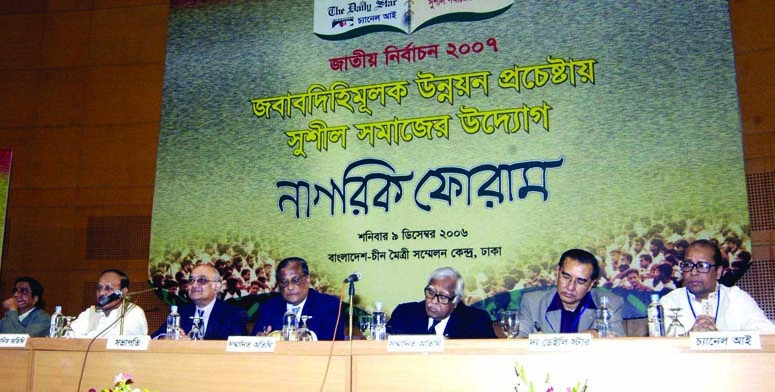
General Secretary of Awami League Abdul Jalil and Secretary General of BNP Abdul Mannan Bhuiyan expressed positive views as regards curbing the influence of black money in the elections and the need for good governance. They felt that appropriate measures have to be taken to strengthen democratic practices in governance. The two leaders were speaking as Special Guests at the Nagorik Forum 2006 on December 9th organized conjointly by CPD, The Daily Star, Prothom Alo and Channel-i at the Bangladesh-China Friendship Conference Centre. The Forum was organized as a round off dialogue to the CPD programme on NATIONAL ELECTION 2007: CIVIL SOCIETY INITIATIVE FOR ACCOUNTABLE DEVELOPMENT. About 1200 people from various segments of the society including participants of the regional dialogues organized as part of the aforesaid programme took part in the Forum. Advisor to the Caretaker Government for Finance and Planning Dr Akbar Ali Khan was present as Chief Guest while CPD Chairman and Nagorik Committee 2006 Convener Professor Rehman Sobhan presided over. CPD Executive Director and Nagorik Committee 2006 Member Secretary Debapriya Bhattacharya conducted the Forum.
In the beginning the participants viewed a twenty two minute video film, an edit version prepared by channel-i based on the series of programmes on regional dialogues encapsulating people’s uninduced opinions.
Dr Bhattacharya, in his inaugural speech, provided the background to the initiative and pointed out a number of outcomes. He elaborated on the challenges that are to be faced by the country on its way to good governance. He, then, read out a set of recommendations that had evolved from the 15 regional dialogues held across the country. The recommendations were formally handed over to the political leaders. Major recommendations included: strengthening democratic institutions, ensuring electoral as well as political reforms, mandatory registration of the political parties, bar on the public servants to contest in the elections for at least three years after retirement or leaving the jobs, disclosure of relevant information about the candidates such as educational background, professional experience, source of income, tax returns, the total amount of wealth owned, any previous criminal record and/or default of bank loans and so forth, formation of an election disqualification commission to probe electoral irregularities, disposal of election disputes and petitions within 180 days, introduction of an electoral college to elect the President, separate electoral roll for the three hill districts, increasing the number of reserved seats and direct elections for women and bringing in necessary amendments to the Representation of People Order (RPO), 1972.
Abdul Mannan Bhuiyan urged the political parties to accept election results whether it is in one’s favour or not and to restrain from politicization of the administration. He added that the civil society leaders and intellectuals should rise above any kind of political bias and work towards a consensus that no political party boycotts parliament or enforces hartal and blockade, the parliamentary standing committees are formed within the first three months and a transparent operational system is in place within the government. He underscored that bureaucrats, academics and other professionals had an equally important role to play along with the politicians to ensure development of the country.
Abdul Jalil stressed that Awami League (AL) is committed to establish an accountable and capable civil administration, independent judiciary, strong local government system, free flow of information and rights of the women, indigenous people and minority community. He remarked that the CPD’s initiative for accountable development, especially in the context of upcoming elections, was important and AL would consider the set of recommendations for implementation. He, however, suggested that the amendment of RPO should be left to an elected government to decide. He concluded by saying that all citizens must try to keep the political and economic arena free from corruption if the spirit of Bangladesh’s independence is to be upheld.
Dr Akbar Ali Khan said, ‘The country is still passing through a deep crisis and top leaders of both the political parties should come forward to resolve it.’ Much depends on the move of the political parties, he argued. Dr Khan cited examples of democratic countries all over the world and emphasized that the system could never be perfect. But, of course, it can be somewhat ameliorated. He sought guidelines from the Supreme Court for a permanent electoral roll.
Members of the Nagorik Committee 2006 briefly spoke about the preparation of Bangladesh: Vision for 2021, which comprises eight inter-related goals. Among the members were: economist Professor Wahiduddin Mahmud, Vice Chancellor of BRAC University Professor Jamilur Reza Chowdhury, Professor of Sociology, Dhaka University Dr Mahmuda Islam and Chairman of Bishwa Shahitya Kendra Professor Abdullah Abu Sayeed addressed the gathering. Appraising Bangladesh’s achievement in poverty reduction Professor Mahmud hoped that the country would graduate into a middle income country given the current trends of poverty reduction. Professor Chowdhury stressed on the need to integrate the three streams of education, Bengali, English and madrasa, and bring these under a core curriculum. Professor Mahmuda Islam advocated in favour of working for empowerment of women and suggested that there should be more seats for them in the parliament. Professor Abdullah Abu Sayeed observed that ‘democratic dictatorship’ is often more harmful than a ‘military dictatorship’ as it rules under the guise of legal coverage and democracy. Editor of The Daily Star Mahfuz Anam, Editor of Prothom Alo Matiur Rahman and Managing Director of Channel-i Faridur Reza Sagar also spoke at the Forum on behalf of the co-organizers.
Professor Rehman Sobhan pointed out that a number of dramatic changes have to take place ‘if the Caretaker Government is to establish enough authority to preside over a credible election.’ He cautioned that we might end up with confrontations instead of elections or with an election which commands a diminished credibility in the eyes of the electorate as well as the international community. Either of these would compromise the legitimacy of future governments and would not in anyway do service to the cause of democracy.
He reiterated that the demand for honest candidates who are not associated with ‘acts of violence or command over a sizeable undeclared wealth’ was now gaining momentum.
Introductory Statement by
Dr Debapriya Bhattacharya
Executive Director, CPD
Remarks by
Mr Abdul Mannan Bhuiyan
Secretary General, Bangladesh Nationalist Party (BNP)
Mr Abdul Zalil
General Secretary, Bangladesh Awami League
Mr Akbar Ali Khan
Former Advisor of the Caretaker Government
Statements by
Mr Motiur Rahman
Editor, Prothom Alo
Mr Mahfuz Anam
Editor, The Daily Star
Concluding Statement by
Professor Rehman Sobhan
Chairman, CPD