

Bangladesh’s economy is currently navigating a complex and fragile macroeconomic environment. Persistent inflation, shrinking fiscal space, sluggish private sector investment, and vulnerabilities in the banking sector have combined to create mounting economic pressure. At the same time, rising debt obligations, energy constraints, and global uncertainties are adding to the policy challenges confronting the country.
In this context, the first 180 days of the newly elected government will be critical. Restoring macroeconomic stability, rebuilding investor confidence, and initiating structural reforms will be essential for sustaining growth and employment. Achieving these goals will require coordinated fiscal and monetary policies, stronger governance institutions, and targeted reforms across key sectors of the economy.
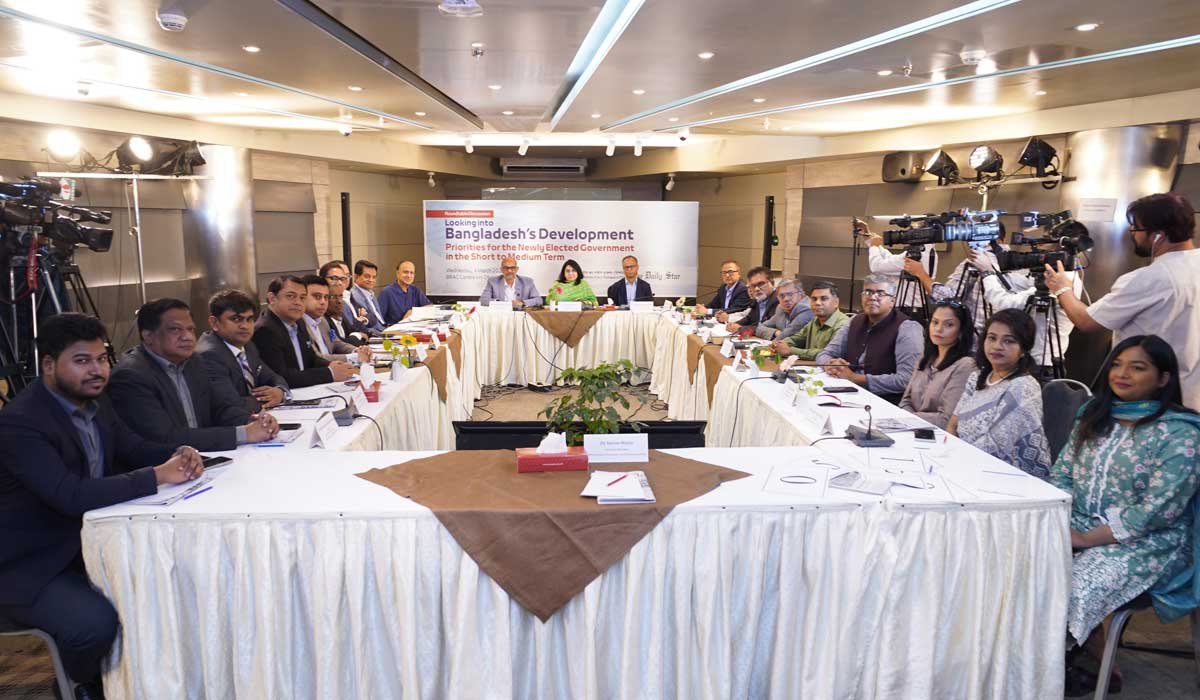
To discuss these challenges and possible policy responses, the Centre for Policy Dialogue (CPD), in partnership with The Daily Star, organised a roundtable titled ‘Looking into Bangladesh’s Development: Priorities for the Newly Elected Government in the Short to Medium Term’ on 4 March 2026 in Dhaka.
In his remarks as Chief Guest, Dr Rashed Al Mahmud Titumir, Hon’ble Prime Minister’s Adviser on the Ministry of Finance and Planning, highlighted the importance of strengthening governance and ensuring more efficient use of public resources. He noted that fiscal inefficiencies remain a key challenge in Bangladesh’s economic management and emphasised that reducing systemic leakages could significantly improve the delivery of public services. He stated that ‘Our major fiscal policy problem is leakage. If we can reduce that, we will be able to go much further in delivering public goods.’
Earlier, in her keynote presentation, Dr Fahmida Khatun, Executive Director of CPD, stressed that policy coordination would be essential for stabilising the economy. She observed that macroeconomic challenges such as inflation and slowing investment cannot be addressed through isolated policy actions. The Executive Director remarked that ‘Monetary and fiscal discipline must be implemented together in Bangladesh. Without coherence between these two policies, they cannot deliver the desired outcomes.’
Participants also emphasised that policy reforms must be accompanied by improvements in administrative efficiency and institutional capacity. Weak implementation mechanisms and bureaucratic bottlenecks often prevent well-designed policies from achieving their intended outcomes. Strengthening institutional coordination, improving transparency, and modernising administrative systems were highlighted as essential steps to ensure effective implementation of economic reforms.
In this context, Mr Mahfuz Anam, Editor and Publisher of The Daily Star, highlighted the importance of modernising public administration through digitalisation. He emphasised that streamlining administrative processes could improve efficiency while reducing delays and wastage. He noted that ‘Digitalisation of our administrative system should not be limited to financial matters; we must move towards digitalisation across every ministry.’
Ensuring macroeconomic stability emerged as one of the central themes of the discussion. With inflation remaining elevated and investment slowing, participants emphasised the need for reforms that strengthen fiscal sustainability, support economic growth, and stabilise the balance of payments.
Speakers highlighted the importance of improving revenue mobilisation, reforming state-owned enterprises, strengthening public expenditure management, and ensuring sustainable external sector management.
In this regard, Dr Sadiq Ahmed, Vice Chairman of the Policy Research Institute (PRI), emphasised the urgent need to reform Bangladesh’s tax system in order to expand the government’s fiscal capacity. The Vice Chairman of PRI recommended that ‘The most important thing is to reform the tax system to achieve a higher share of GDP revenue from 6.5 per cent to at least 12.5 per cent of GDP.’
At the same time, Dr Mohammed Helal Uddin, Executive Vice Chairman of the Microcredit Regulatory Authority, highlighted the importance of addressing employment challenges in the short term. Dr Helal Uddin stated that ‘If we want to create employment within 180 days, it will be very difficult to build formal facilities. Instead, we can inject financing into the informal sector and MFI-based activities.’
Fiscal discipline and revenue mobilisation were also highlighted as key priorities for stabilising the economy. Participants noted that Bangladesh continues to face structural challenges in its revenue system, including a narrow tax base, weak tax administration, and limited transparency in fiscal management. Addressing these challenges will be critical for expanding the government’s fiscal space and ensuring sustainable financing for public investment and social protection programmes.
Against this backdrop, Ms Doulot Akter Mala, President of the Economic Reporters Forum (ERF), emphasised the importance of inclusive and transparent policy processes. She highlighted that effective fiscal reforms require consultation with relevant stakeholders to ensure that policies are practical and widely supported. She stated that ‘stakeholders must be involved in policy formulation through meaningful consultation.’
Concerns regarding Bangladesh’s growing debt burden were also highlighted by Dr M. Masrur Reaz, Chairman of Policy Exchange Bangladesh. He noted that rising debt obligations could place increasing pressure on public finances if not managed carefully. He recommended that ‘the accumulated debt should be renegotiated, particularly the non-concessional portions.’
The stability of Bangladesh’s financial sector was another key focus of the discussion. Participants noted that rising non-performing loans, weak governance in some banks, and declining depositor confidence have created significant vulnerabilities in the banking system. Addressing these challenges will be essential for restoring financial stability and ensuring that the banking sector can support investment and economic growth.
Mr Mohammed Nurul Amin, Former Chairman of the Association of Bankers, Bangladesh (ABB), emphasised the importance of rebuilding public trust in the banking system, stating that ‘restoring depositor confidence must be the foremost priority for banking sector stability.’
Legal enforcement against loan default was also highlighted as an important reform priority. Dr Md Main Uddin, Professor at the University of Dhaka, recommended that ‘wilful defaulters should be blacklisted, as practiced in countries such as China and Malaysia, to prevent them from leaving the country.’
Linking financial sector stability with broader economic policy priorities, Mr A K M Azad, Vice President of ICC Bangladesh, observed that ‘public investment should shift from infrastructure such as bridges and culverts towards the energy sector, while households move to LPG so that natural gas can be prioritised for industry.’
With Bangladesh approaching its transition from Least Developed Country (LDC) status, strengthening export competitiveness and improving trade facilitation were identified as key policy priorities. Participants noted that LDC graduation will gradually lead to the loss of several trade preferences, requiring Bangladesh to enhance its competitiveness, diversify exports, and streamline trade procedures to remain competitive in global markets.
In this regard, Dr Mostafa Abid Khan, former member of the Bangladesh Tariff and Trade Commission, emphasised the importance of improving trade facilitation systems. He suggested that ‘all agencies responsible for issuing certificates, licences and permits should be integrated into the National Single Window as quickly as possible.’
Highlighting the external trade dimension, Mr Shams Mahmud, former President of DCCI, noted that ‘GSP renegotiation is critically important as the new arrangements will come into effect next year, and Bangladesh must strengthen regional supply chain integration.’
From the perspective of the export industry, Mr Mahmud Hasan Khan (Babu), President of BGMEA, emphasised the need for a balanced approach to financial sector accountability, observing that ‘a distinction must be made between looting and non-performing loans, as they cannot be treated in the same way.’
Supporting established industries through targeted financial assistance was advocated by Mr Shawkat Aziz Russell, President of BTMA, who suggested that the government ‘reassess the 350 garment factories and more than 50 textile mills that have closed, and alongside loan rescheduling, also consider refinancing support.’
Encouraging private investment and generating employment were identified as critical priorities for sustaining economic growth. Participants noted that investment activity has remained subdued in recent years, partly due to regulatory bottlenecks, limited access to finance for smaller enterprises, and uncertainty in the business environment. Addressing these constraints will be essential for stimulating industrial expansion and creating new employment opportunities.
In this regard, Mr Asif Ibrahim, Former Director of BGMEA, emphasised the importance of improving the investment climate. He stated that ‘the BIDA Act and its associated procedures need to be streamlined to shorten approval timelines and remove overlapping bureaucratic processes.’
Focusing on the role of small and medium enterprises, Mr Mirza Nurul Ghani Shovon, President of NASCIB, highlighted the need for greater financial support for local industries. He noted that ‘district-specific loan programmes should be reintroduced to promote industrialisation, investment and employment at the local level.’
Emphasising the importance of innovation-led growth, Mr Syed Almas Kabir, Managing Director of Metronet Bangladesh Limited, stated that ‘research and development should be incentivised through tax rebates and matching grants.’
From the perspective of export diversification, Ms Amrita Islam, Deputy Managing Director of Picard Bangladesh Ltd, noted that ‘other export sectors should receive the same facilities provided to the garment industry, including Free of Cost import of raw materials.’
Ensuring reliable and affordable energy supply was also highlighted as a key requirement for sustaining industrial growth and maintaining Bangladesh’s competitiveness in global markets. Participants noted that energy shortages and supply constraints continue to pose significant challenges for industry and investment, making energy sector reforms a critical policy priority.
Mr Shafiqul Alam, Lead Energy Analyst at the Institute for Energy Economics and Financial Analysis (IEEFA), emphasised the need to strengthen domestic energy production. He noted that ‘there is no alternative to intensifying domestic gas exploration and increasing investment in the energy sector.’
At the same time, the long-term transition toward renewable energy was also highlighted. Dr M Asaduzzaman, Former Research Director at BIDS, stated that ‘the cost of solar electricity per unit has already become lower than that of traditional primary fuels, and this should be the direction for the future.’
Participants also emphasised the importance of broader institutional reforms and new strategies to support employment generation. In this regard, Mr A K M Fahim Mashroor, CEO of Bdjobs.com Limited, highlighted the potential role of overseas employment in expanding job opportunities and strengthening foreign exchange inflows. He remarked that ‘the government should develop a roadmap to send 20 to 30 lakh workers abroad over the next two to three years and connect the banking sector with this migration process.’
The roundtable concluded with a broad consensus that restoring macroeconomic stability, strengthening institutions, and accelerating structural reforms will be critical for Bangladesh’s economic recovery.