

Bangladesh’s remaining natural gas reserves may approach depletion by 2031 if the present trajectory continues, making domestic exploration and structural reform increasingly urgent. The prevailing shortage is already affecting critical sectors: as of 11 August 2026, power plants received only 29 per cent of their gas demand, while fertiliser companies received 38 per cent of their requirements.
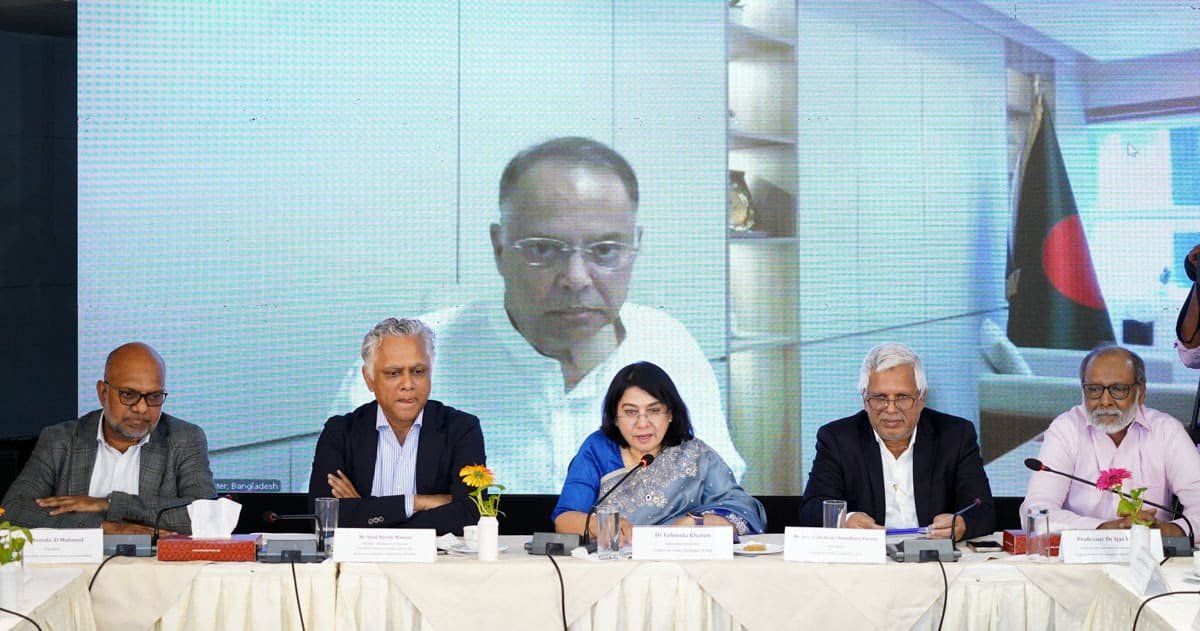
Against this backdrop, the Centre for Policy Dialogue (CPD) organised the discussion titled “Navigating Bangladesh’s Energy Crisis: Immediate Priorities and the Path to a Sustainable Energy Future” on Thursday, 13 August 2026, at the Auditorium, BRAC Centre Inn, Dhaka. Policymakers, energy experts, academics and private sector representatives explored both immediate responses to the crisis and pathways towards a more resilient energy system.
The Chief Guest, Mr Iqbal Hassan Mahmood, MP, Hon’ble Minister, Ministry of Power, Energy and Mineral Resources, Government of Bangladesh, acknowledged the difficulties industries are facing because of gas and electricity shortages. Referring to the recent technical disruption at an FSRU, he said the government was working to restore supply and expand LNG handling capacity, including plans to add three FSRUs by 2029. Drawing on his own experience in industry, he emphasised that he understood the pressure businesses face from loan repayments, interest and wages when production is disrupted.
Chairing the discussion, Dr Fahmida Khatun, Executive Director, CPD, stressed that energy is a strategic necessity without which industries, offices and households cannot function. She observed that the present crisis is multidimensional and has accumulated over many years. Immediate action is therefore essential, alongside medium- and long-term measures to ensure adequate, affordable and financially sustainable energy.
Presenting the keynote, Mr Foqoruddin Al Kabir, Senior Research Associate, CPD, showed that Bangladesh’s energy mix remains overwhelmingly dependent on fossil fuels. Imported LNG accounted for 28.82 per cent of national gas consumption in FY2024–25, while Petrobangla’s LNG subsidy bill increased to BDT 16,600 crore against an allocation of BDT 6,000 crore in FY2025-26. He highlighted that growing import dependence has increasingly exposed Bangladesh to global price volatility and external supply shocks.
The impact on industry featured prominently in the discussion. “Energy is a lifeline for our economy,” said Mr Anwar-Ul-Alam Chowdhury Parvez, President, Bangladesh Chamber of Industries (BCI). He warned that production losses, higher costs and uncertainty over gas availability are making it increasingly difficult for exporters to retain customers. Industry, he argued, must receive appropriate priority in energy allocation, alongside greater accountability in the sector.
For Dr Sakib Bin Amin, Professor, Department of Economics, North South University, reducing gas system losses, promoting energy efficiency and removing barriers to rooftop solar should form part of the immediate response. He also called for transparent and accountable policymaking with measurable targets, stressing that “policy needs to be translated into projects” and ultimately into investment.
Practical demand-side measures were also emphasised by Ms Rubiya Binte Mustafiz, Energy Sector Expert. Illegal connections, gas leakage and weaknesses in distribution management can be addressed immediately, she noted. At the same time, a stronger support ecosystem is needed to enable industries to adopt rooftop solar and energy-efficient technologies without having to manage the technical process themselves.
There is, however, no quick supply-side fix. Mr Shafiqul Alam, Lead Energy Analyst, Institute for Energy Economics and Financial Analysis (IEEFA), cautioned against viewing greater LNG imports as the solution, given their fiscal cost and exposure to international price volatility. Reducing system losses, import dependence and inefficient consumption, while expanding distributed renewable energy, should receive greater attention.
Describing the situation as an emergency, Mr David Hasanat, President, Bangladesh Independent Power Producers’ Association (BIPPA), drew attention to the persistent gas shortfall and resulting underutilisation of gas-fired power generation capacity. He argued that the discussion must now move beyond preparing for a crisis to identifying measures capable of tackling one that is already underway.
Questions of preparedness and governance were raised by Ms Moshahida Sultana, Associate Professor, Department of Accounting & Information Systems, University of Dhaka. She questioned the lack of adequate contingency planning for critical energy infrastructure and cautioned against treating privatisation as a substitute for addressing underlying supply and governance weaknesses.
Renewable energy must form a much larger part of the response, argued Mr Mostafa Al Mahmud, President, Bangladesh Sustainable and Renewable Energy Association (BSREA). He called for removing duties and regulatory bottlenecks constraining household and industrial solar, expanding solar-powered irrigation and accelerating renewable projects that could reduce dependence on imported fuel.
Rather than searching for a single solution, Professor Dr Ijaz Hossain, Energy Sector Expert, called for action on multiple fronts. “We have to do something,” he stressed, arguing that efficiency, demand management, pricing reform and additional supply must work together, as the crisis has become too deep for an exclusively supply-driven response.
Bringing the discussion back to business predictability, Mr Syed Nasim Manzur, Member, CPD Board of Trustees and President, Footwear Leathergoods and Accessories Exporters Association (FLAXA), said, “We need reliable power, affordable power, quality power.” Where uninterrupted supply cannot be ensured, industries at least need predictable schedules that allow them to plan production and manage costs.
The discussion underscored that Bangladesh’s immediate energy shortage cannot be separated from longstanding structural weaknesses. Addressing the crisis will require emergency supply management alongside domestic exploration, energy efficiency, stronger infrastructure, greater accountability, predictable policies and a substantially faster transition towards renewable energy.