

Resorces: Presentation | Report | Policy Brief
Capital adequacy, which reflects the banking sector’s ability to absorb losses, fell to a historic low of –2.93 per cent, signalling deep stress in the Bangladesh economy. A weak banking sector does not remain confined to banks alone. It can make credit harder for businesses, slow down investment, weaken job creation and reduce confidence among depositors and entrepreneurs.
This financial stress comes at a time when people are already facing pressure from high prices and weak income growth. Inflation has remained persistently high, while wage growth has failed to keep pace. For ordinary households, this means greater difficulty in managing food, transport, education and healthcare expenses.
The pressure is also visible in public finance. Revenue mobilisation remained weak, ADP implementation was slow, and the government became increasingly dependent on bank borrowing to finance the budget deficit. This may further limit the availability of credit for the private sector.
The external sector also showed signs of strain. While remittances helped maintain some stability, export performance weakened. At the same time, factory closures and job losses added to uncertainty in the labour market.
Recent shocks have exposed further vulnerabilities. The Strait of Hormuz blockade showed Bangladesh’s dependence on global energy supply chains. The Haor flood raised concerns over rice production, farmer compensation and food supply management. The measles outbreak revealed gaps in vaccine procurement, health preparedness and institutional accountability.
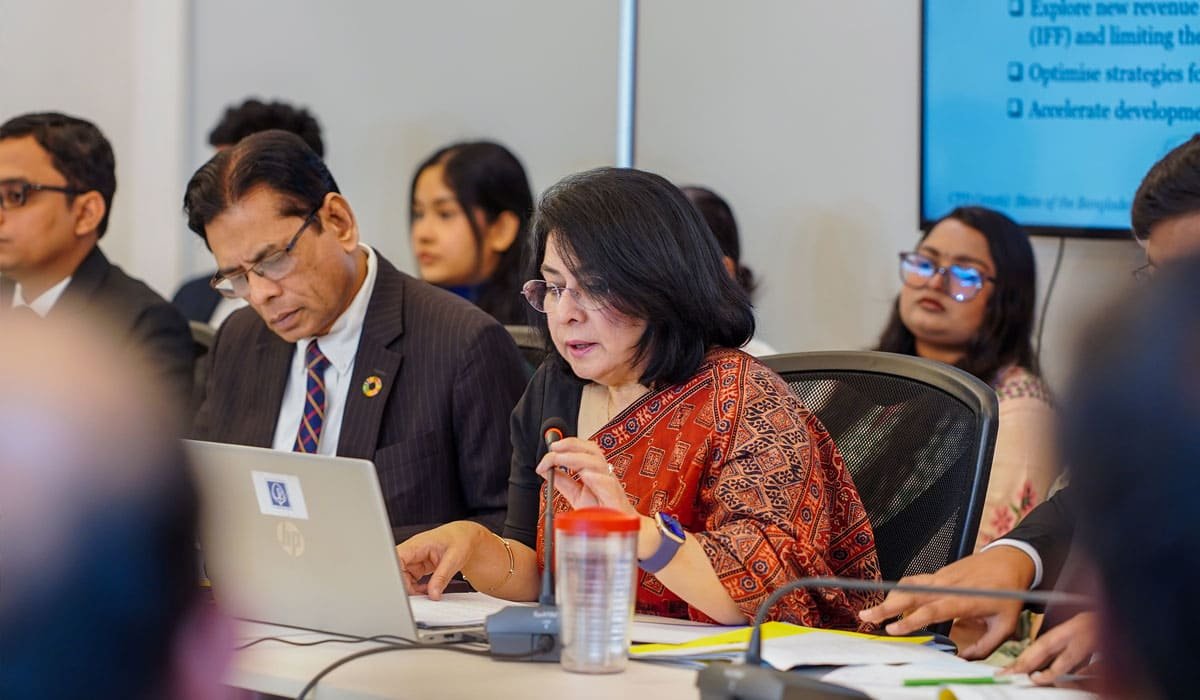
These observations emerged at the media briefing titled ‘State of the Bangladesh Economy in FY2025-26: Multidimensional Challenges during the Transition Period’, organised by the Centre for Policy Dialogue (CPD) on Thursday, 4 June 2026, under its flagship programme Independent Review of Bangladesh Development (IRBD). Dr Fahmida Khatun, Executive Director of CPD, delivered the keynote presentation on behalf of the IRBD team.
Dr Khatun emphasised that Bangladesh’s recovery would require credible governance reform ‘beyond macroeconomic stabilisation’. She highlighted the need to strengthen revenue mobilisation, improve tax efficiency, reduce fiscal leakages and accelerate development spending through better project management and monitoring.
On inflation, she underscored the importance of stronger market monitoring, strategic buffer stocks, regulation of intermediaries and targeted support for low-income households. She stated that inflation management must go beyond monetary tightening and address supply-side constraints and market governance failures.
Referring to the banking sector, Dr Khatun recommended stronger loan classification, improved disclosure of actual non-performing loans, limits on repeated restructuring, and greater independence and enforcement capacity for Bangladesh Bank. She also stated that political influence in lending must be stopped to restore discipline in the financial sector.
Dr Khatun further suggested linking industrial support with labour rights compliance, timely wage payment, workplace safety and trade union recognition. On the external sector, she recommended export diversification, higher domestic value addition and prudent external debt management.
On energy security, she highlighted the need for digital monitoring of the petroleum supply chain, stronger domestic gas exploration and expansion of renewable energy. She also recommended improved flood-loss assessment, higher farmer compensation, input support and stronger rice market monitoring.
In the health sector, Dr Khatun called for strengthened vaccine procurement, real-time inventory monitoring, protected financing for immunisation and stronger accountability mechanisms. She concluded that the government would need stronger institutions and better implementation capacity to achieve the development goals outlined in its election manifesto.
An open-floor Q&A session with journalists from both print and electronic media followed the discussion.
The IRBD team responded to questions raised by journalists during the discussion. Professor Mustafizur Rahman, Distinguished Fellow, CPD, said that the impact of energy price adjustments should be assessed through both direct and indirect channels. He noted that higher energy prices create an immediate burden for consumers, but they also affect producers, exporters and import-substituting industries through higher production costs. He emphasised that the government has policy tools to partially compensate affected sectors and protect competitiveness, stating that the concern becomes more serious when such supportive measures are not taken.
Professor Rahman also commented on labour-related trade measures in export markets. Referring to concerns over forced labour and child labour, he observed that Bangladesh’s domestic realities need to be understood with proper context. He said that the solution should not be the imposition of additional tariffs on Bangladeshi exports. Instead, development partners should support Bangladesh in addressing labour vulnerabilities. He noted that additional tariff pressure could weaken Bangladesh’s export competitiveness and may not solve the underlying labour problem.
On the proposed new pay scale for government employees, Professor Rahman said there is a rationale for reviewing public sector salaries, as the last pay scale was implemented in 2015 and inflation has eroded real purchasing power since then. However, he underscored that any salary revision should be accompanied by a clear implementation roadmap, merit-based recruitment, performance-based promotion, better working conditions and stronger accountability in public service delivery.
At the end of the briefing, CPD emphasised that addressing the present economic stress will require not only corrective policy measures, but also stronger institutions, better enforcement and accountable implementation.