

Unplanned surge of three wheelers damaging urban transport system, public safety, environment, and public health — this was flagged as the central concern as stakeholders warned that Dhaka’s streets are becoming increasingly unsafe and unmanageable amid weak regulation and mounting environmental risks.
In response, banning lead-acid batteries in electric three-wheelers was presented as the most urgent recommendation to reduce toxic exposure and protect the urban environment, alongside calls for a dedicated road network for low-speed vehicles, stricter licensing and registration, and stronger institutional coordination to bring electric three-wheelers (E3Ws) within a regulated urban transport framework.
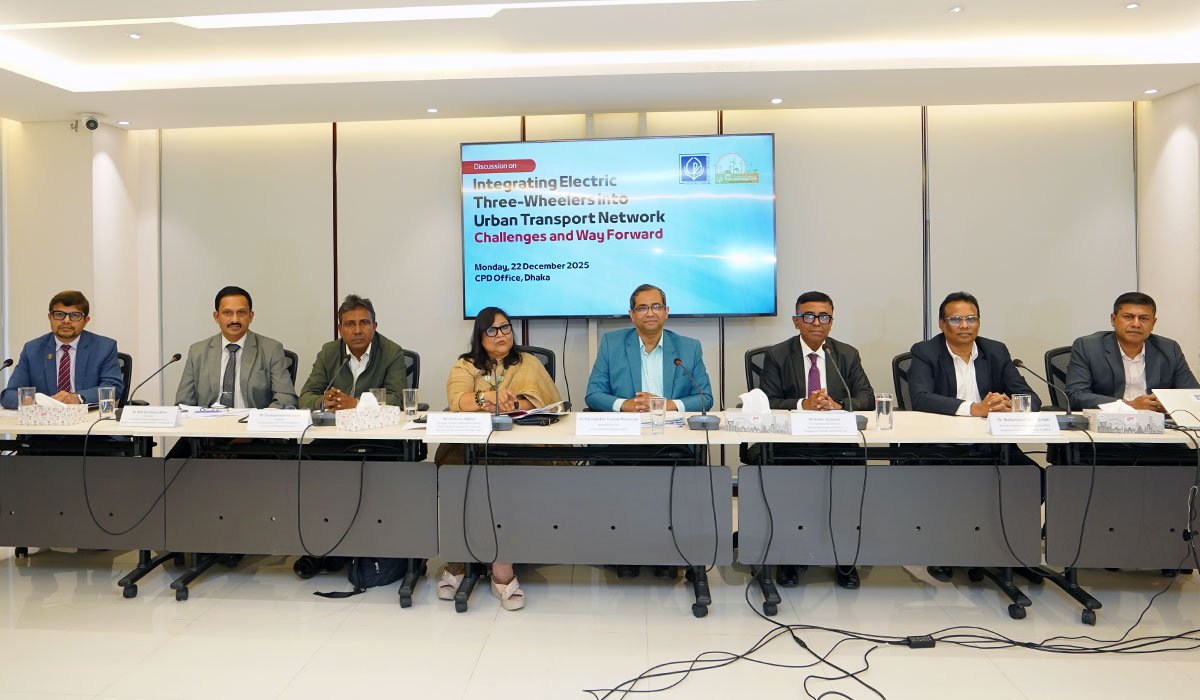
These issues were discussed in detail at a Discussion Session on “Integrating Electric Three-Wheelers into Urban Transport Network: Challenges and Way Forward”, held on Monday, 22 December 2025. The session was organised by the Centre for Policy Dialogue (CPD) at its premises.
As Special Guests, Ms Neelima Akhter, Executive Director (Additional Secretary), Dhaka Transport Coordination Authority (DTCA), and Mr Kabir Ahamed, Chief (Additional Secretary), Physical Infrastructure Division, Bangladesh Planning Commission, underscored the need to move from fragmented debate to coordinated action.
“Do not say there is ‘nothing’ in place. Existing legal and policy documents must be compiled and analysed properly so the discussion is grounded in evidence,” Ms Akhter said, adding that “if we can ensure a decent public transport system, especially buses, this problem will reduce automatically,” and urging organisers to include importers and manufacturers in future dialogues to address supply-side drivers.
Mr Kabir Ahamed called for firm limits and enforceable rules, saying, “we must determine how many of these vehicles Dhaka can sustain and license only that number,” and stressing that they “should not run on highways or district roads,” alongside stronger training and enforcement to protect public safety.
The session was moderated by Dr Khondaker Golam Moazzem, Research Director, CPD, who underscored the gravity of the situation, noting that “despite their potential as a clean, affordable mode for first- and last-mile connectivity, the unregulated expansion of electric three-wheelers has created serious safety, health and environmental risks.” He added that without a coherent urban transport strategy, E3Ws risk undermining rather than supporting sustainable mobility.
The keynote presentation was delivered by Mr Md. Khalid Mahmud, Programme Associate (Engineering), CPD, who highlighted evidence showing that electric three-wheelers now account for a significant share of road accidents while consuming a sizeable portion of daily electricity supply.
“Only around 20 per cent of used lead-acid batteries are recycled formally, exposing millions of people, especially children, to dangerous levels of lead,” he said, warning that continued reliance on lead-acid batteries could deepen a public health crisis. He further argued that “transitioning to safer battery technologies and enforcing proper charging and routing systems are no longer optional, but essential for any credible urban transport reform.”
Among the Distinguished Discussants, Dr Asif-Uz-Zaman Khan, Professor, Department of Urban and Regional Planning, BUET, argued that the city is now beyond an outright ban and must focus on safe integration. “At this stage, banning them is not feasible; so we must integrate them into the urban transport system,” he said, emphasising that speed control is decisive: “we should restrict them, as in West Bengal where the maximum is 25 kilometres per hour.” He also called for standardised vehicle design and clear route hierarchies so that E3Ws can function as regulated first- and last-mile services rather than competing with higher-order corridors.
Mr Mohammad Shahidullah, Director (Engineering), Engineering Wing, Bangladesh Road Transport Authority (BRTA), warned that overlapping jurisdictions would worsen disorder. “In one city, two authorities controlling vehicles will create disorder; there should only be one authority operating there,” he said, adding that drivers must come under licensing and training, and vehicles under registration and route permits to prevent indiscriminate cross-city operation. On battery safety, he was unequivocal: “lead-acid batteries should not be considered,” noting that such batteries are not permitted for other electric vehicles and should not be allowed for E3Ws either.
Mr Md. Sayed Abdul Baqi, Executive Engineer (Training), Bangladesh Industrial Technical Assistance Center (BITAC), highlighted manufacturing and safety weaknesses and offered technical support. “BITAC can ensure the quality of materials and components, strength, standard size and composition, so durability and safety can improve,” he said, adding that “if responsibility for driver training is given, BITAC can do it.” He stressed that stronger standards for key components and quality assurance are essential to reduce crash risks.
Mr Khalequzzaman Lipon, Convener, Rickshaw, Battery-Powered Rickshaw-Van, and Easy Bike Sangram Parishad, said workers and operators have long demanded regulation rather than blanket crackdowns. “From day one we demanded three things: bring it under a policy framework, create service-road arrangements, and stop extortion on the roads,” he said, arguing that formal licensing, registration and permits would also help limit numbers. He urged a single, unified framework to avoid confusion and market capture, saying, “we need one unified framework under BRTA, not multiple policies that create confusion and open the door to syndication.”
In the open floor, journalists pressed panellists on institutional accountability, unchecked production of vehicles in informal workshops, the health consequences of battery misuse, and whether enforcement bodies can realistically control routes and numbers without improving footpaths and public transport.
Government officials, experts, academics and journalists participated in and contributed to the discussion, responded to questions from journalists and shared their valuable insights.