

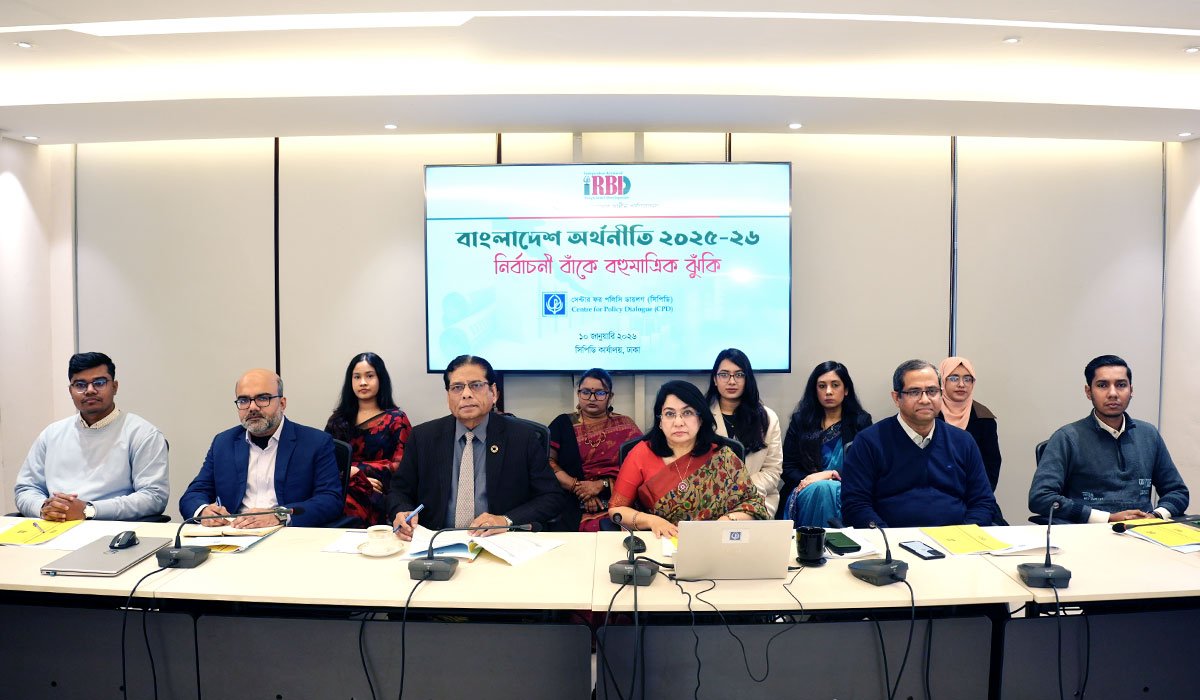
Presentation Policy Brief Report
As Bangladesh prepares for the 2026 national elections, IRBD team of the Centre for Policy Dialogue (CPD) is urging immediate economic reforms to ensure sustainable development and long-term stability. Addressing fiscal space crunch, inflation, food supply bottlenecks, banking issues, energy transitions, and external sector performance will be key to navigating the challenges ahead.
These discussions unfolded at a media briefing titled State of the Bangladesh Economy in FY2025-26: Multidimensional Risks at an Electoral Crossroads, held on 10 January 2026 at the CPD premises. Dr Fahmida Khatun, Executive Director of CPD, delivered the keynote presentation, highlighting several areas requiring urgent attention from policymakers.
In her keynote presentation, Dr Khatun emphasised that as the country moves closer to the elections, addressing fiscal issues should be a top priority. ‘As Bangladesh approaches the election year, addressing the fiscal space crunch and strengthening institutional frameworks must be top priorities. Without these changes, the country will face significant challenges in managing its budget, debt, and long-term economic growth,’ she said. The briefing also explored the importance of reforms in enhancing public finance management to ensure fiscal discipline and long-term stability.
The session also delved into the challenges posed by inflation, particularly food price volatility. Dr Khatun pointed out that while monetary tightening and fiscal restraint have been implemented, the real issue lies in supply-side constraints.
‘Inflation continues to be driven by supply-side issues, particularly in food prices. Climate-induced shocks and supply chain disruptions are significant factors,’ she stated, calling for stronger focus on boosting domestic agricultural production and improving market efficiency.
CPD noted that Bangladesh’s food security remains vulnerable due to stagnating crop yields and a rising reliance on imports. Dr Khatun stressed the need for improving agricultural practices by introducing climate-resilient crops and enhancing farmers’ access to credit and storage. “Increasing production must be a priority to ensure that Bangladesh does not remain dependent on imports to meet its food needs,’ she said.
The banking sector was another focal point. High levels of Non-Performing Loans (NPLs) and low capital adequacy ratios are undermining financial stability. “The banking sector’s stability is at risk due to weak governance and slow pace of reforms. Comprehensive changes are required to strengthen banks and ensure a more resilient financial system,’ Dr Khatun explained.
The IRBD team also raised concerns about the country’s sluggish investment scenario. With weak infrastructure and slow public investment, the private sector’s growth potential is under threat. ‘The government must ensure that public investment does not crowd out private sector participation. Prioritising foreign-funded projects is essential to ensure continued growth,’ Dr Khatun said.
Furthermore, the energy sector’s challenges were highlighted, with Bangladesh needing to shift towards renewable energy sources and improve energy efficiency. ‘The transition to renewable energy is not just an environmental necessity but an economic opportunity for Bangladesh. It’s crucial for the country’s industrialisation and environmental sustainability,’ she concluded.
Finally, the event also covered external sector performance, where IRBD team noted the importance of improving foreign exchange reserves and managing trade imbalances to ensure economic resilience.
An open-floor Q&A session with journalists from both print and electronic media followed the presentation.
Professor Mustafizur Rahman, Distinguished Fellow at CPD, commented on export growth, explaining that while exports saw a nearly 25 per cent increase in July 2025, this figure must be interpreted carefully. ‘The growth in July 2025 is compared to a very low base from July 2024, and the true picture emerges when we consider the more challenging conditions in December and the negative 14 per cent growth in December 2025,’ he explained. Regarding imports, he noted that while the value has increased by a modest 4 per cent, this growth is driven by volume rather than value, as international commodity prices have fallen. ‘The increase in import volume, particularly of key inputs like cotton, rice, wheat, and fuel, is not fully reflected in the 4 per cent growth figure,’ he said.
Mr Muntaseer Kamal, Research Fellow at CPD, addressed the foreign currency situation, noting that remittances are improving, but with reduced budget support and declining exports, the country faces a growing need for careful management of its foreign currency reserves. ‘We need to effectively utilise the foreign currency earmarked for foreign funded projects,’ he explained.
Mr Tamim Ahmed, Senior Research Associate at CPD, discussed the investment climate, stating that while Foreign Direct Investment (FDI) inflows have increased, the growth is largely driven by intra-company loans rather than equity investments. “The picture would be clearer if we used the Bangladesh Bank’s definition of FDI, as the current figures are skewed by corporate lending,” he said.
As the country approaches elections, the risks of inaction on these critical issues are significant. However, the recommendations presented offer opportunities for transformative reforms. Whether the next government will take decisive action remains to be seen, but it is clear that the nation stands at a crossroads, with both risks and opportunities in the coming years.