

Download: Presentation | Policy Brief | Report
While the newly elected government will need to work to overcome ongoing economic turbulence and restore macroeconomic stability, it must simultaneously continue with structural reform measures to lay a robust foundation for the economy and ensure its long-term sustainability. Bangladesh’s economy is currently navigating a complex macroeconomic environment marked by persistent inflation, weak revenue mobilisation, slow budget implementation, declining private investment, and pressures in the financial sector. Addressing these challenges will require both immediate policy responses and sustained reform efforts. The upcoming national budget will therefore need to strike a careful balance between short term stabilisation and medium to long term reforms aimed at improving productivity, strengthening institutions, and supporting inclusive economic growth.
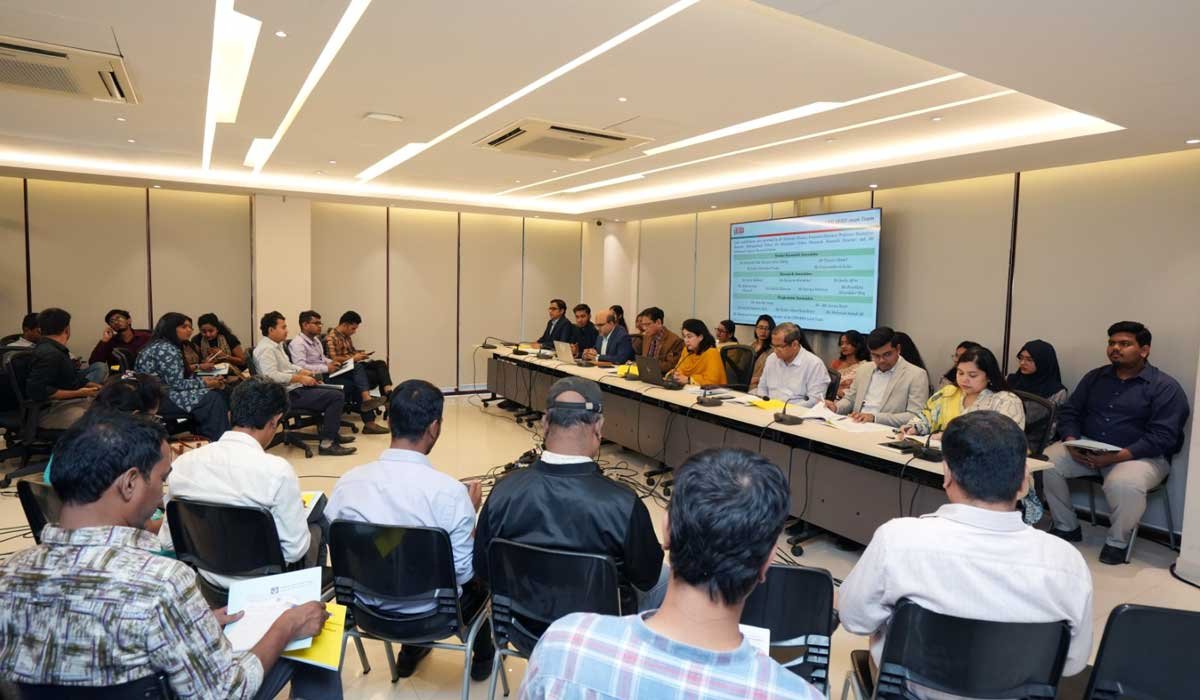
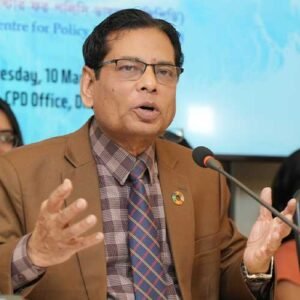
The above-mentioned observations emerged at a media briefing titled ‘Recommendations for the National Budget FY2026-27’, held on Tuesday, 10 March 2026, organised by the Centre for Policy Dialogue (CPD) under its flagship programme Independent Review of Bangladesh Development (IRBD). As part of its regular initiative to contribute to the preparation of the national budget, CPD prepares recommendations for the government each year. In line with this practice, CPD has prepared a set of recommendations for the upcoming National Budget FY2026-27, which was presented by Dr Fahmida Khatun, Executive Director of CPD, on behalf of the IRBD team.
Dr Fahmida Khatun highlighted that ‘the upcoming national budget will be particularly significant as it will be the first budget of the newly elected government and will need to address ongoing macroeconomic pressures while continuing reform measures to build a stronger and more resilient economic foundation.’
She noted that the economy continues to face multiple challenges including high inflation, weak revenue mobilisation, slow implementation of development projects, declining export growth, subdued investment, and structural weaknesses in the financial sector. At the same time, Bangladesh must prepare for major structural transitions including the country’s impending graduation from the Least Developed Country (LDC) category and evolving global trade arrangements.

Dr Khatun underscored that recent fiscal performance reflects notable implementation gaps. Revenue mobilisation growth remained modest at 12.9 per cent during July to January of FY2025–26, significantly lower than the 34.5 per cent annual target. Meeting the target would require revenue collection to increase by 59.4 per cent during February to June, which appears unlikely given current trends. Indeed, a revenue shortfall of around BDT 60,000 crore has already emerged. She also noted that the implementation rate of the Annual Development Programme (ADP) stood at only 20.3 per cent during July to January of FY2025–26, marking the lowest progress in the past fifteen years.
Referring to inflationary trends, Dr Khatun observed that price pressures continue to remain elevated. She pointed out that general inflation reached 9.13 per cent in February 2026, while food inflation stood at 9.30 per cent and non-food inflation at 9.01 per cent. Rural inflation also increased from 8.63 per cent in January to 9.21 per cent in February, indicating growing cost of living pressures outside urban areas. She emphasised that inflation in Bangladesh is currently largely supply driven and therefore requires policy responses that address both supply side and demand side factors.
CPD suggested that ‘addressing inflation will require a balanced fiscal strategy, alongside targeted support for vulnerable groups.’ In this regard, CPD recommended limiting excessive reliance on central bank borrowing and prioritising productive public investment while reducing non-essential public expenditure. Strengthening public procurement of essential commodities was also suggested as a way to stabilise food prices. In addition, CPD urged expanding targeted subsidies and social protection programmes to help low income households cope with rising living costs. Measures such as increasing minimum wages and encouraging salary adjustments in the private sector were also highlighted as important for protecting real incomes.
She further noted that strengthening Social Safety Net Programmes (SSNPs) will be crucial for improving the effectiveness of public support. CPD suggested reviewing existing programmes to better align them with the evolving needs of beneficiaries, developing a unified database for monitoring and evaluation, and improving coordination across ministries. Introducing clear exit strategies for beneficiaries was also urged in order to reduce overlaps and enhance programme efficiency.
Turning to the agriculture sector, Dr Khatun highlighted the importance of strengthening food security and stabilising agricultural production. CPD recommended expanding subsidised agricultural credit, promoting climate resilient crop varieties, investing in cold storage facilities, and encouraging solar powered irrigation systems. At the same time, she underscored the need to strengthen market regulation. CPD suggested empowering the Competition Commission to curb anti competitive practices, improve market monitoring, and prevent hoarding and excessive intermediation in supply chains.
Dr Khatun also pointed to the urgent need to improve the investment climate and generate employment opportunities. She noted that private investment declined to 22.03 per cent of GDP, the lowest level in a decade, while foreign direct investment remained below 0.5 per cent of GDP, significantly lower than in many comparable economies. To address these challenges, CPD recommended simplifying regulatory procedures and establishing an integrated digital one stop service platform for business registration, licensing, taxation, and regulatory compliance. Temporary tax incentives for firms adopting digital compliance systems were also suggested.
In addition, CPD underscored the importance of expanding fiscal support for Small and Medium Enterprises (SMEs). The think tank stressed the importance of introducing subsidised refinancing schemes, establishing sovereign backed credit guarantee programmes, and reserving 20 to 25 per cent of government procurement for SMEs and new enterprises in order to improve their access to markets and finance.
Energy security and the country’s transition towards cleaner energy were also highlighted during the presentation. CPD noted that Bangladesh remains highly dependent on imported fossil fuels, particularly LNG and crude oil sourced from Middle Eastern countries. In this context, Dr Khatun emphasised that ‘strengthening domestic energy security should be a key priority in the FY2026–27 budget.’
CPD recommended diversifying fuel import sources, accelerating domestic gas exploration, and prioritising investment in electricity transmission and distribution systems rather than expanding generation capacity. The IRBD team also proposed establishing a dedicated Renewable Energy Subsidy Fund and reducing import duties on renewable energy components. Currently, import duties reach 58.6 per cent for solar panels and lithium ion batteries and 89.32 per cent for lead acid batteries, which significantly increases the cost of adopting clean energy technologies.
CPD also underscored the need to strengthen climate financing. Climate relevant budget allocation declined slightly from 5.30 per cent of the total budget in FY2025–26 to 5.22 per cent in FY2025–26, while the allocation as a share of GDP fell from 0.75 per cent to 0.66 per cent. According to CPD, this level of allocation remains insufficient to meet the country’s growing climate adaptation and mitigation needs, particularly given Bangladesh’s target of generating 40 per cent of electricity from clean energy sources by 2041.
Dr Khatun further drew attention to emerging fiscal challenges arising from global developments including Bangladesh’s upcoming LDC graduation, the Bangladesh United States Agreement on Reciprocal Trade (ART), and geopolitical tensions in the Middle East. She noted that tariff liberalisation under the Bangladesh United States ART could potentially lead to a revenue loss of around USD 108.3 million, or BDT 1,327 crore, underscoring the importance of careful fiscal planning.
CPD also recommended reviewing the fiscal and policy implications of the Bangladesh–United States Agreement on Reciprocal Trade (ART). The think tank noted that tariff liberalisation under the agreement could potentially lead to a revenue loss of around BDT 1,327 crore if the current import structure remains unchanged. CPD suggested undertaking a careful assessment of the agreement and engaging in dialogue with the United States Trade Representative (USTR) where necessary to safeguard Bangladesh’s revenue and development interests.
Summing up the recommendations, CPD emphasised that the FY2026–27 national budget should prioritise realistic macroeconomic targets, stronger domestic resource mobilisation, improved social protection, enhanced investment climate, and greater resilience against both domestic and external economic shocks.
An open-floor Q&A session with journalists from both print and electronic media followed the discussion.
Responding to questions, Professor Mustafizur Rahman, Distinguished Fellow at CPD, argued that social spending should be viewed as an economic stimulus rather than merely a fiscal cost. ‘When vulnerable families receive BDT 2,500 monthly support, the money circulates within the domestic economy and eventually returns through tax revenues,’ he noted, stressing the need to reduce tax leakages through stronger digital monitoring.
Mr Tamim Ahmed, Senior Research Associate, observed that investment has declined to 22.9 per cent of GDP, reflecting structural weaknesses and weak private sector credit growth of about 6 per cent, partly due to government bank borrowing. At the same time, Ms Helen Mashiyat Preoty added that the current fuel situation reflects panic buying and market distortions rather than an actual shortage.