

Government should establish a dedicated renewable energy fund as Bangladesh’s renewable energy ambitions continue to outpace the fiscal architecture needed to deliver them. With renewable energy still treated as a marginal component within a fossil fuel-dominated power budget, the upcoming national budget offers an important opportunity to shift public spending towards cleaner, cheaper and more resilient energy.
A dedicated fund, backed by direct Annual Development Programme allocation, should be accompanied by a dedicated Ministry of Renewable Energy, stronger authority for SREDA, full-chain duty relief for solar and renewable energy equipment, grid modernisation, reformed tender design, faster rooftop solar deployment, a rolling three-year renewable energy budget, rationalisation of fossil fuel subsidies, decentralised renewable energy adoption, and legal recognition of Renewable Energy Service Companies.
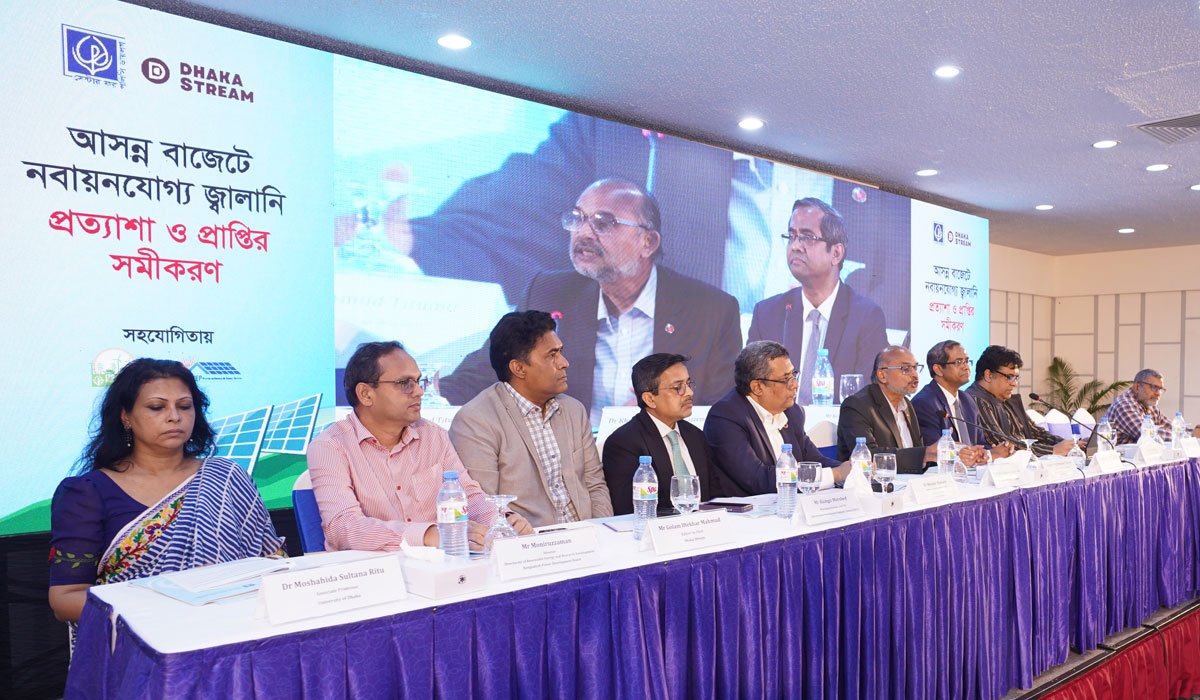
These recommendations emerged at the dialogue titled ‘Renewable Energy in the Upcoming Budget: Expectations and Reality’ organised by the Centre for Policy Dialogue (CPD), in partnership with The Dhaka Stream on Sunday, 17 May 2026. Dr Khondaker Golam Moazzem, Research Director, CPD, will moderate the session. Mr Md. Khalid Mahmud, Programme Associate, CPD, will deliver the keynote presentation.
‘The government wants to ensure energy security through domestic means, by increasing the share of renewable electricity and diversifying the overall energy portfolio. Bangladesh must move away from energy dependency and towards energy capability, with stronger domestic production, renewable energy expansion and clear benchmarks for energy security,’ said Dr Rashed Al Mahmud Titumir, Hon’ble Adviser to the Prime Minister, Ministry of Finance and Planning, Prime Minister’s Office and the Chief Guest of the dialogue.
Mr Rehan Asif Asad, Hon’ble Adviser to the Prime Minister, Ministry of Posts, Telecommunications and Information Technology, Prime Minister’s Office, said, ‘Renewable energy is essential, but Bangladesh must approach it through careful planning, policy clarity and system integration. We need to look at energy production, renewable energy, electric vehicles, lithium batteries and storage as part of one integrated system.’
‘Bangladesh cannot achieve its renewable energy targets with a budget structure that continues to privilege fossil fuel-based generation. The upcoming budget must create a dedicated fiscal pathway for renewable energy, backed by predictable allocation, stronger institutions and credible investment safeguards,’ said Dr Moazzem.
‘If Bangladesh is to move towards a fully renewable energy-based future by 2050, ambition alone will not be enough. We need realistic targets, genuine entrepreneurs and investors, good governance, and stronger capacity to implement and scale up the transition,’ said Mr Golam Iftekhar Mahmud, Editor-in-Chief, The Dhaka Stream.
Dr Monzur Hossain, Member, General Economics Division, Planning Division, Government of Bangladesh, said, ‘Renewable energy should not be treated as a standalone issue. It has to be integrated into the broader electricity system, budgetary planning and energy security framework, with planning, financing, procurement, grid readiness and policy incentives moving together.’
In his keynote presentation, Mr Md. Khalid Mahmud observed that renewable energy in Bangladesh remains ‘constrained under the overwhelming dominance of fossil fuel-based allocation within the national budget framework’. Although energy transition has become increasingly important, public expenditure, subsidies and development allocations in the power sector continue to be largely directed towards conventional fuel-based generation and related infrastructure.
Bangladesh’s total renewable energy installed capacity stood at around 1,745.25 MW as of 11 May 2026, of which solar accounted for 1,452.16 MW, or 83.2 per cent. However, renewable energy still represented only 5.39 per cent of the country’s total installed power capacity. Net metering rooftop solar reached around 262 MWp, with a compound annual growth rate of 59.77 per cent during 2019–2026.
Mr Moniruzzaman, Director, Directorate of Renewable Energy and Research Development, Bangladesh Power Development Board, said, ‘If Bangladesh wants to expand renewable energy quickly, rooftop solar offers the fastest route. With the right duty, tax and VAT support for private investment, around 3,000 MW of rooftop solar could be added within six to eight months without requiring the government to finance the full cost directly.’
Mr Mohammad Hatem, President, Bangladesh Knitwear Manufacturers and Exporters Association (BKMEA), said, ‘Policy intent alone is not enough if field-level implementation remains unclear. Solar and renewable energy equipment, including mounting structures and related components, must be clearly defined at the HS code and circular level so that investors do not face unnecessary complications during implementation.’
‘Renewable energy is not only environmentally necessary, it also makes economic sense. The amount spent on power sector subsidies in a single year could support around 10,000 MW of solar capacity, which would generate electricity and gradually reduce the subsidy burden on the government,’ said Mr Shahriar Ahmed Chowdhury, Director, Centre for Energy Research (CER), United International University (UIU).
Dr Moshahida Sultana, Associate Professor, University of Dhaka stated ‘Renewable energy will remain a slogan rather than a real transformation unless Bangladesh increases budgetary allocation, invests in research and development, strengthens transmission infrastructure, implements pending solar projects and breaks away from the fossil fuel-dependent policy structure’.
‘If Bangladesh wants to scale up renewable energy, financing cannot depend only on foreign funds or donor-supported models. We need to build a domestic financing structure, supported by concessional loans, technical assistance, risk-sharing mechanisms and stronger policy support,’ said Mr Alamgir Morshed, Executive Director and CEO, IDCOL.
Participants at the open floor said Bangladesh’s clean energy transition must support industrial competitiveness, especially for export-oriented sectors facing carbon reduction pressures. They stressed the need to reduce duties and taxes on solar panels, batteries, inverters and related equipment, improve access to long-term finance, and make renewable energy tenders more bankable through clear government guarantees and investor-friendly terms.