

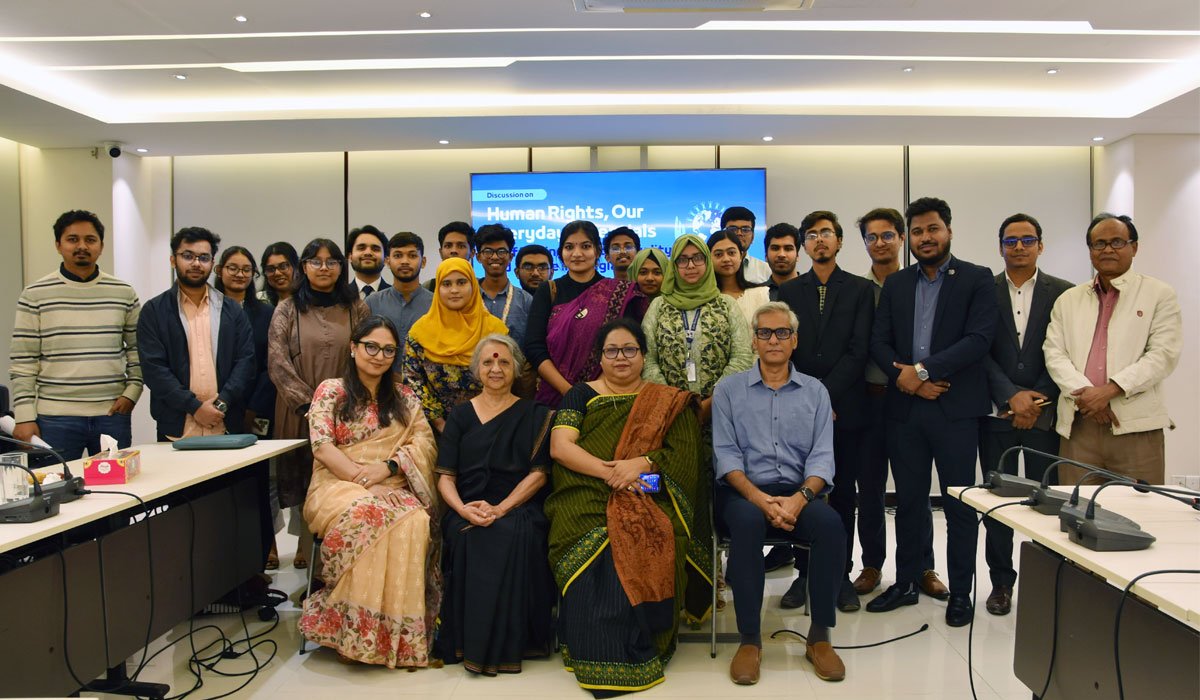
Human rights were reaffirmed as practical, everyday essentials at this year’s International Human Rights Day commemoration, with a clear call to uphold dignity, equality and justice amid growing uncertainty and exclusion. The discussion also reflected on the enduring relevance of the Universal Declaration of Human Rights in shaping laws, policies and the 2030 Agenda for Sustainable Development.
In this context, the discussion titled “Human Rights, Our Everyday Essentials: Reaffirming Dignity, Equality and Justice in Bangladesh” was held on 10 December 2025 at the CPD premises.
Ms Khushi Kabir, Member of the CPD Board of Trustees and Coordinator of Nijera Kori, chaired the session and set the tone by emphasising that human rights are not abstract ideals but lived realities that can be either protected or violated in daily life. As she noted, rights are routinely infringed, which is precisely why such days of commemoration and public reflection matter.
Barrister Sarwat Siraj Shukla, Senior Advocate, Supreme Court of Bangladesh, spoke on human rights and political inclusion, stressing that exclusion is often the point at which rights begin to erode: “Inclusion’s opposite is exclusion or marginalisatio. When the power structure disconnects its own citizens and pushes them to the margins, from that crisis many human-rights violations begin.”
Barrister Rashna Imam, Senior Advocate, Supreme Court of Bangladesh, addressed human rights and gender issues, emphasising that structural design and institutional culture frequently centre men and exclude women from decision-making. As she put it: “Everything has been designed with men in mind and the law is no exception.”She warned that discussion alone is insufficient without measurable change: “We need results, and unfortunately we have not seen any major results.”
The participants discussed the shared responsibility to uphold one another’s rights so that the exercise of individual rights does not result in the violation or diminishment of others’ dignity; the place of constitutional freedoms in public life, including discussion of freedom of thought and conscience and how rights may be treated as “qualified” or “unqualified” in practice; and the policy implications of national security considerations and Bangladesh’s wider international and geopolitical context. The discussion also reflected on institutional decision-making and political inclusion, including concerns about representation in formal policy spaces and the extent to which participation aligns with the country’s commitments to equality.
In addition, participants discussed parliamentary accountability and political practice, including the purpose of provisions designed to prevent “horse-trading”, floor-crossing and destabilising manoeuvres, alongside the need to protect space for conscience, judgement and reasoned disagreement. A further strand of the conversation focused on translating constitutional rights, the rule of law and standards of good governance into lived realities at the grassroots, with emphasis on rebuilding public confidence through credible examples of equal application of the law. Human rights and gender issues were addressed throughout, including women’s representation in leadership and decision-making, the difference between formal measures and meaningful empowerment, and the importance of ensuring that commitments to dignity, equality and justice are reflected not only in law and policy but also in institutional culture and everyday practice.
The discussion was also attended by young economists, academics, researchers, and students from renowned universities.