

Originally posted in The Daily Star on 16 October 2026
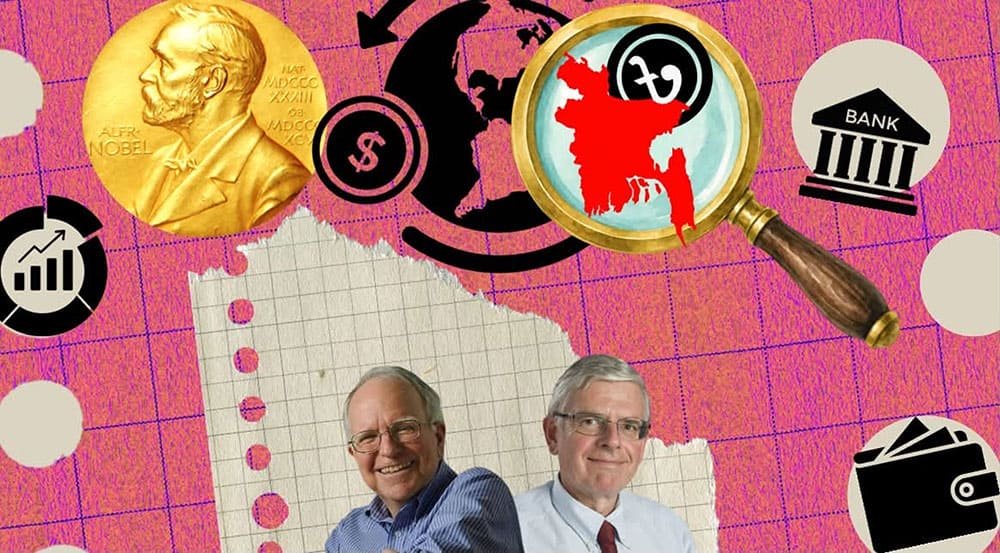
 Robert E. Hall and Michael Woodford won the 2026 Nobel Prize in Economic Sciences for their work on “the microeconomic foundations of macroeconomic stabilisation.” Their work helps explain how household and business decisions shape the wider economy, and how public policy can respond when growth, employment, and prices move in harmful directions. Robert E. Hall and Michael Woodford’s research transformed how economists understand these policies. They showed that a broad, top-down view of the economy alone is insufficient. Household and business decisions together shape the overall economy. Models based on this idea are called New Keynesian models.
Influential economist John Maynard Keynes argued that insufficient demand for goods and services can increase unemployment and weaken economic growth. When people and businesses spend too little, shops and factories sell fewer goods and services. They may then produce less and hire fewer workers, so unemployment can rise and the economy can slow down. Excessive demand, by contrast, can overheat the economy and push up inflation. Stabilisation policy therefore aims to boost demand when it is too weak and curb it when it becomes excessive.
Older economic models assumed the economy would respond in familiar ways. They expected prices to rise when employment and production were strong, and to fall when the economy weakened. But the oil crises of the 1970s broke this pattern. Oil prices surged, raising the cost of many goods even as businesses cut production and jobs. As a result, inflation and unemployment rose together. Policies built on old assumptions struggled to address this situation. Robert E. Hall showed how expectations influence household spending. He showed that household spending depends not only on current income but also on expectations about future income. If families feel hopeful about the future, they may spend more. Based on this idea, Hall argued that household spending should remain fairly stable unless people receive new information about the future. His theory implies that changes in household spending cannot be accurately predicted. Later research supported his idea.
Michael Woodford’s model shows how central banks can influence economic activity. In 2003, Woodford introduced a macroeconomic model of how the economy works, based on decisions by households and businesses. Policymakers can use it to explore questions such as: what might happen to production and inflation if interest rates fall? How much should rates rise to control inflation? The model incorporates Hall’s findings on household spending and shows how changes in interest rates can shape families’ saving and spending decisions. Woodford’s work explains how a central bank can influence economic activity by adjusting its policy interest rate or the amount of money in circulation.
Businesses cannot always adjust prices immediately when demand or costs change. Updating price lists, contracts, or informing customers takes time and money, so prices may stay fixed, a phenomenon economists call price stickiness. If customers buy less, a business may initially keep prices unchanged and instead reduce production or staff hours. Continued declines can reduce both output and employment. Businesses set prices by considering future costs and competitors’ prices. Their views about the central bank’s future policies can also affect inflation. This is why clear and credible communication from the central bank matters. Woodford used the idea of the output gap. If actual production is above the level the economy can sustain, demand may be too strong, and inflation may rise. If actual production is below that level, the economy may be weak and inflationary pressure may ease. One aim of stabilisation policy is to reduce this gap.
Supply shocks force policymakers to make difficult choices. A sudden increase in energy prices or a disruption to international supply chains can limit an economy’s productive capacity. Production may decline as inflation and unemployment rise at the same time. In these circumstances, focusing solely on boosting demand is not enough. Policymakers must also account for inflationary pressure. The most effective response depends on the cause of the shock and the state of the economy.
This research by Hall and Woodford provides policymakers with better tools to stabilise the economy. New Keynesian models, building on the work of Hall and Woodford, are now used by central banks and finance ministries in many countries. Policymakers can tailor the models to each country’s economic conditions, and further research is needed to improve them. The Nobel laureates’ research can help explain Bangladesh’s current economic challenges and inform how to respond. Their work helps policymakers understand how people respond to changes in income, prices and interest rates, and how firms adjust prices, production, and investment. This framework helps analyse Bangladesh’s current difficulties, but it is not a ready-made policy formula.
Bangladesh faces high inflation alongside weak growth and investment. Inflation rose to 8.34 percent in September 2026, up from 8.26 percent in August 2026. Subdued economic activity, supply and cost pressures, and slow growth in private-sector credit are key challenges. In August, private-sector credit grew by 4.75 percent. Businesses are delaying investment amid high financing costs, energy shortages, infrastructure bottlenecks, and uncertainty about demand. These points indicate that policymakers must take appropriate measures to reduce inflation without further weakening production, investment, and employment.
The Nobel laureates’ approach helps show how these pressures affect different parts of the economy. As prices rise, households may spend less, use their savings, or cut essential expenses. Low-income families with limited access to credit have less room to adapt. Businesses, meanwhile, consider interest rates alongside energy costs, access to imported inputs, infrastructure, demand, and policy uncertainty when deciding whether to invest, produce, or hire. Higher interest rates can curb borrowing and demand, but cannot, on their own, fix energy shortages, port delays, or other supply problems.
When inflation is driven mainly by demand outpacing the economy’s capacity to supply, tighter monetary policy can help curb spending. But when a supply shock pushes up costs while production and employment remain weak, raising rates further may reduce investment and jobs without addressing the source of inflation. A lower rate is not automatically the answer, either. If households and businesses expect prices to keep rising, inflation may persist. Bangladesh Bank must, therefore, continue to weigh both risks and explain how it will respond to new evidence.
The Nobel laureates’ framework also helps understand the need for consistency across public policy. Bangladesh Bank’s monetary tools and the government’s decisions on taxes, spending, and borrowing serve different purposes, but affect the same economy. When government borrowing boosts demand or competes with businesses for bank funds, it can weaken the effects of monetary restraint.
Bangladeshi policymakers can take three practical lessons from this. First, track inflation by its sources and the groups it affects, drawing on data about household spending, wages, business costs, import prices, and expectations. Second, set interest rates with inflation risks in mind, alongside growth, employment, and credit conditions. Third, strengthen supply and productivity with reliable energy, efficient ports, better transport, and fewer administrative barriers. Targeted support can help protect low-income families as these changes take effect.
The theory applies to Bangladesh because households and businesses everywhere make decisions that shape economic outcomes. However, the country’s high informality, limited household savings, reliance on imports, supply constraints, and banking-sector weaknesses call for locally grounded analysis. The key lesson is to use the Nobel laureates’ framework to understand how policies influence real decisions, while pairing credible monetary policy with sound fiscal choices and practical steps to address high costs and weak investment.
Dr Fahmida Khatun is an economist and distinguished fellow at the Centre for Policy Dialogue (CPD).
Views expressed in this article are the author’s own.