

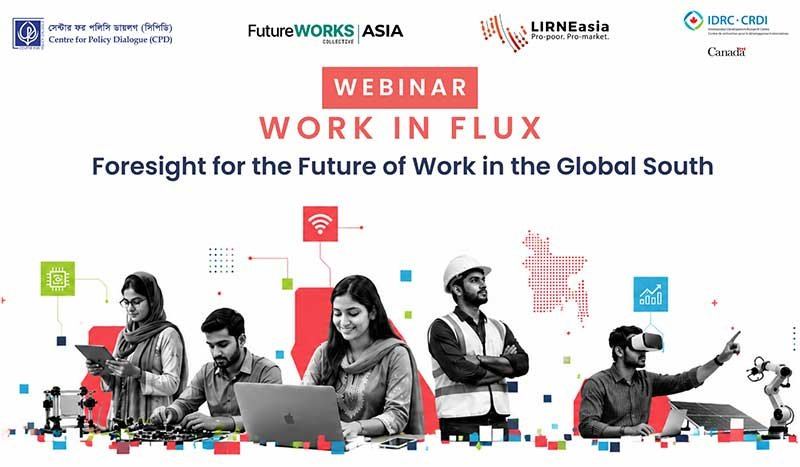
On 15 July 2026, the Centre for Policy Dialogue (CPD), Bangladesh, organised a Webinar titled Work in Flux: Foresight for the Future of Work in the Global South. The webinar was part of CPD’s foresight study titled ‘Life After Life: Future of Work in Bangladesh’. The webinar was arranged in collaboration with JustJobs Network, LIRNEasia, Southern Voice and Citizen’s Platform for SDGs, Bangladesh, under the FutureWORKS Asia initiative, supported by the International Development Research Centre (IDRC).
The study examines how jobs in Bangladesh may evolve by 2035 by analysing key forces such as automation, LDC graduation, demographic shifts, and digital and platform economies—to identify emerging drivers, map risks and opportunities for youth, women, and persons with disabilities, and inform policies for a decent, inclusive, and resilient labour market. The webinar was convened to disseminate the key findings and final policy recommendations from the study while facilitating knowledge exchange on the changing world of work. The event brought together leading researchers and policy experts around the globe, especially from South Asia and Latin America, to exchange perspectives on how governments, businesses and workers can prepare for multiple plausible futures.
Dr Debapriya Bhattacharya, Distinguished Fellow at CPD and Convenor of Citizen’s Platform for SDGs, Bangladesh, chaired the webinar. In his opening remarks, he highlighted that the impacts of technological change vary across countries depending on their context, timing, and pace of transformation.
Delivering the keynote presentation, Towfiqul Islam Khan, Additional Research Director at CPD, presented the study’s key findings. Rather than attempting to predict a single future, he explained, the research adopted a foresight approach to explore multiple plausible labour market scenarios for 2035 and identify policy priorities that remain relevant regardless of how the future unfolds.
The distinguished panel comprised Helani Galpaya, Chief Executive Officer, LIRNEasia; Sabina Dewan, President and Executive Director, JustJobs Network; Gunjan Bahadur Dallakoti, Head of Programme and SME Development Specialist at the International Labour Organization (ILO); and Ramiro Albrieu, Lead of the Sur Futuro Initiative and Principal Researcher at CIPPEC (Argentina).
Gunjan Bahadur Dallakoti emphasised that both the way skills are perceived and delivered, and the way expertise is developed, must evolve to meet the demands of a changing labour market.
Helani Galpaya noted that countries in the Global South may have a relatively longer window than those in the Global North before technological change significantly reshapes employment, providing an opportunity to prepare and adapt.
Sabina Dewan highlighted that survivalist employment is likely to increase as labour market precarity continues to rise.
Ramiro Albrieu underscored the dual nature of technological progress, cautioning that without appropriate policies, technological advancement could widen existing power imbalances and inequalities.
Drawing on experiences from South Asia and Latin America, the panelists reflected on how countries are responding to automation, digitalisation and changing workforce aspirations. The webinar concluded that preparing for the future of work requires more than technological readiness. It demands institutional agility, sustained investment in people, and long-term political commitment.