

Year in Review 2024
Some more initiatives of CPD
In 2024, a Social Insurance Forum was launched in January to support the NSIS action plan, followed by a second forum in November to set priorities for the Interim Government. Additionally, CPD proposed implementing Universal Basic Income (UBI) in Bangladesh to alleviate poverty, empower citizens, and enhance social protection, despite fiscal constraints.
The same year saw the release of Fifty Years of Bangladesh: Economy, Politics, Society and Culture, published by Routledge and co-edited by Professor Rounaq Jahan and Professor Rehman Sobhan of CPD.
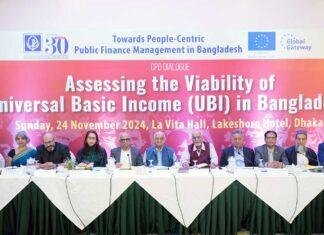
UBI can potentially be a promising tool to reduce poverty: CPD
The Centre for Policy Dialogue (CPD) has suggested implementing Universal Basic Income (UBI) in Bangladesh as an effective method to alleviate poverty, enhance citizen empowerment, and improve social protection systems, despite the existing fiscal limitations.
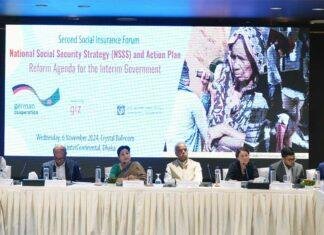
Second Social Insurance Forum Sets Priorities for the Interim Government
On 6 November 2024, the Centre for Policy Dialogue (CPD) and Deutsche Gesellschaft für Internationale Zusammenarbeit (GIZ) GmbH held the Second Social Insurance Forum (SIF) in Dhaka to advance the implementation of the National Social Insurance Scheme (NSIS) in Bangladesh.
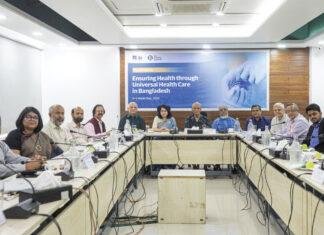
Bangladesh urgently requires equitable, accessible, and sustainable healthcare
The urgent need for Bangladesh to transition to a universal healthcare system that is equitable, accessible, and financially sustainable has become a pressing priority.
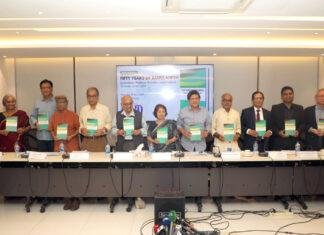
Launching of the book ‘Fifty Years of Bangladesh: Economy, Politics, Society and Culture’
The Centre for Policy Dialogue (CPD) organised a launching programme for the book titled “Fifty Years of Bangladesh: Economy, Politics, Society and Culture”, on...
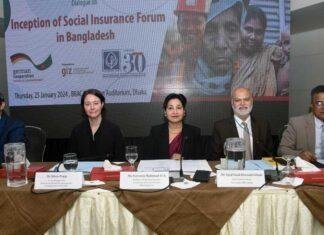
Implementation of social insurance scheme can be facilitated by the newly formed forum
Download Presentation
A forum has been established to facilitate the implementation of social insurance scheme in Bangladesh. Social Insurance (SI) is a government-backed initiative that...
Publications
Health Budget of Bangladesh – Optimising Resources for Improved Health Outcomes
Health spending has become a vital area of public investment regardless of a nation's economic standing. The United Nations' 2030 Sustainable Development Agenda recognises the paramount significance of healthcare.
Readymade Garments Industry in Bangladesh: An Analysis of the Value Chain
Bangladesh's readymade garments (RMG) industry is primarily labour-intensive, utilising simple technology compared to other high-tech industries. Fundamentally, the value chain components for Bangladesh’s RMG industry are straightforward.
Bicycle Industry in Bangladesh: An Analysis of the Value Chain
In Bangladesh, bicycle exports are the largest exports in the country’s light engineering sector. Notably, bicycle exports account for 7.5 per cent of all light engineering exports (Kathuria & Malouche, 2016). In the global value chain (GVC) of bicycle production, Bangladesh focuses on assembling a large number of parts, with the manufacturing process being less energy-intensive.
Leather Industry in Bangladesh: An Analysis of the Value Chain
The leather industry is an important contributor to Bangladesh’s export revenue. As such, this industry is vital in emerging as a promising sector, especially in export diversification and creating a more integrated industrial value chain.

50 Years of Bangladesh’s Independence: Legacies of Civil Society Organizations on...
This book is a tribute to the dedication of CSO leaders and members, aiming to inspire future generations to work toward a better Bangladesh.
Implementing National Social Insurance Scheme (NSIS) in Bangladesh: Role of the...
The Government of Bangladesh is advancing social security reforms in alignment with the National Social Security Strategy (NSSS) of 2015.
Social Safety Net Budget of Bangladesh – Catching Some, Missing Many
Social protection is expected to play a crucial role in development planning when aiming to promote inclusive growth in an economy with a significant number of people living in poverty, a large proportion of vulnerable individuals, and a high rate of informal employment.