

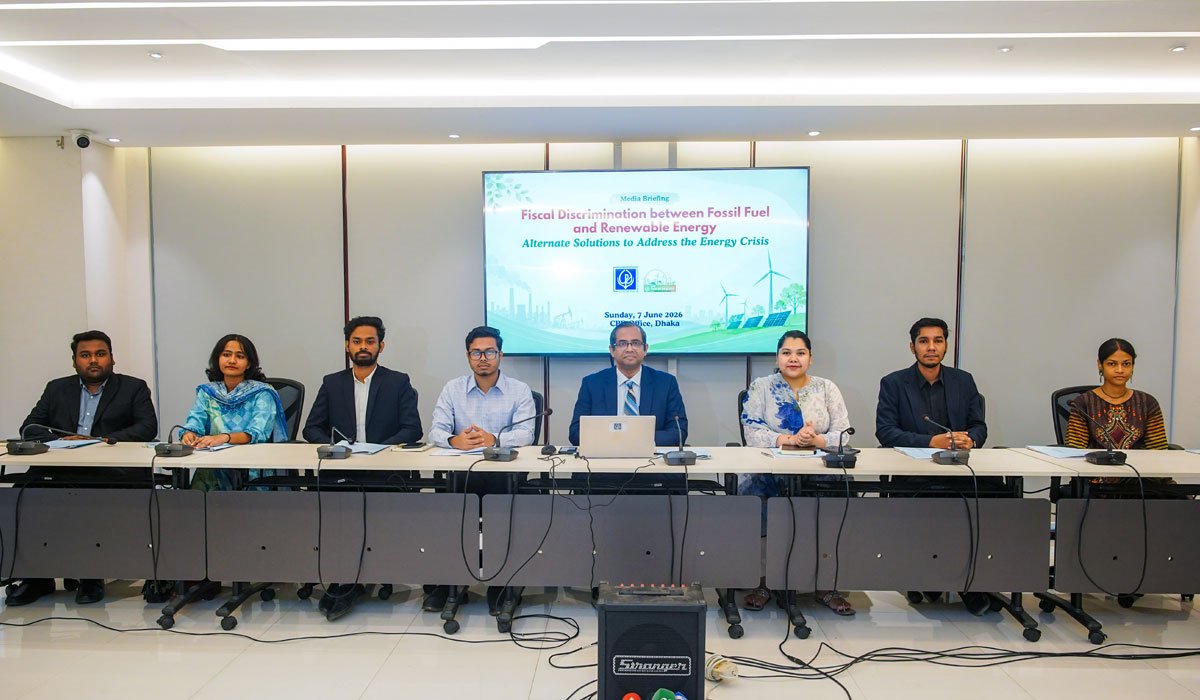
Bangladesh’s energy transition is being slowed not only by investment constraints, but also by discriminatory tax and budgetary structure that keeps fossil fuel-based power artificially competitive while raising the cost of renewable energy, storage, grid modernisation and electric mobility. To address this imbalance, the government should withdraw the discriminatory fiscal treatment between fossil fuel and renewable energy.
The observations were made at a media briefing titled “Fiscal Discrimination between Fossil Fuel and Renewable Energy: Alternate Solutions to Address the Energy Crisis”, held on Sunday, 7 June 2026. The keynote presentation was delivered by Dr Khondaker Golam Moazzem, Research Director, CPD.
The briefing was based on a study titled “Fiscal Discrimination between Fossil Fuel and Renewable Energy: Alternate Solutions to Address the Energy Crisis.” The study was conducted by Dr Khondaker Golam Moazzem; Ms Helen Mashiyat Preoty, Senior Research Associate, CPD; and Mr Atikuzzaman Shazeed, Research Associate, CPD.
Dr Moazzem stated that LNG imports enjoy the lowest tax burden among major energy imports, with a total tax incidence of only 9.5 per cent, largely due to zero VAT and only 2 per cent advance income tax. By contrast, critical technologies needed for the energy transition face much higher fiscal burdens.
According to the study, the National Board of Revenue is foregoing around BDT 1,059 crore to BDT 1,293 crore in revenue by favouring LNG-based businesses compared with solar and wind-equivalent tax treatment. LNG businesses also receive an estimated fiscal benefit of BDT 1,672 crore through the existing VAT exemption.
Dr Moazzem underscored that the bias is not limited to fuel imports. Batteries, grid infrastructure and electric vehicles — all essential for renewable energy integration — face tax incidences ranging from 61 per cent to over 93 per cent. Lithium-ion batteries face 61.8 per cent total tax incidence, while some storage batteries, grid components and EVs face more than 93 per cent.
He urged the government to remove the 7.5 per cent advance tax on solar and wind equipment, reduce customs duty on lithium-ion batteries from 25 per cent to 5 per cent, and eliminate the 20 per cent supplementary duty on energy storage batteries.
He also recommended reducing customs duty on grid infrastructure components, including transformers, conductors, towers and meters, from 25 per cent to 5 per cent, as high taxation raises the cost of grid expansion needed for renewable energy integration.
Dr Moazzem further emphasised the need to rationalise taxes on electric mobility. EVs currently face among the highest tax burdens in the energy sector, with total tax incidence between 61.8 per cent and 93.2 per cent. He recommended removing supplementary and regulatory duties on EVs and lowering customs duty from 25 per cent to 10 per cent in the upcoming budget.
The study also found that Bangladesh’s public spending pattern remains heavily tilted towards fossil fuel-based infrastructure. In the revised FY2026 allocation, fossil fuel-based projects received around 79 per cent of the power and energy allocation, while renewable energy projects received only about 5 per cent.
Dr Moazzem said targeted incentives for fossil fuels, including capacity payments, should be withdrawn, as they increase BPDB’s financial burden and slow the country’s energy transition. He recommended introducing green subsidies and grants for renewable energy, smart grids, electric vehicles and grid-strengthening projects in the national budget for FY2026-27.
During the Q&A session, journalists asked whether imposing VAT on LNG would be logical when the government itself is a major importer, and whether Bangladesh should invest heavily in renewables when other countries are also exploring carbon capture, green hydrogen and nuclear power.
In response, Dr Moazzem said the issue was not only who imports LNG, but how fiscal privileges artificially favour one technology over others, distort investment decisions and make renewable options less competitive. He added that renewables remain commercially attractive, while battery-related environmental risks should be addressed through better technology and recycling.
Journalists also raised questions on the bankability of renewable energy projects, capacity payments for fossil fuel-based plants and whether Bangladesh should diversify the sources of renewable energy equipment. Dr Moazzem and Ms Helen Mashiyat Preoty responded that financing depends on payment certainty, duty structure and payback period, and that investment costs can be recovered through per-unit tariffs without relying on capacity payments. They also said Bangladesh should keep import sources open and competitive, while the government’s role should be to remove tariff and duty barriers instead of favouring one technology or supplier over another.