

Originally posted in Agamir Somoy on 13 June 2026
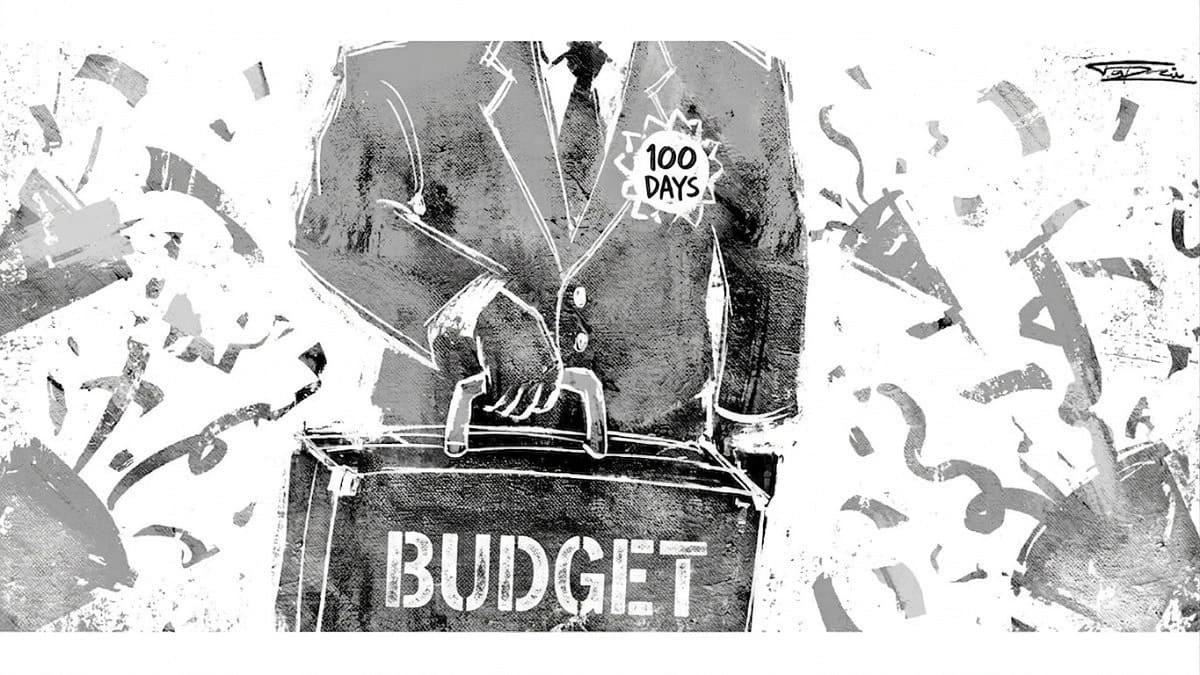
Soon after the BNP government that came to power through the 13th national parliamentary election completed its first 100 days, the 2026–27 budget was presented. After the interim government that came amid the July mass uprising, expectations of the newly elected government were high for many reasons. In this context, renowned economist and analyst Dr. Devapriyo Bhattacharya was interviewed by Agamir Somoy. The interviewer was taken by Saaid Jubary.
Agamir Somoy: After a major mass uprising and the interim government’s tenure, the newly elected government has presented its first budget. Do you see any major change in this government’s “budget philosophy”?
Dr. Debapriya Bhattacharya: I don’t see any abrupt major change in the traditional philosophy. Any new government’s first budget has to first assimilate the inherited economic situation, various constraints, and opportunities. At the same time, there is the pressure of confronting the current global economic and political crises. Besides that, the government faces several specific realities. A budget’s real philosophy is revealed through its allocations and implementation. Philosophically, they are speaking about building a humane society and a welfare state. We must see what concrete economic measures are included in the budget to achieve this humane society. The finance minister repeatedly uses the words liberalization and decontrol. We will need to see what kinds of decontrol they undertake, through which business costs will fall and production, investment, and productivity will increase. The finance minister says this is a budget for everyone. But merely showing conventional or nominal allocations does not make it “everyone’s budget.” The big question is whether those allocations can be preserved in the face of resource scarcity. They cannot step outside the current capitalist market economy or the globalized economic order. Within that framework, the question is what practical, welfare- or production-oriented measures they are taking—that is the government’s true budget philosophy.
Agamir Somoy: At the grassroots, there is a visible culture of “this time it’s our turn.” As a representative of civil society, do you think this is reviving the same-old trend of politicization that we saw earlier?
Dr. Debapriya Bhattacharya: In the past patterns in which the state, government, society, and economy operated, politicization or party-ization was a major tendency. That was linked with terror, force and coercion, and, above all, a lack of public safety or social vulnerability. I don’t think these problems have been fundamentally resolved in the current situation. As a result, a major crisis arises in implementing the budget from the state’s side. For example— the promise in the budget that we will “stand on the side of humanity” faces severe challenges at the grassroots. Because of these adverse conditions, how the aggregate economic management’s benefits will reflect at the local level has become a big question.
Agamir Somoy: The Prime Minister is not taking a duty-free car and is foregoing VIP protocol — such symbolic positive gestures are visible. But how effective can these personal initiatives really be in changing our overall political culture and the broader collective landscape?
Dr. Debapriya Bhattacharya: This should certainly be seen positively. But there is a major “but.” If the satisfaction and praise society feels for the Prime Minister’s behavior do not translate into real improvements in ordinary people’s livelihoods, food security, and safety of life and property, then I fear this positive atmosphere will quickly fade. This personal good conduct must be reflected within overall economic and political governance. If district commissioners or police superintendents continue to treat people in the same colonial manner as before, then the Prime Minister’s gesture will have no reflection. The big question is whether the Prime Minister can teach this ideal and behavior to his own followers (party activists) and to the state machinery’s officials. More than the Prime Minister’s personal behavior, the biggest measure of change is how the state as a whole treats its citizens.
Agamir Somoy: It has been announced that ministers and state ministers who fail to show tangible success will be removed from their posts after six months. How do you view this accountability measure?
Dr. Debapriya Bhattacharya: I view this very positively. It is not limited to rhetoric; we have seen a promising start. A few days ago, several ministers had to stand before the Prime Minister and members of parliament to explain their work in areas such as education and health. In response to MPs’ questions they admitted their shortcomings and pledged to rectify them. The question is whether this streak of accountability can be maintained in the coming days.
Agamir Somoy: Transparency International Bangladesh (TIB) has identified the current economic instability, high inflation, and weaknesses in the banking sector as major challenges for this government. Have the government’s first 100 days of economic measures pointed to a clear direction to overcome these crises?
Dr. Debapriya Bhattacharya: We know where we stand now, and the government is also saying where it wants to take us. But they are not clarifying the path from the current situation to the desired goal. The answer to “how to get there” lies in institutional reforms. For example: what changes will be made to revenue collection? How will the quality and efficiency of public spending be improved? What specific steps will be taken to raise standards in education and health? How will half-completed mega infrastructure projects be finished? Additionally, what reforms will be carried out in fuel, the banking sector, or port management? When the finance minister says the economy will take “two years to recover,” I accept that timeframe. But he is not telling me exactly how he will make it recover. Will it recover by gradual effort, by decisive measures, or by some other method—he must state a concrete strategy or formula. I have not yet seen that clear outline in the budget or the government’s 100-day measures.
Agamir Somoy: TIB calls the agreements with three countries to repatriate laundered money and the seizure of assets a positive step. How long might it actually take for the financial benefits of this process to become visible in Bangladesh’s economy?
Dr. Debapriya Bhattacharya: Bringing back money or assets laundered to other countries is by no means easy. Several major steps are involved. First assets must be specifically identified, then lengthy legal processes must be carried out, after which seized assets must be converted into cash and brought home. Now not only are the people absconding, but their laundered money is also on the run. And we don’t just need that laundered cash; we must also settle the issue of the (bank) accounts from where these looters took tens of thousands of crores in loans from banks and did not repay. This is an extremely complex administrative, international, and multilateral process. The crucial issue is political will. If within the current government, in parliament, or in society these looters again receive any form of political shelter, then the whole effort to recover laundered money will be futile.
Agamir Somoy: As you know, there is currently an instability surrounding Islami Bank. One political quarter is trying to take over the bank’s ownership. On the other hand, there is an attempt to repeat the old process of seizing the bank by appointing a Governor like in the previous era. What is your observation on this?
Dr. Debapriya Bhattacharya: Yes, this is actually a continuation of that old process, and now a political party is becoming directly involved with it—which is truly alarming. Any bank, regardless of its sector, must certainly operate within the policy framework determined by our central bank, ‘Bangladesh Bank’. If a crisis arises there, we need to see where the deviation or aberration from the policy framework is occurring. The government hasn’t taken any firm or specific structural steps yet. They appoint someone today, remove them tomorrow, say half-truths—a state of uncertainty persists. The Home Minister has given a lengthy explanation from his side in Parliament; but we haven’t heard any specific plan from the central bank’s Governor yet. Even from the Finance Minister’s side, no effective statement has come. A permanent and institutional solution to this is needed. It’s not just about ownership or a specific party; the hard-earned savings of millions of ordinary people are involved here. So, whether this bank will survive or not, or how it will operate—that must be determined by Bangladesh Bank’s neutral policy framework. This is not just a matter of winning political arguments through debates in Parliament. Other important reforms of Bangladesh’s financial structure are also linked to this.
Agamir Somoy: So, at the end of the day, what actually happened to banking sector reform? Or will we simply continue like this, carrying forward all the old mistakes without any reform?
Dr. Debapriya Bhattacharya: In the electoral manifesto or pledge that the ruling party gave, there was mention of forming a specific ‘Reform Commission’. Specifically, this Reform Commission for the banking sector was mentioned. So, why was that much-anticipated ‘Reform Committee’ not formed within these 100 days? An economy cannot be made acceptable to the people without a strong political narrative. In the past, a narrative was created—’Development, Development, and Development’. Similarly, this new government must now say—’Employment, Employment, and Employment’ or ‘Poverty Eradication’ or a ‘Humane Society’.
Agamir Somoy: Regarding the narrative you mentioned, we do get an indication of it within initiatives like the Family Card, Farmer Card, or unemployment allowance. Furthermore, the government says they won’t undertake mega-projects like before (although they have later taken on large projects like the Padma Barrage).
Dr. Debapriya Bhattacharya: When lakhs of young people enter the labor market every year in Bangladesh, are you going to keep them all idle by giving them Family Cards? Will you print money to provide unemployment allowance without increasing revenue collection? Printing money will cause inflation to skyrocket. These might provide temporary relief, but they won’t solve the core economic problems. You must reform the banking sector, reform the energy sector so that industries receive uninterrupted gas and electricity. The main focus must be there.
The government’s statement ‘We won’t do mega-projects’—this is a half-educated or immature statement. Those who are saying this don’t actually understand the meaning of ‘Mega’ or ‘Project’. If we implement the Family Card scheme on a massive scale across the country, that itself could become a mega-project! If a project like the Padma Barrage is necessary for the country, then it must definitely be undertaken. I would say that, within the government, a specific coordination of work has still not developed. I see a clear lack of coordination here, a lack of a far-sighted economic narrative, and above all, I still do not see the certainty (security) needed for the ‘livelihood’ of ordinary people on the ground and for the ‘investment’ of businesspeople.
Agamir Somoy: Incidents of murder, violence against women and children have increased in the country. Alongside this, ‘mob violence’ or public lynchings, as well as attacks on shrines and minorities, have also not been brought fully under control. To what extent will this ‘alarming’ picture of law and order hinder the overall business environment, investment, and economic activities of the country?
Dr. Debapriya Bhattacharya: Social security and economic security in any country are deeply intertwined. If you do not feel secure about your assets, if you do not feel secure about the workforce of your business or factory, then stability will never come to the economy; rather, social unrest will continue to increase. The government must give the highest priority to the security of women, children, religious and ethnic minorities, the hijra community, or people who have lost everything due to river erosion. If we cannot protect these vulnerable people, then the ‘roadmap’ for reform that I am talking about will never see the light; it will remain in darkness.
Agamir Somoy: During the peak of the July uprising, you said in a talk show— ‘The immediate chapter of our history is over, the post-chapter has arrived.’ Meaning Bangladesh is currently in a ‘transitional period’ between these two chapters. In the current context, do you think the immediate chapter has truly ended? Or will the complexity of this transitional period be prolonged further?
Dr. Debapriya Bhattacharya: This is an excellent question. To paraphrase the famous line of poet Rabindranath Tagore— ‘It ends, yet does not truly end.’ The old chapter has not completely ended. I had hoped that perhaps with this election, the ‘transitional period’ would come to an end. But it seems that many important issues in society and the economy remain unresolved. From the constitution to politics, society, and the economy—in the areas where we wanted to institutionalize lasting change and reform, those efforts are still incomplete. And until these institutional reforms are completed, this crisis-ridden transitional period will not end for us either. If we, as citizens, do not create pressure and force politicians to quickly bring an end to this period, the ultimate price will have to be paid by us in the end. However, another new global obstacle has emerged in navigating this transitional period—the current political-economic environment of the world or this region is not very favorable to us. This has increased the challenge further. The duration of this transitional period must be shortened.