

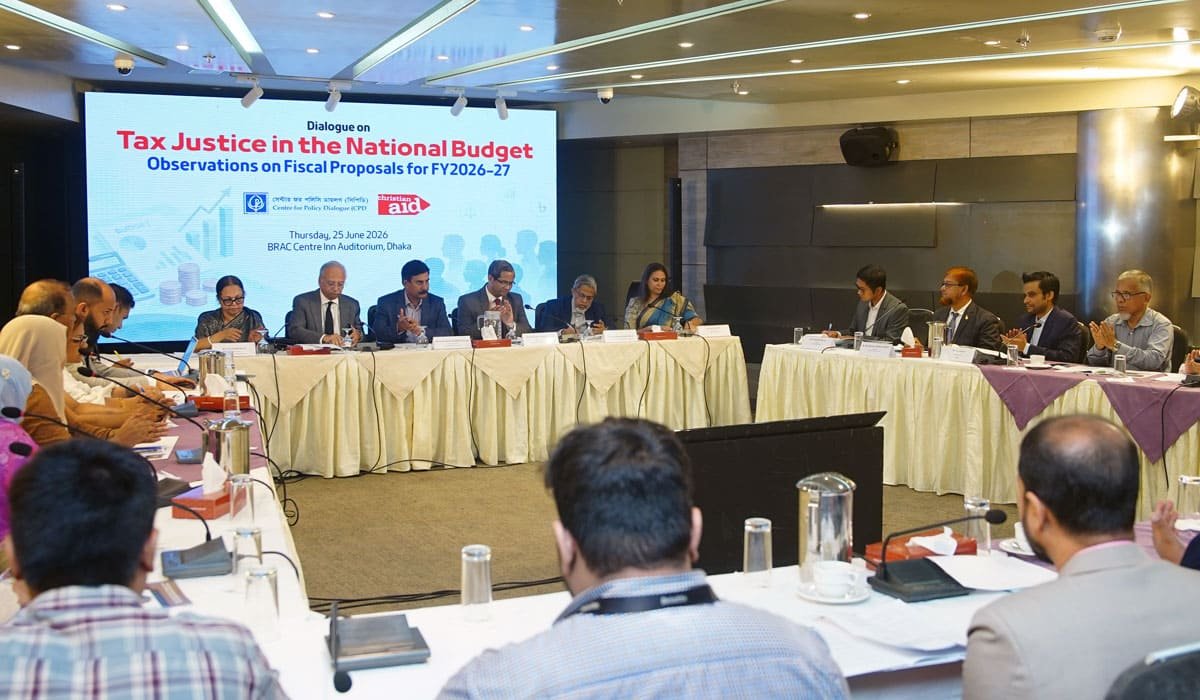
Budget discussions in Bangladesh have often centred on numbers—revenue targets, expenditure allocations, deficit financing and growth projections. Yet the quality of those fiscal choices matters just as much as their size. Who pays taxes, who receives public benefits, how exemptions are granted, and whether the burden falls fairly across income groups are now critical questions for public finance. In the context of the FY2026-27 national budget, these questions have brought tax justice to the centre of the fiscal reform debate.
The Centre for Policy Dialogue (CPD), in partnership with Christian Aid Bangladesh, organised a dialogue titled “Tax Justice in the National Budget: Observations on Fiscal Proposals for FY2026-27” on Thursday, 25 June 2026.
Speaking as the Special Guest, Barrister Mutasim Billah Faruqui, Member (Tax Policy), National Board of Revenue (NBR), said, “Tax justice and revenue collection are complementary. Without a fair tax system, adequate revenue collection is not possible; and without adequate revenue, social justice cannot be ensured.” He noted that the proposed revenue measures had sought to move gradually away from unfair tax practices and place greater emphasis on making the system business-friendly, investment-friendly and easier to comply with.
Delivering the welcome remarks, Dr Khondaker Golam Moazzem, Research Director, CPD, said that budget discussions in Bangladesh need to give greater attention to the qualitative dimensions of fiscal policy. He noted that while budget proposals are often assessed through revenue targets, expenditure figures and macroeconomic indicators, it is equally important to examine whether these measures are fair, inclusive and distributionally balanced. Fiscal proposals, he observed, may benefit one group while creating pressure for another; therefore, issues of inequality, inclusion and tax justice must be examined more carefully.
Ms Nuzhat Jabin, Country Director, Christian Aid Bangladesh, delivered the introductory remarks. Reflecting on Christian Aid’s collaboration with CPD, she said, “For the last four years, we have worked very dedicatedly with CPD on tax issues.” She noted that discussions on tax justice were once limited to a small group, but the issue is now gradually being reflected in policy thinking and policy documents.
Speaking as a Guest of Honour, Mr Kamran T. Rahman, President, Metropolitan Chamber of Commerce and Industry (MCCI), said, “Taxation is not only about collecting revenue or raising rates. It is about creating a fair, predictable and growth-oriented environment where enterprises can thrive and citizens can also prosper.” He stressed the need to broaden the tax base, simplify tax administration, ensure policy stability and build trust between taxpayers and the state.
Mr Mohammad Hatem, President, Bangladesh Knitwear Manufacturers and Exporters Association (BKMEA), thanked NBR for addressing some long-standing concerns in the budget, including issues related to advance income tax and solar systems. However, he cautioned that new complexities remain. He urged policymakers to make the system more business-friendly, particularly at a time when export-oriented industries are facing survival challenges.
Dr Muhammad Abdul Mazid, Former Secretary to the Government of Bangladesh and Former Chairman, NBR, said that budget dialogue should not stop once the Finance Bill is passed. “Keep it open,” he said, adding that the culture of discussing fiscal measures only until 30 June should change. He argued that tax justice requires continuous review, follow-up and institutional learning throughout the year. Referring to the broader principles of taxation, he said that revenue, redistribution, repricing and representation must be properly embedded in the tax system.
Mr Tamim Ahmed, Senior Research Associate, CPD, delivered the keynote presentation. The presentation assessed the FY2026-27 fiscal proposals through four pillars of tax justice: equitable financing of development, reduced regressivity, elimination of revenue leakage and accountable governance. He noted that the discussion should not be limited to raising revenue, but should also examine whether revenue is collected fairly and whether citizens are overburdened in the process. The presentation highlighted Bangladesh’s low tax-to-GDP ratio, continued reliance on indirect taxes, revenue leakage, under-realised VAT potential and the need for stronger tax administration.
Reflecting on the concerns of businesses and taxpayers, Mr Rizwan Rahman, Former President, Dhaka Chamber of Commerce & Industry (DCCI), said, “The middle-income group is our economic driver. If you do not allow them to graduate into large taxpayers, the economy will not see future growth.” He also called for greater accountability in public sector implementation and stronger support for small businesses, including better databases and cash-flow-based financing.
Mr Zia Ashraf, Co-Founder and COO, Chaldal, spoke from the perspective of start-ups and digital entrepreneurs. “From an entrepreneurial point of view, we want to express the feelings of entrepreneurs to policymakers so that they can bring changes to the system,” he said. He welcomed the proposed support for IT and start-ups but asked for greater clarity on how start-ups would be defined, when the nine-year tax benefit would begin, and how firms in the growth stage would be treated.
Mr Md. Mizanur Rahman (Dulal), President, Dhaka Taxes Bar Association, said, “The budget is good, but whether NBR has the manpower to fulfil it is doubtful.” He noted that if the buildings between Narayanganj and Gazipur alone could be properly surveyed and brought under the tax net, revenue mobilisation would improve significantly.
Ms Priti Chakraborty, Senior Vice President, Bangladesh Chamber of Industries (BCI), said, “We all want fairness in every sector, even if fairness for everyone is difficult; we can still fight for it.” Speaking from the perspective of the service sector, particularly health, she argued that tax measures should consider the real operating pressures of service providers. She added that increasing the tax burden on lower-income groups is inconsistent with social equity and the principle of fairness in the tax system.
Mr Snehasish Barua, FCA, ACA (ICAEW), Partner, Snehasish Mahmud & Co., reflected on predictability, affordability and compliance in the tax regime. “If we want a predictable tax regime, we must also have an affordable tax rate. A high tax rate is one of the biggest barriers to reducing tax evasion,” he said. He also called for inflation-adjusted tax thresholds and careful consideration of the effective tax burden on individuals and businesses.
During the open floor discussion, participants raised concerns on differentiated indirect tax rates, tax education, rural and informal taxpayers, accountability of registered companies, support for women entrepreneurs, digital business identification, SME taxation and the need for a clearer LDC graduation preparation roadmap. Speakers also called for a more practical and accessible tax system that encourages formalisation rather than discouraging new taxpayers through fear, complexity or uncertainty.
The dialogue concluded with a call for embedding tax justice in the national fiscal framework. Participants observed that revenue mobilisation is essential, but it must be pursued through fairness, transparency, accountability and a stronger social contract between taxpayers and the state. A tax system that is predictable, progressive and inclusive can strengthen public trust, support investment and ensure that public resources are directed towards equitable and sustainable development.