

Green financing should be expanded to accelerate rooftop solar adoption in Bangladesh’s RMG sector. The discussion highlighted that high financing costs remain a major barrier, particularly for small and medium factories, while CPD’s analysis showed that the investment-ready category disappears when commercial interest rates reach 10.5 per cent or above. Blended green finance, concessional lending and greater access to suitable financing instruments will therefore be critical for turning the sector’s substantial rooftop solar potential into actual investment, including Chinese investment.
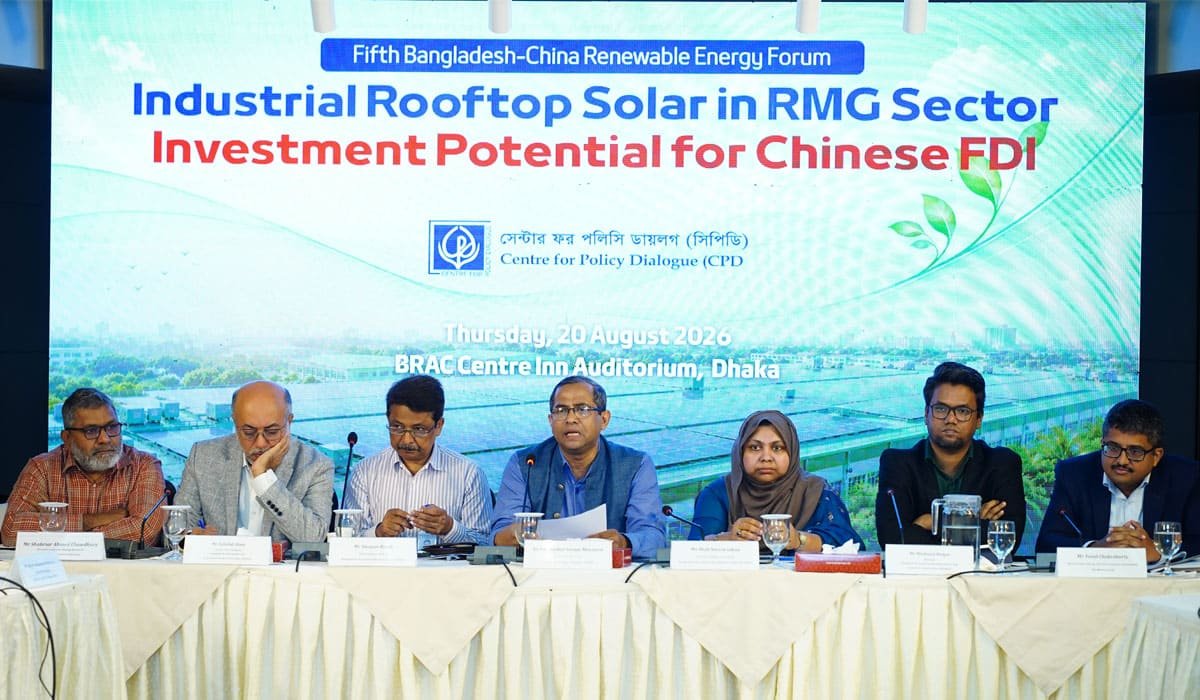
These issues came to the forefront at the Fifth Bangladesh-China Renewable Energy Forum on “Industrial Rooftop Solar in RMG Sector: Investment Potential for Chinese FDI”, organised by the Centre for Policy Dialogue (CPD) on 20 August 2026.
Opening the discussion, Dr Khondaker Golam Moazzem, Research Director, CPD, observed that Bangladesh’s present energy crisis could have been less severe if renewable energy adoption in the industrial sector had been expanded earlier. While rooftop solar installations have increased over the past few years, he stressed that considerably more could be done to reduce pressure on conventional energy sources and advance industrial decarbonisation.
A CPD study presented by Mr Abrar Ahammed Bhuiyan, Research Associate, CPD, with contributions from Dr Moazzem and Ms Noor Yana Jannat, Programme Associate, CPD, examined rooftop solar potential from an investment perspective. Using satellite-based rooftop mapping, factory-level information and a machine-learning model for estimating electricity demand, the study assessed 3,320 RMG factories and developed an investment-readiness framework for potential investors. These are new approaches in the Bangladesh context where rooftop area has traditionally been estimated through manual surveys or assumptions, and electricity demand has been estimated through blanket industry benchmarks rather than factory-specific machine-learning models.
The study estimated around 1,768 MWp of rooftop solar potential across 3,320 factories. It found that rooftop solar could meet a median of approximately 39.9 per cent of electricity demand in large factories, 33.1 per cent in medium factories and 38 per cent in small factories. Installing rooftop solar in 2,303 factories without existing solar systems would require an estimated USD 188.2 million.
Financing emerged as a decisive factor. Under the study’s assessment, 34 large, 100 medium and 375 small factories were classified as investment-ready, while another 1,359 factories could become investable with appropriate support under the model’s blended financing scenario. However, once commercial interest rates reach 10.5 per cent or above, the investment-ready category disappears altogether. The findings therefore underscored that access to concessional green financing is not simply an incentive—it can determine whether projects are bankable at all.
The experience of Ha-Meem Group demonstrated both the potential and the remaining constraints. Mr Tanul Chakraborty, Head of Power, Energy and Environmental Sustainability, Ha-Meem Group, said the group had already installed about 29.2 MWp of rooftop solar, covering around 15 per cent of its electricity demand. He noted, however, that the roof area of multi-storey RMG factories is often insufficient relative to their total energy requirements. He also highlighted the value of verified factory-level energy data and suggested that stronger data platforms could make investment assessments more accurate and useful to prospective investors.
Policy consistency will be equally important. Mr Shahriar Ahmed Chowdhury, Director, Centre for Energy Research, United International University, called for better alignment among renewable energy policies and clearer, measurable targets. He argued for a time-bound policy window in which barriers such as import duties could be reduced to accelerate renewable energy deployment. He also highlighted the potential of battery storage, merchant power arrangements and improved wheeling mechanisms to allow industries to source a greater share of their electricity from renewables.
Industry associations can play a direct role in bridging financing and information gaps. Mr Minhazul Hoque, Director, Bangladesh Knitwear Manufacturers and Exporters Association (BKMEA), said BKMEA’s Green Cell could work with CPD and individual member factories identified as needing intervention, including by engaging financial institutions where factories face difficulties accessing green finance. He also highlighted BKMEA’s ongoing work to develop a unified data platform containing information on factories’ energy, water and fuel consumption.
Chinese investment was identified as an important opportunity for scaling up deployment. Mr Zahidul Alam, Senior Vice President, Bangladesh Sustainable and Renewable Energy Association (BSREA), stressed that Chinese investment in Bangladesh’s rooftop solar segment remains limited despite China’s strong technological and investment capacity. He called for concrete renewable energy targets, reduced cost barriers and measures that would make rooftop solar more accessible to small and medium factories.
From the investment facilitation perspective, Ms Shah Nusrat Jahan, Director, Country Liaison, Bangladesh Investment Development Authority (BIDA), said renewable energy had been identified as a priority investment sector by BIDA. She noted that BIDA has both renewable-energy and China-focused desks and can bring relevant government agencies together to facilitate investors requiring multiple approvals. Data-driven studies such as CPD’s, she added, could support both investor communication and policymaking.
The discussion also highlighted the central role of electricity distribution agencies. Mr Swapan Banik, Chief Engineer (Planning and Operation), Bangladesh Rural Electrification Board (BREB), emphasised BREB’s commitment to expanding rooftop solar and net-metering while ensuring that grid protection and technical requirements are properly maintained.
The study recommended a blended green financing facility combining concessional finance with Chinese green capital, aggregation of smaller factories into investable portfolios, faster interconnection approvals, stronger support from industry associations, and expanded RESCO and BOOT financing models for small and medium factories. Awareness-building and visits to factories that have already successfully adopted rooftop solar could also help encourage new adopters.
Concluding the dialogue, Dr Moazzem proposed considering a dedicated facilitation window extending to 2036, under which administrative, technical, financial and legal issues related to renewable energy investment could be addressed more quickly and flexibly. Removing these relatively small but persistent barriers, he stressed, could create space for a much larger expansion of industrial renewable energy in Bangladesh.