

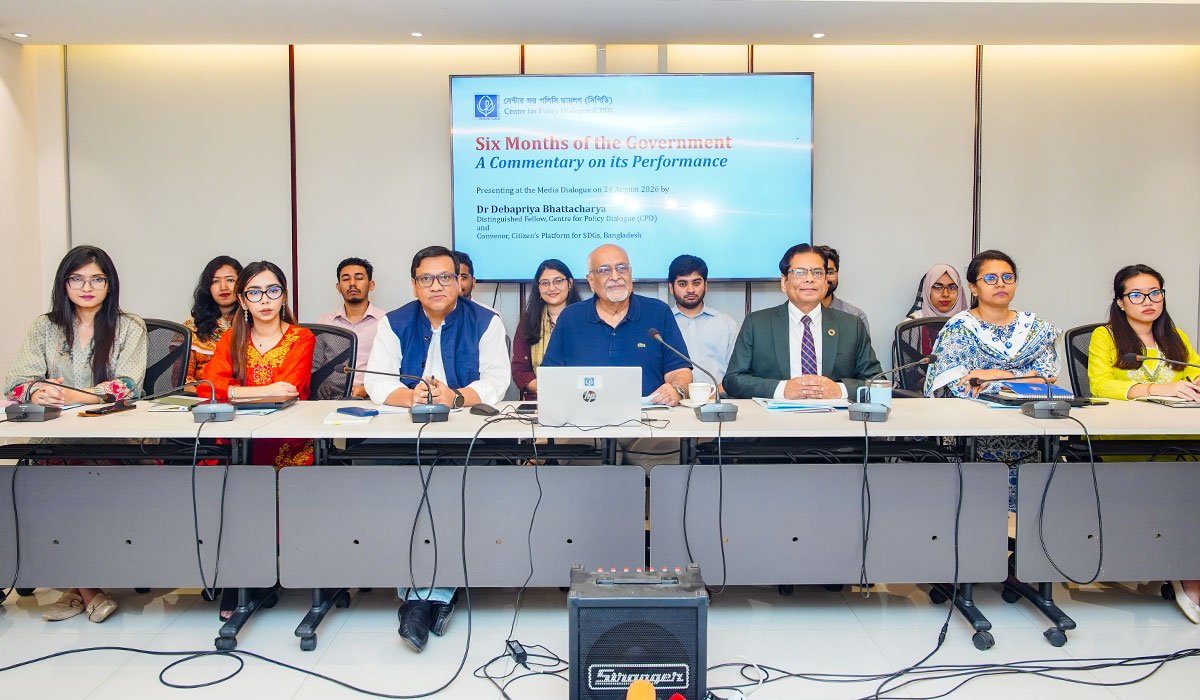
Bangladesh is moving towards a protracted economic recovery, as the stabilisation achieved so far remains fragile and several structural weaknesses continue to constrain investment, employment and economic growth. To navigate this prolonged recovery, the country needs a realistic fiscal framework, an integrated reform package and stronger coordination across economic policymaking institutions.
This observation emerged at the media dialogue “The New Government’s First Six Months: An Economic Review,” organised by the Centre for Policy Dialogue (CPD) on 24 August 2026. The keynote presentation was delivered by Dr Debapriya Bhattacharya, Distinguished Fellow, Centre for Policy Dialogue (CPD), and Convenor, Citizen’s Platform for SDGs, Bangladesh.
His presentation assessed the government’s first six months against two central expectations: achieving an economic turnaround through higher growth, investment and employment while containing inflation and the cost of living; and strengthening good governance through accountable and effective institutions.
Presenting the analysis, Dr Bhattacharya noted that the government had inherited an economy characterised by fragile banks, weak revenue mobilisation, fiscal constraints and subdued investment, while an adverse global environment had added further pressure. However, the absence of a clearly documented economic baseline and a coordinated reform programme made it more difficult to assess progress and establish accountability for the recovery process.
CPD reviewed 362 concrete government actions across nine areas, including governance, public financial management, industry and trade, banking, energy and transport, agriculture, education, health and social protection. Rather than assessing announcements or pledges, the exercise focused on measures that had actually translated into action.
The economic recovery scorecard presented a mixed picture, but with negative trends outweighing positive ones. Of the indicators assessed, 12 showed improvement while 19 deteriorated. Inflation provided some relief: headline inflation declined from 9.1 per cent in February to 8.3 per cent in July 2026, while food inflation fell from 9.3 per cent to 7.2 per cent.
Nevertheless, the prices of essential commodities remained high and real wage growth remained negative. Investment and industrial production indicators, meanwhile, continued to show significant weakness.
According to the analysis, recovery has been held back by the lack of a comprehensive and integrated reform package, a weakened fiscal framework, external shocks, inadequate navigation of political-economy constraints, continuing law-and-order concerns and limited improvement in institutional capacity. Dr Bhattacharya stressed that recovery should therefore no longer be viewed within a short, one-year horizon.
To manage this prolonged adjustment, CPD proposed preparing a core budget for October 2026–June 2027, based on credible and real-time data, and aligning fiscal targets and reform timelines. The presentation also called for an integrated reform package covering banking, revenue administration, energy security, public expenditure, ADP effectiveness, logistics and digitalisation. Greater coordination within the government and regular parliamentary scrutiny of major economic and institutional reforms were also emphasised.
During the question-and-answer session, journalists raised issues concerning the government’s overall economic performance, investment, employment generation, energy management, the proposed pay scale, institutional reform and whether the new government had demonstrated sufficient departure from previous approaches. Dr Debapriya Bhattacharya and Professor Mustafizur Rahman, Distinguished Fellow, CPD, responded to the questions and elaborated on the challenges ahead.
The discussion underscored that employment policy must focus not only on the number of jobs created but also on their quality, with industrialisation remaining an important driver of decent employment. On energy, the emphasis was on reducing excessive dependence on imported LNG, accelerating domestic exploration, expanding renewable energy and developing a coordinated strategy for meeting immediate and medium-term energy needs.
The panellists also stressed that difficult reforms require political courage, institutional capacity and effective coordination. Delaying necessary decisions would make existing challenges more complicated, while renewed politicisation of key institutions could undermine economic reforms themselves. Sustainable recovery, therefore, will require structural change in the way institutions function, coordinate and remain accountable—not merely changes in the individuals occupying public office.