

Originally posted in Times of Bangladesh on 1 September 2026
The government that came to power following the 12 February election has inherited an economy under pressure from several directions. It has assumed office at a time when the country is confronting a combination of long-accumulated structural weaknesses, unmet expectations, fiscal constraints and a deteriorating global environment.
The first challenge is the legacy it inherited. When the Awami League government fell in July 2024, Bangladesh’s inflation rate was around 12.5 percent. Private-sector investment stood at roughly 22 percent of GDP.
Foreign-exchange reserves had fallen from around $48 billion to approximately $24 billion, and were even lower by the International Monetary Fund’s calculations. The exchange rate had also deteriorated significantly: the US dollar, which had previously been worth around Tk86, had risen to about Tk110.
Taken together, these indicators reflected an economy that had become deeply stagnant and increasingly vulnerable. The second challenge arose from the interim government, which undertook several reform initiatives – many of them positive.
Yet those reforms were not sufficient to meet the immediate need to revive economic activity. The third was the new government’s election manifesto. It has made some commitments that people expect to see implemented quickly.
And the fourth is perhaps the most politically sensitive: ordinary citizens have experienced a deterioration in their standard of living and have faced persistent difficulties in their daily lives. Naturally, they have placed considerable expectations on the new government to deliver relief.
These domestic pressures have been compounded by a worsening global environment. Wars and instability in the Middle East have disrupted international markets and increased pressure on a range of imports and external costs.
It would be difficult to argue that the past six months have brought about any major transformation. Nevertheless, several positive measures have been taken, and some of them are reflected in the national budget.
In particular, the government has introduced many financial and fiscal measures aimed at strengthening export-oriented and import-substituting industries. The expansion of bonded warehouse facilities is a notable example.
Businesses that cannot obtain bonded warehouse facilities will also be able to import duty-free against bank guarantees under certain arrangements.
There have also been some structural changes in the composition of public expenditure. Allocations for education and health have been increased, reflecting the government’s electoral commitment to raise spending on these sectors towards 5 percent of GDP.
Progress has been made, although the target remains some distance away. Education spending has risen to around 2 percent of GDP, while health spending has reached approximately 1 percent, both higher than previously.
The real question, however, is whether the state has the institutional capacity to turn these budgetary commitments and incentives into higher investment, a better business environment and, ultimately, more employment. This is not simply a question of allocating more money.
It requires institutional reform, stronger initiative, greater accountability and a fundamental restructuring of the way public programmes are designed and implemented.
Consider the health sector. Previously, health expenditure was only around 0.3 percent of GDP, while the target had been approximately 0.7 percent. The new budget has raised it to around 1 percent. This means that institutions accustomed to spending 0.3 percent must now manage more than three times that amount.
One of Bangladesh’s most serious structural weaknesses is its inability to raise sufficient revenue. The revenue-to-GDP ratio is around 8 percent, while the tax-to-GDP ratio is below 7 percent. These are among the lowest levels in the developing world, and Bangladesh has no worse-performing country in South Asia in this respect.
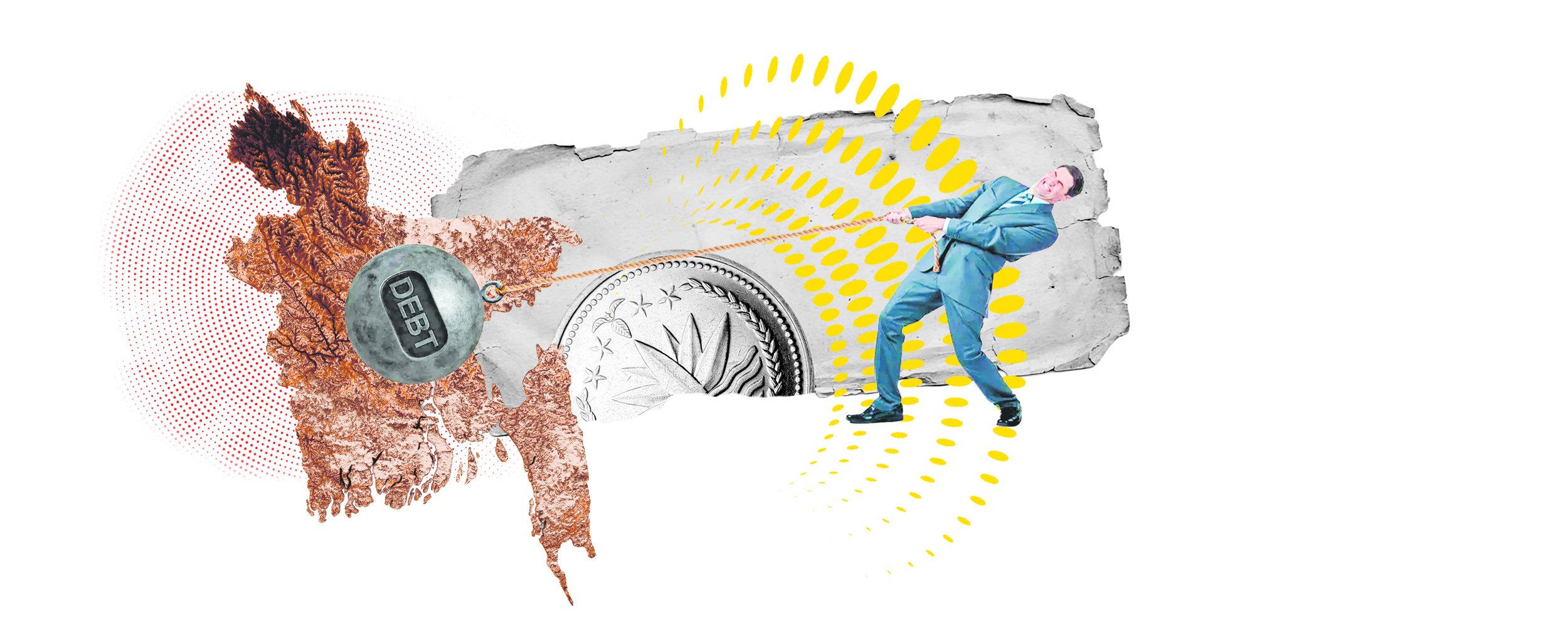
The consequences are profound. As government expenditure continues to grow while domestic revenue remains weak, the financing gap is increasingly being filled through borrowing. The Annual Development Programme, or ADP, has traditionally been heavily dependent on borrowing.
This year, there has been an attempt to show a slightly greater contribution from domestic financing. But if the figures are examined closely, much of the financing still ultimately depends on debt – whether domestic or external.
There are, in my view, two particularly important warning signs. First, there is a growing mismatch between the government’s ambitions and the institutional capacity available to deliver them.
Second, the spending requirements being generated by the economy cannot be met through domestic savings alone. The resulting dependence on debt is creating an increasingly serious fiscal risk.
Bangladesh graduated from low-income status to lower-middle-income status in 2015. But moving from one income category to another is not the same as achieving sustained economic transformation. Many countries have become trapped at the lower-middle-income level.
The Philippines is one example. Across Latin America, there are also numerous countries that managed to move from low-income to lower-middle-income status but struggled to progress further into the high-income category. For Bangladesh, the danger is therefore twofold: the middle-income trap and a debt trap.
A decade ago, annual external debt-servicing requirements were around $2 billion. This year, Bangladesh will have to pay roughly $4.5 billion in external debt service. By 2029–30, that figure could rise to more than $7 billion.
A substantial amount of the country’s hard-earned foreign exchange is therefore being diverted towards debt servicing. The fundamental reason is our failure to raise adequate revenue.
Another concern is the structure of taxation itself. Bangladesh remains heavily dependent on indirect taxes, which place a disproportionate burden on ordinary citizens. People pay taxes when they purchase everyday necessities. But not everyone has the same ability to bear that burden.
The fundamental principle of a fair budget should be simple: those who have more should contribute more, while public expenditure should prioritise the areas that benefit ordinary citizens most – education, healthcare, social protection and infrastructure. This is essential if we are to build a more equitable economy.
The question, then, is how Bangladesh can escape the debt trap. The answer must begin with two things: increasing revenue mobilisation and making public expenditure more efficient.
The interim government took a positive step by initiating reforms to the fiscal system, including efforts to separate policy formulation from implementation. The present government has also formed a committee to continue this work. But more needs to be done to reduce leakages.
There is an important distinction between the revenue recorded by the government and the amount actually paid by citizens. The two figures are not necessarily the same. The government may report a revenue-to-GDP ratio of around 8 percent, while the effective tax burden borne by citizens could be considerably higher.
Technology offers an important opportunity to address these problems. We have already seen the benefits of electronic submission systems, through which taxpayers can file VAT and income-tax returns. These systems should be expanded and implemented more effectively.
The objective should be to minimise unnecessary human interaction wherever possible. The more transactions and administrative processes can be handled digitally, the fewer opportunities there are for discretionary intervention, informal payments and corruption. At the same time, digital records can strengthen transparency and accountability.
Bangladesh has long faced the problem of capital flight through informal channels. During the period of the interim government, remittance inflows rose above $12 billion.
This demonstrated that when formal channels become more attractive and informal channels are constrained, money can be brought into the country through legitimate financial systems. We need to build on that experience.
The Bangladesh Financial Intelligence Unit needs greater investigative and forensic capacity. Within customs, institutions such as the Central Intelligence Cell and the Transfer Pricing Cell should be given the resources and authority necessary to identify and disrupt money-laundering channels.
The problem must be tackled from both the demand and supply sides. Ultimately, corruption creates both the supply of illicit funds and the demand for mechanisms through which those funds can be moved abroad. We therefore need to identify the networks that facilitate this process and dismantle them.
International cooperation is equally important. Countries and institutions around the world have developed sophisticated systems for tracking illicit financial flows. Bangladesh should work closely with them. Illicit funds are often routed through offshore financial centres and jurisdictions such as the Cayman Islands or the Isle of Man.
They can also end up in countries where foreign buyers have historically been able to purchase property or establish second homes. These jurisdictions and financial channels need to be subject to greater scrutiny. At the end of the day, we must remember one thing: this is Bangladesh’s money.
There are also cases in which illicit funds are held through offshore banking structures, including accounts associated with Swiss financial institutions. Bangladesh should learn from international best practice and pursue information-sharing mechanisms that can help identify the beneficial owners of offshore accounts.
India, for example, has sought information concerning citizens who hold accounts with Swiss banks. Such information can help authorities determine whether funds held abroad represent legitimate business transactions or undeclared and illicit wealth.
Bangladesh has not historically pursued such initiatives with sufficient determination. If we can obtain credible information about offshore assets and establish their origins, appropriate legal action can be taken. It would also help expose the networks and intermediaries that facilitate illicit financial flows.
Bangladeshi exporters and other businesspeople may maintain foreign bank accounts for perfectly lawful commercial purposes. Such accounts can be essential for international transactions. The mere existence of an overseas account does not, by itself, prove wrongdoing.
Unfortunately, some media reports have presented such matters without sufficient context, creating misconceptions. The distinction between legitimate international business and illicit capital flight must therefore be maintained.
There are, nevertheless, some encouraging signals from the present government, and credit should also be given to the opposition parties for supporting certain measures.
Consider the taxation of expensive vehicles. Bangladesh imposes duties of 150 to 200 percent on certain high-value cars. The underlying principle is straightforward: those who can afford an extremely expensive lifestyle should also be able to make a proportionately greater contribution to the public exchequer.
A progressive fiscal system should reflect the ability to pay. Similarly, measures requiring people travelling abroad for particular purposes to undergo relevant training or meet specific requirements can help distinguish legitimate travel from activities associated with illicit wealth.
Such policies must, of course, be designed carefully so that they do not unnecessarily restrict lawful citizens or legitimate business.
The government has taken several encouraging steps, but isolated policy measures will not be enough. The country needs stronger institutions, better revenue mobilisation, more disciplined public expenditure and far greater accountability.
Above all, we must move decisively against money laundering and the networks that facilitate capital flight. If illicit financial flows continue unchecked, the pressure on an already fragile economy will only intensify. The challenge is immense, but the direction is clear.
Bangladesh cannot borrow its way indefinitely out of a revenue crisis. Nor can it achieve sustainable economic growth without stronger institutions, greater domestic savings and a fairer tax system.
The country must therefore close the leakages, strengthen accountability, modernise revenue administration, improve the quality of public investment and, above all, follow the money. Because the money being lost abroad is not someone else’s. It belongs to Bangladesh.
The author is of an Honorary Fellow of Centre for Policy Dialogue (CPD).