

Originally posted in New Age on 22 September 2026
 RIDE-HAILING and delivery apps have transformed urban mobility in Bangladesh, but the systems protecting the platform workers have not kept pace. App-based motorcycles and cars carry passengers across Dhaka and other metropolitan areas, while delivery riders transport food, groceries and parcels through heavy traffic from morning until late at night. This relatively new mode of employment gained significant traction over the last decade. Once viewed largely as a temporary or supplementary source of income, platform work has become a long-term livelihood for many platform workers. Some unverified industry estimates place the number of platform workers in ride-hailing and delivery at around 600,000, within a broader gig economy that may encompass millions. Indeed, platform work has clearly emerged as a significant source of livelihood in urban Bangladesh.
The economic consequences of an interruption in work for many of these workers can be immediate. For example, when an accident prevents platform workers from completing trips, their platform earnings generally cease, while medical expenses and the resulting income shortfall are borne by them and their households. The underlying challenge is partly structural. Platform workers do not fit neatly within the conventional employer-employee relationship on which most labour protections in Bangladesh are based. They are generally treated as self-employed or independent contractors, although platforms may exercise considerable control over how assignments are allocated, priced and monitored. The employment status of platform workers has consequently become a subject of growing debate across countries. Bangladesh’s evolving social protection framework should address the needs of platform workers without waiting for this debate to be resolved.
Protection exists, but it is fragmented
PLATFORM workers in Bangladesh are not entirely without protection. Some ride-hailing and delivery companies arrange accident coverage through private insurers. However, the terms vary across platforms, and protection may apply only during an active trip or order. Risks arising while platform workers wait for assignments, travel to pick-up points or return after completing work may therefore remain outside the policy. Publicly available information on premiums, exclusions, claims and payouts is also limited.
Existing protection is narrow as well as uneven. Accident policies do not ordinarily replace earnings during general illness, build retirement savings or protect the vehicles on which many platform workers depend for their livelihoods. Because coverage is attached to a platform rather than to the platform worker, those using several apps may be covered differently over the course of the same working day. Leaving a platform, or being deactivated from it, may also result in the loss of associated insurance coverage.
A new global standard
THE international context has also changed. On June 12, 2026, the International Labour Conference adopted the Decent Work in the Platform Economy Convention, 2026 (No 193), together with a supplementary recommendation. It is the first international labour standard devoted specifically to work organised through digital labour platforms.
The Convention defines a digital platform worker as a person employed or engaged to work through a digital labour platform for remuneration, irrespective of classification in employment. This formulation is particularly relevant for Bangladesh: extending appropriate safeguards to platform workers need not depend on classifying every person earning through an app as an employee under existing industry legislation. The Convention addresses occupational safety and health, social security, remuneration, algorithmic management, data protection, suspension and deactivation, and access to remedies, among other issues.
One may argue that ratification and domestic implementation will require careful national consideration. Nonetheless, the adoption of Convention No 193 confirms that platform work is no longer a completely regulatory grey area that governments can leave indefinitely undefined. Bangladesh should now assess its laws and institutions against this emerging global benchmark.
Lessons from Asia’s early movers
REGIONAL experience demonstrates that these gaps can be addressed without first resolving every question of employment classification. India formally recognises gig and platform workers without automatically treating them as regular employees. Its framework combines self-registration through the e-Shram portal and a portable national account number with aggregator contributions of 1 to 2 per cent of annual turnover, subject to a cap linked to payments made to platform workers. Singapore similarly retains the self-employed status of platform workers while integrating them into established institutions: mandatory Central Provident Fund contributions are being phased in through 2029, while work injury protection covers medical expenses, income loss during medical leave, permanent incapacity and death.
Malaysia has adopted a narrower approach. Its Gig Workers Act establishes a distinct legal category and links platform workers to the existing self-employment social security scheme. A 1.25 per cent deduction from earnings finances employment injury protection, including occupational and travel-related accidents, but not general illness or routine healthcare. The Act also establishes a specialised tribunal for disputes concerning payment, account deactivation and contractual terms. Although these examples reflect different institutional choices, each moves beyond optional, platform-specific insurance towards a defined statutory framework.
Bangladesh’s central challenge, therefore, is not the complete absence of protection. It is the absence of a common minimum standard that is portable across platforms, transparent to platform workers and integrated into a broader social insurance architecture.
Why smart regulation benefits business too
A WORKABLE national framework can therefore serve the interests of both platforms and platform workers. Common rules can prevent responsible businesses from being undercut by competitors that provide little or no protection, while portability can reduce duplication when platform workers use several apps. Well-designed regulation is not inherently anti-business. If proportionate and predictable, it can promote fair competition, strengthen trust and reduce the costs associated with regulatory uncertainty.
A workable national framework can therefore benefit both platforms and the people who earn through them. Common rules prevent responsible businesses from being undercut by competitors that provide little or no protection. Portability also reduces duplication when individuals use several apps. Good regulation is not inherently anti-business; if designed proportionately, it can support fair competition, improve trust and reduce the costs of regulatory uncertainty.
The foundations may already be in place
BANGLADESH has relevant domestic experience on which to build. Under the newly enacted Bangladesh Labour Act. While the rules associated with the Act have not been finalised, under this legal framework, certain sectors or companies contribute 5 per cent of net profits to worker welfare funds. At present, export sectors contribute to a Central Fund, while other welfare functions are administered through the Labour Welfare Foundation. These mechanisms are imperfect, but they establish an important principle: protection can be financed through contributions linked to economic activity rather than through general taxation alone.
More directly, Bangladesh has piloted employment injury protection with support from the International Labour Organisation since 2022 for approximately four million garment workers, with part of the financing provided by international buyers. An actuarial assessment for the national scheme estimates long-term benefit costs at 0.042 per cent of insurable wages when commuting accidents are included and 0.014 per cent when they are excluded. On a monthly wage of Tk 17,000, this amounts to approximately Tk 86 and Tk 29 per worker each year, respectively. Although platform work involves different risks and earnings patterns, these estimates suggest that basic injury protection need not be prohibitively expensive.
The existing framework also permits flexibility in contribution design. Contributions need not be calculated solely as a proportion of payroll; they may instead be linked to platform revenue, transaction value, completed orders or a standard amount per registered platform worker. Digital records of transactions and work activity could support registration, contribution collection and verification. The technology that complicates the regulation of platform work may thus also facilitate the administration of contributory social protection.
A policy window is opening
TIMING matters because Bangladesh’s labour and social protection systems are already changing. The newly enacted Bangladesh Labour Act recognises platform workers in law for the first time, although the recognition currently concerns the right to organise rather than comprehensive social insurance. The Act also establishes a national employment injury fund, which the government has committed to making operational nationwide by July 2027. The implementing rules are now being drafted.
The new social security strategy envisages a national workers’ database linked to national identification and identifies platform workers for gradual inclusion. Proposals have also been made to bring ride-share platform workers within the contributory pension scheme for informal workers, while employment injury protection is expected to expand beyond its initial sectors.
These are not isolated policy initiatives. Bangladesh is simultaneously recognising platform work, developing a national employment injury system and building registration infrastructure. Incorporating platform workers during this design phase would be institutionally more coherent and cost-effective than establishing a separate mechanism at a later stage.
Choosing the right financing model
THESE developments point to a choice Bangladesh has not yet made explicit: how protection should be financed. Legal recognition alone cannot provide medical benefits, replace lost earnings or finance long-term entitlements. A durable scheme requires a defined contribution base, a collection mechanism, rules on eligibility and benefits, and an institution accountable for administration.
The appropriate starting point is contributory social insurance rather than reliance on social assistance alone. Social assistance is financed through general revenue and allocated according to assessed need. Social insurance pools specified risks and links entitlement to participation, with financing shared among the relevant parties. For platform workers, contributions could be shared by platforms and platform workers, with targeted public support where considerations of affordability or equity warrant it.
A fully tax-financed arrangement might appear administratively simpler, but it would be difficult to sustain. Given Bangladesh’s limited fiscal space, the government is unlikely to be able to finance a comprehensive social protection system for platform workers through public revenue alone. Such an arrangement would also weaken the connection between platform-generated economic activity and responsibility for the risks associated with it. Conversely, placing the full cost on platform workers, many of whom have low or volatile earnings, would discourage participation and limit coverage. The contribution formula should therefore balance benefit adequacy, affordability, administrative feasibility and equitable burden-sharing.
What should happen now
A PHASED policy programme would be more credible than an attempt to close every protection gap simultaneously. The immediate objective should be to establish the institutional foundations of a portable system for platform workers and progressively expand its scope as administrative capacity and evidence improve.
First, the government should undertake a legal and actuarial assessment of including platform workers within the national employment injury framework while the implementing rules remain under preparation. The assessment should define covered contingencies, including the treatment of commuting and waiting time; specify minimum benefits; estimate costs under alternative contribution bases; and clarify the relationship between platform-specific private insurance and the statutory scheme.
Second, registration and entitlement should attach to the platform worker rather than to a single platform. A unique account linked to the planned national database could consolidate contributions and activity across multiple apps while ensuring appropriate protection of personal data. Portability would reduce discontinuities arising from platform switching, concurrent work through several apps or temporary inactivity.
Third, the financing arrangement should be explicit, progressive and subject to periodic review. A modest initial contribution could be shared between platforms and platform workers and calculated against transactions, gross earnings or another verifiable base. Targeted public co-financing may be justified for low-earning platform workers or during the transition. Any phased increase should be announced in advance and informed by actuarial evidence, compliance data and an assessment of its effects on earnings, prices and platform participation.
Fourth, the governance framework should clearly allocate responsibilities among the labour administration, the social insurance authority, platforms and any intermediaries. Standardised reporting, accessible claims procedures, time-bound decisions, grievance and appeal mechanisms, and regular publication of coverage and payout data would be essential. Representatives of platform workers and platform businesses should participate meaningfully in the design and periodic review of the scheme.
Fifth, the evidence base must be strengthened. The forthcoming labour force survey should incorporate a statistically credible classification of location-based and online platform work, distinguish primary from supplementary earnings, and collect information on working time, income variability, occupational risks and multi-platform activity. Administrative data should complement rather than replace survey evidence. A stronger evidence base would enable contribution rates and benefit parameters to be revised in light of observed risks rather than industry estimates.
Employment injury protection provides a practical first layer because the relevant risks are immediate and some platforms already offer partial coverage. Once registration, contribution collection and claims administration are functioning effectively, the system could be extended progressively to sickness, life insurance and pensions. Such sequencing would preserve policy ambition while containing implementation risks.
An opportunity Bangladesh should not miss
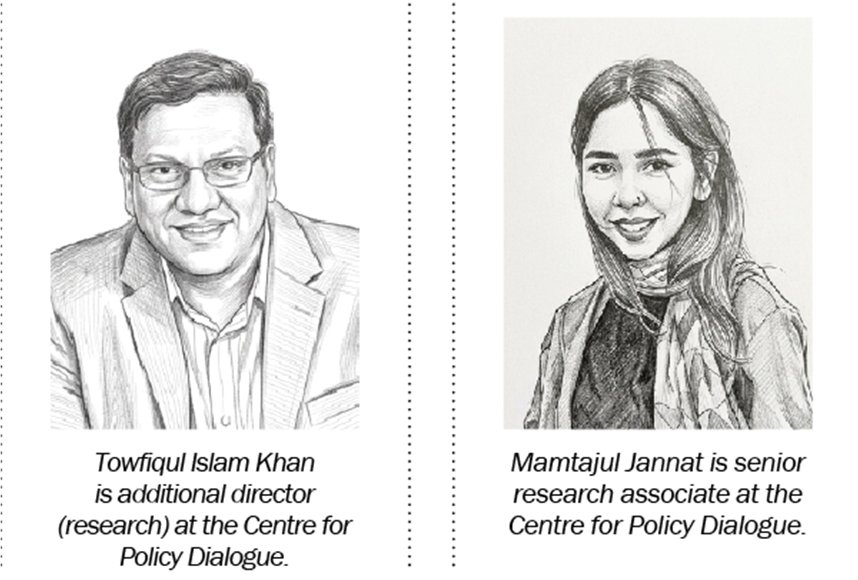
BANGLADESH requires a deliberate policy process that treats social protection for platform workers as an institutional design challenge rather than merely a statement of intent. The financing model must be feasible and sustainable, supported by a clear legal mandate, capable administration, appropriate technology and effective oversight. The design must also be workable for both principal constituencies in the platform economy. Platforms are businesses competing across markets, while many platform workers operate on narrow and volatile margins. Neither group should bear disproportionate costs under a system intended to pool shared risks. At the Centre for Policy Dialogue, we are currently working to develop a framework that seeks to balance these considerations.
The envisaged framework should also be designed for expansion from the outset. Ride-hailing and delivery are only the most visible forms of platform work; a system designed exclusively around them would require early and costly revision as online and other forms of platform work expand.
Platform workers are already active on the roads, in warehouses and behind screens across a rapidly expanding platform economy. For the first time, the institutions required to protect them are beginning to take shape. Bangladesh should use this policy window to establish a portable, contributory and progressively expandable system that provides meaningful protection to platform workers without predetermining every question of employment status.