

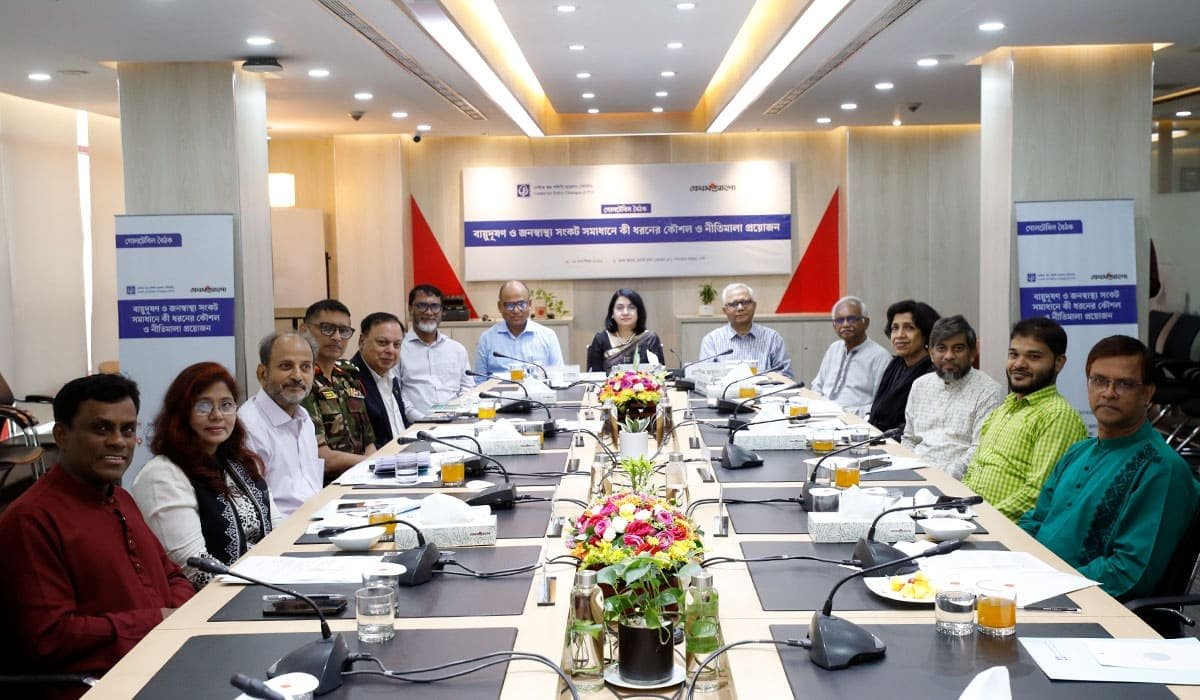
Air pollution in Bangladesh can no longer be treated solely as an environmental issue; it has become a major public health, economic and development challenge requiring coordinated action across government institutions, local authorities, the health system, industries and citizens. Experts emphasised this at a CPD–Prothom Alo Roundtable titled “What kind of strategies and policies are needed to address air pollution and the public health crisis?”, held on 29 September 2026.
Bangladesh continues to experience persistently high levels of fine particulate pollution. The country’s annual PM2.5 exposure averaged 78 µg/m³ in 2024, while the population-weighted urban annual average stood at 79.4 µg/m³ during 2018–2023, approximately 16 times the World Health Organization’s 2021 guideline level of 5 µg/m³. Air pollution also imposes a substantial health and economic burden. Ambient air pollution was estimated to have contributed to 78,145–88,229 deaths in 2019, while the associated economic cost was equivalent to approximately 3.9–4.4 per cent of GDP.
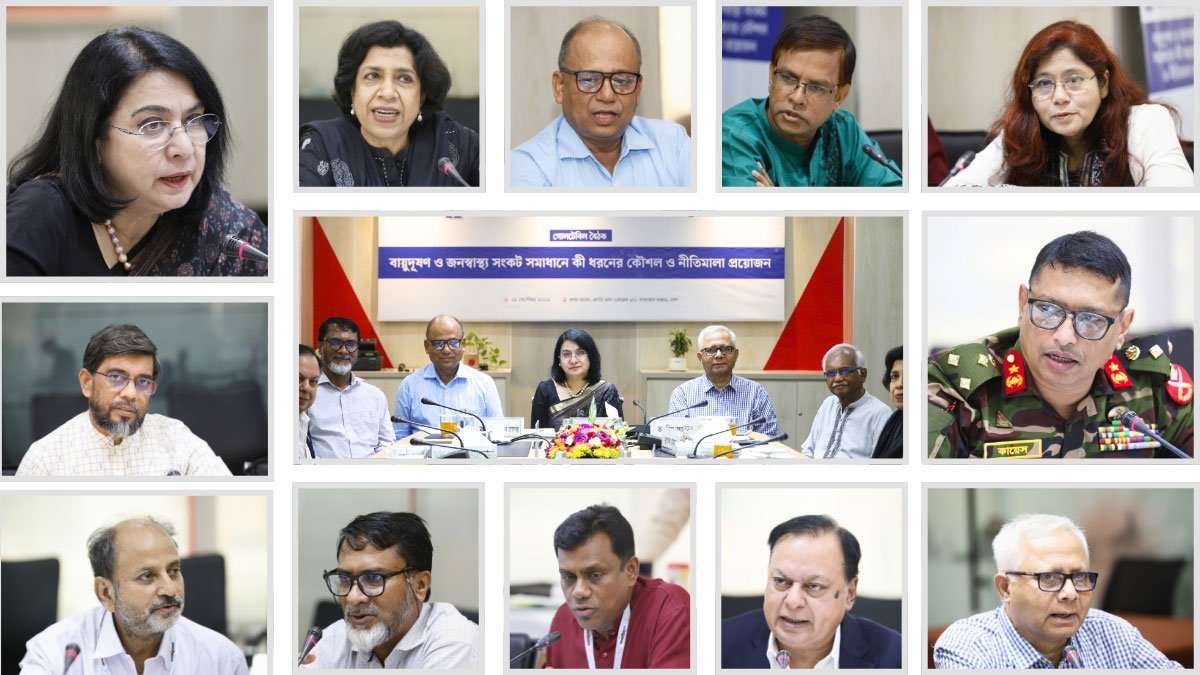
In her opening remarks, Dr Fahmida Khatun, Distinguished Fellow, Centre for Policy Dialogue (CPD), said air pollution needs to be addressed through an integrated framework encompassing the environment, public health, economic costs and productivity.
She observed that although the major sources of air pollution are generally known, the challenge is to address each source systematically. Construction activities, road dust, ageing and poorly maintained vehicles, waste burning, brick kilns and other emission sources require targeted interventions.
Dr Khatun also highlighted the transboundary nature of air pollution, noting that pollutants are not confined by national borders. Bangladesh therefore needs regional cooperation alongside stronger domestic action against pollution sources within its own control.
She stressed that the economic consequences of pollution extend beyond medical treatment costs. Recurrent illnesses lead to lost working hours and working days, reduced income and lower productivity. She also emphasised the importance of enforcing existing environmental laws and regulations more effectively.
Mohammed Solaiman Haider, Additional Director General, Department of Environment, said Bangladesh already has a substantial regulatory framework to address air pollution, including the Air Pollution Control Rules, 2022. However, enforcement, maintenance and institutional coordination continue to pose significant challenges.
He identified cement factories, power generation, diesel generators, steel re-rolling mills, brick kilns and construction activities among the major sources of pollution. Brick kilns, for example, generate pollution not only through fuel combustion but also through the loading, unloading and transportation of materials, which create large quantities of dust.
Mr Haider stressed that Bangladesh’s development ambitions will require substantial construction and industrial activity, but environmental impacts need to be considered before projects begin rather than after pollution has already occurred. He also highlighted poor coordination among public agencies, noting that roads are sometimes excavated repeatedly by different authorities, generating unnecessary dust and disruption.
He further drew attention to open burning at educational and other public institutions. Fallen leaves and plastic waste are sometimes burnt together even though safer alternatives are available. According to him, Bangladesh has laws, regulations and standards, but effective implementation also requires institutions and individuals to accept responsibility.
Dr Tahmeed Ahmed, Executive Director, icddr,b, focused particularly on the disproportionate effects of air pollution on children. He explained that children breathe more frequently than adults, are physically closer to ground-level pollutants and have organs that are still developing. These factors make them particularly vulnerable to exposure.
He highlighted the relationship between air pollution and childhood pneumonia and discussed its potential implications for neurodevelopment, maternal and newborn health, and emerging metabolic health concerns. He also drew attention to household air pollution, particularly where wood and other biomass fuels are used for cooking in poorly ventilated spaces.
Dr Ahmed noted that exposure to indoor smoke can affect women as well as children, with implications for outcomes such as preterm birth and low birth weight. He also emphasised that air pollution can weaken respiratory defences and increase children’s susceptibility to infections such as pneumonia.
He proposed that television channels, newspapers and online media provide simple daily air-quality information, enabling people to understand the level of risk and take precautions, including wearing masks during periods of severe pollution.
Dr Ahmed also highlighted methane emissions from waste, human waste management and the environmental pressures associated with population density. He called for greater public responsibility and stronger enforcement of basic environmental practices.
Prof. Dr Fazilatunnesa Malik, Professor and Chief Consultant (Cardiology), National Heart Foundation Hospital & Research Institute, explained that the danger posed by PM2.5 is particularly difficult for the public to appreciate because these particles are invisible to the naked eye.
She noted that PM2.5 particles can penetrate deep into the lungs and reach the bloodstream, where they can affect blood vessels throughout the body. Such exposure can contribute to processes associated with heart attacks, strokes and heart failure.
Prof. Malik also drew attention to cardiovascular disease occurring at comparatively young ages in Bangladesh. A heart attack during a person’s most productive years may lead not only to premature death but also to significant loss of working capacity, with consequences for families, the economy and society.
She argued that improving air quality is an enormous undertaking requiring collective determination. Government commitment must be accompanied by public awareness and behavioural change.
Prof. Dr Iqbal Hasan Mahmood, Chest Diseases Specialist, Labaid Hospital, said chest physicians directly confront the consequences of air pollution through patients suffering from chronic obstructive pulmonary disease (COPD), respiratory illnesses and other lung conditions.
He highlighted the effects of both outdoor and indoor pollution. Women who spend long periods cooking with wood-burning stoves, for example, may experience prolonged smoke exposure even if they have never smoked.
He also discussed the harmful consequences of active and passive smoking and called for stronger enforcement of restrictions on smoking in public places. Brick kilns, vehicle emissions and construction dust remain major concerns, he added, while simple measures such as covering construction materials and sprinkling water are often inadequately implemented.
Given current levels of urban pollution, he also recommended the use of appropriate masks when travelling through heavily polluted areas.
Brigadier General Imrul Kayes Chowdhury, Chief Health Officer, Dhaka North City Corporation (DNCC), discussed the municipal dimensions of air pollution, including waste management, open burning, mosquito-control activities and public communication.
He explained that the Amin Bazar landfill, established in 2007, was not developed as a fully modern landfill. Approximately 4,000 tonnes of waste are transported there each day. The accumulation of large volumes of waste can generate methane, while internal fires may continue to smoulder for prolonged periods and are difficult to extinguish because fire-service vehicles cannot always reach the affected areas.
He clarified that open burning is not an institutional practice of DNCC, although burning by individuals and at some government institutions remains common, particularly during the dry season.
Brigadier General Chowdhury also discussed mosquito-control fogging and said DNCC has substantially reduced its use. He noted that the public often associates mosquito control with visible smoke, while less visible interventions such as source reduction and larviciding receive less recognition.
He further highlighted the importance of communicating Air Quality Index (AQI) information and appropriate health advice so that vulnerable groups can take precautions when pollution levels become dangerous.
Ms Siddika Sultana, Executive Director, Environment and Social Development Organization (ESDO), called for indoor and outdoor air pollution to be addressed within the same broader policy framework.
She highlighted open waste burning, household cooking emissions, plastics, hazardous chemicals, heavy metals and pesticides as issues requiring greater attention. Air-quality monitoring, including regular measurement of PM2.5 and PM10, should also be expanded in industrial and densely populated areas.
Ms Sultana stressed that burning plastic and hazardous waste can release toxic pollutants and that many members of the public remain unaware of these risks. She called for stronger media engagement to ensure that scientific information on toxic pollution reaches the wider population rather than remaining confined to technical reports.
She also urged caution regarding waste-to-energy initiatives unless Bangladesh first develops adequate waste segregation, management and environmental safeguards.
Mr Gawher Nayeem Wahra, Founder Member Secretary, Foundation for Disaster Forum, cautioned that environmental interventions can themselves create unintended consequences if they are not carefully designed.
Using the concept of the “cobra effect”, he argued that development interventions need to consider not only their immediate objectives but also their longer-term consequences. He referred to tree planting, biomass burning, construction materials and renewable-energy batteries as examples where the full life cycle of an intervention needs to be considered.
He also placed particular emphasis on local government, arguing that pollution is experienced at community and neighbourhood levels. Strong, capable and accountable local government institutions could therefore play a central role in addressing pollution.
Dr Syed Abdul Hamid, Professor, Institute of Health Economics, University of Dhaka, argued that air pollution has not been sufficiently incorporated into public health planning partly because health itself is not consistently treated as a central consideration in development policymaking.
He suggested that Bangladesh could consider stronger institutional arrangements dedicated to public health, given the number of ministries, agencies and stakeholders involved in issues such as air and water pollution.
Dr Hamid also called for a more intensive seasonal approach to pollution control, particularly during the months when air pollution becomes most severe. Environmental authorities, local government institutions, local administration and educational institutions could coordinate stronger preventive measures during these periods.
He argued that health should be treated as a fundamental priority at the individual, family, social and national levels. He also emphasised the importance of beginning environmental and health education from preschool level, so that environmentally responsible behaviour is developed from childhood.
Mr Alamgir Kabir, General Secretary, Bangladesh Poribesh Andolon (BAPA), described pollution as a national problem encompassing air, water, plastics, noise and lead pollution.
He questioned why Bangladesh remains unable to control well-known sources such as brick kilns and old, unfit vehicles despite years of policy discussions. He also raised concerns about whether public expenditure on pollution-control initiatives is producing measurable improvements.
Mr Kabir argued that Bangladesh does not necessarily need more environmental laws every time a new problem emerges. The more fundamental challenge is to ensure implementation, enforcement and accountability and to direct resources towards interventions that tackle pollution at its source.
Mr Md Mahmudur Rahman, Scientific Officer, BCSIR Laboratories, Rajshahi, Bangladesh Council of Scientific and Industrial Research (BCSIR), brought attention to the need to look beyond Dhaka when assessing Bangladesh’s air-pollution challenge. Regional cities such as Rajshahi also require stronger monitoring as urbanisation, traffic, construction and other activities increase pressure on local air quality.
The discussion also highlighted the importance of examining toxic gases, chemical pollutants and other hazardous substances alongside particulate matter. Scientific monitoring and laboratory-based evidence are essential for identifying the composition and sources of pollution and for understanding the risks associated with prolonged exposure.
The discussion was moderated by Firoz Choudhury, Assistant Editor, Prothom Alo. He guided the conversation around the need to move beyond reactive responses and consider how air pollution can be more effectively incorporated into public health planning, how compliance can be improved across major emission sources, and how environmental and health authorities can work together more effectively.
The roundtable underscored that Bangladesh’s air-pollution challenge is not the responsibility of a single ministry or institution. Effective action will require coordination among environmental and health authorities, local government institutions, local administration, industries, educational institutions, researchers, the media and citizens.
Participants emphasised the need to shift from fragmented and largely reactive responses towards a coordinated, preventive and public-health-centred approach. Stronger enforcement, better monitoring, source-specific interventions, effective local governance, public communication and behavioural change will all be necessary if Bangladesh is to reduce the health and economic burden of air pollution.