

Originally posted in JagoNews24 on 9 October 2026
For Bangladesh’s industries, next leap requires technology, not just capital
“We have about 600 machines, with which we can produce roughly 310,000 pieces a month. However, a Chinese factory with similar machinery, capacity and infrastructure can easily produce 350,000 pieces or more,” said Abrar Hossain Sayem, director of export-oriented sweater manufacturer Sayem Fashions Ltd.
“The difference—about 40,000 pieces a month—is now more than just a productivity statistic for me. It represents the gap I need to close to remain competitive in the global market,” Abrar told Jago News, describing the challenges he faces in international markets after more than 25 years in the industry.
Rather than expanding his factory or simply adding more machines and workers, Abrar is looking to upgrade existing operations. His ambition is to produce an additional 40,000 pieces in the same building, using the same machinery and roughly the same workforce.
The productivity gap is not limited to China. Bangladesh also trails competitors such as Vietnam and Cambodia in several areas of manufacturing efficiency.
Comparisons with China have convinced Abrar that Bangladesh’s next manufacturing gains must come not from adding more workers, but from making existing machinery and the workforce more productive.
He also emphasised the need to adopt the latest technologies, including artificial intelligence (AI), and learn from manufacturers that have already demonstrated the benefits of technological upgrading.
These challenges are confronting hundreds of factory owners across the garment industry and beyond. The pressure is being felt across a wide range of sectors, including textiles, garment accessories, electronics, pharmaceuticals, leather, food processing and other emerging industries.
The broader question, therefore, is why Bangladesh’s industries need to accelerate technological upgrading—and, more importantly, how this can be achieved. Which technologies are most relevant? How can businesses finance the transition? And where can they find the technical expertise and support they need?
Manufacturers argue that the answer lies in greater cooperation, investment and skills development, drawing on the experience and expertise of countries that have already established themselves as industrial leaders.
Chinese investment through joint ventures, technology partnerships and knowledge-sharing could play a crucial role, business leaders and experts say.
China, the world’s largest apparel exporter and a global manufacturing hub, has developed extensive expertise in production technologies and industrial processes that could help Bangladesh accelerate its own technological transformation.
Why is technological upgrading necessary?
Once reliant primarily on its labour-cost advantage, Bangladesh’s industry is now under growing pressure to compete with technology-driven manufacturers such as China and Vietnam.
“There is little choice but to invest in technological upgrading and innovation to boost productivity and efficiency and remain competitive in global markets,” said Abrar Hossain Sayem, a former director of the Bangladesh Garment Manufacturers and Exporters Association (BGMEA).
“Rising raw material costs, workers’ wages and utility charges are eroding our competitive edge. Technological upgrading is therefore an imperative, not an option.”
“Our goal is to transform a traditional industry with more than 40 years of experience into a technology-driven manufacturing sector. We need to understand how technology can improve productivity, make production processes more efficient and ultimately help us move towards high-end, value-added products,” Abrar said.
In this transformation, Chinese technology, technical know-how and smart manufacturing expertise could play an important role. Chinese solutions in automation, digital systems and smart factory management could help Bangladesh strengthen its industrial capabilities, he added.
However, the adoption of such technologies in Bangladesh remains at an early stage.
“We are currently working with a Chinese smart factory technology provider that has developed 100 smart factories globally. We want to bring this technology to our factory,” Abrar said.
After inspecting the entire factory, the company is conducting a detailed assessment to identify areas where efficiency can be improved, production increased and output raised without expanding existing capacity, he explained.
Another growing concern is that many international buyers are increasingly reluctant to work with apparel suppliers that continue to rely on outdated production methods.
Technology adoption and innovation have therefore become increasingly important to buyer confidence, exporters say, leaving manufacturers with little practical alternative to modernising their operations.
“I started as a knitwear manufacturer in 1998, facing liquidity shortages, a slow flow of work orders, low-skilled workers and outdated technology. Initially, I had little knowledge of technology or how to adopt it,” Fazlee Shamim Ehsan, founder and chief executive officer of Fatullah Apparels, told Jago News.
However, he was curious about the industry’s future and the technical knowledge needed to advance. Rather than sticking to traditional practices, he began focusing on cutting-edge technology and sustainability, he said.
An expert from China introduced him to the latest technological developments, and he began adopting them gradually.
“When the expert suggested upgrading our cutting machinery to improve productivity, I first tested the new equipment on a trial basis. After seeing the results, I expanded the upgrade,” Fazlee Shamim said.
More importantly, the expert trained his workers and provided technical support to keep the system running.
“I realised that there is no alternative to adopting technology. It is important to learn technical know-how and gain practical experience from those who have already succeeded. China, the world’s largest apparel exporter and a global manufacturing hub, could be a valuable partner for Bangladesh in this regard,” he said.
The investment in technological upgrading paid off over time. Fatullah Apparels expanded its business and became a certified green factory. It is now receiving more work orders than its existing capacity can accommodate, according to Fazlee Shamim.
Why workers’ productivity matters
Improving workers’ productivity and operational efficiency is crucial to maintaining competitiveness, industry insiders say. Achieving this requires innovation, technology adoption and more efficient production management.
According to the Asian Productivity Organization (APO), Bangladesh’s annual output per worker was $10,400 in 2020, compared with $12,700 in Vietnam, $15,800 in India and $23,800 in China.
These figures indicate that, on average, each worker in Bangladesh generated less economic output annually than workers in the three other countries.
“Bangladesh needs to keep pace with its global competitors in workers’ productivity and other areas. If we fall behind, exporters will lose competitiveness and business,” said Zahid Husain, former lead economist at the World Bank’s Dhaka office.
Zahid emphasised the need to attract investment while developing workers’ skills and technical expertise to improve productivity.
What kind of investment does Bangladesh need?
Innovation, technological upgrading, technology transfer and productivity growth will depend substantially on foreign investment and stronger cooperation between Bangladesh and China.
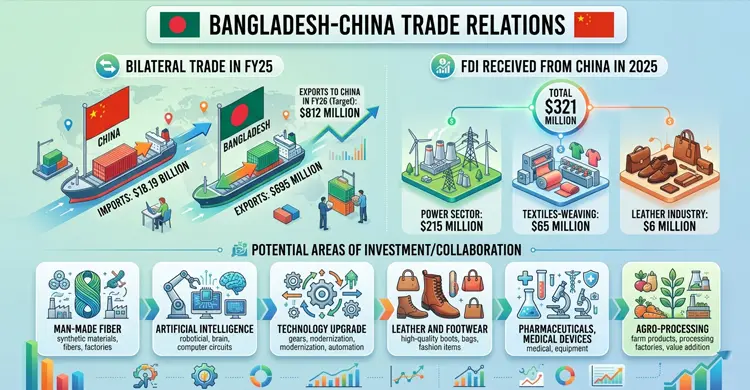
According to the Bangladesh Investment Development Authority’s (BIDA, now Invest Bangladesh) 2025 FDI Heatmap, Bangladesh has identified 19 high-potential sectors, including renewable energy, electronics and electric vehicle (EV) batteries, pharmaceuticals and medical devices, advanced textiles, agro-processing and logistics.
Investment in these sectors can bring more than capital. It can facilitate technology transfer, develop local skills, create quality jobs, diversify exports and connect domestic industries to global value chains.
According to Bangladesh Bank data, Bangladesh received $321 million in foreign direct investment from China in 2025, accounting for 18.1% of the country’s total FDI of $1.77 billion.
Of that amount, $215 million went to the power sector, $65 million to textiles and weaving, and $6 million to the leather industry.
Compared with China’s outward FDI, however, Bangladesh’s inflows from China remain relatively small. According to China’s Ministry of Commerce, the country’s outward FDI totalled $213.58 billion in 2025.
Textiles and garments in the spotlight
As Bangladesh’s textile and garment sector is its largest employment-generating industry and contributes more than 85% of national exports, investment should prioritise technological upgrading and man-made fibre (MMF) production, where significant gaps remain.
“As the world’s second-largest apparel exporter, Bangladesh has a strong foundation but needs transformation to reach the next level. With fashion trends shifting rapidly towards non-cotton products, man-made fibre is crucial for our future,” BGMEA President Mahmud Hasan Khan told Jago News.
Bangladesh’s apparel industry is gradually moving away from its traditional cotton-based model towards MMF and more technology-intensive, high-value-added products.
To make this transition successful, the country needs access to modern technology, technical know-how, advanced production management and stronger research and development, Hasan said.
He also emphasised China’s potential role in attracting investment in MMF production.
Greater Chinese investment and technological cooperation across Bangladesh’s textile and apparel value chain could improve productivity, support the development of higher-value products and strengthen the country’s position in global supply chains, he added.
A BGMEA-commissioned PwC report, From Shirts to Shores: Blueprint for Bangladesh RMG Industry, projects that MMF-rich garments will account for 60% of global garment exports by 2030.
Globally, more than 70% of garments are already made from man-made fibres. However, these products account for only 29% of Bangladesh’s garment exports, while cotton-based products make up 72%, highlighting the gap between global demand and Bangladesh’s production profile.
Automation and the adoption of artificial intelligence are also critical areas for investment and technology transfer, offering new opportunities for collaboration.
“Since 2023, we have equipped around 10,000 sewing machines with Internet of Things (IoT) devices to track production in real time. This has helped us achieve productivity gains of up to 25% compared with manual monitoring,” said SM Khaled, managing director of Snowtex Group.
By flagging machine slowdowns and defects instantly, the system enables faster corrective action. It demonstrates how smart manufacturing can improve efficiency and strengthen Bangladesh’s readymade garment (RMG) industry’s competitiveness, he added.
Beyond textiles and RMG
Bangladesh’s leather industry faces barriers to obtaining Leather Working Group (LWG) certification because of gaps in environmental compliance.
Chinese investment and technical expertise could help modernise the sector, while greater FDI in leather and footwear manufacturing could reduce reliance on exports of raw and semi-processed hides.
“I think our biggest challenge right now is compliance. Many of our tanneries do not meet the requirements for exporting to global markets. We also lack adequate waste-treatment facilities and capacity,” said Md Sakawat Ullah, senior vice-president of the Bangladesh Tanners Association (BTA).
To strengthen the industry, Bangladesh needs greater investment from China and collaboration to help tanneries obtain LWG certification and make the Savar tannery estate fully compliant, particularly in waste management, he added.
“Joint ventures and collaboration are highly welcome, as our product development needs an upgrade,” he said.
“Greater investment in high-value and strategically important sectors—including electronics, pharmaceuticals and active pharmaceutical ingredients (APIs), man-made fibres, automotive components, renewable energy, medical devices, logistics, agro-processing, digital services and advanced manufacturing—could generate significant and wide-ranging economic benefits,” Mustafizur Rahman, distinguished fellow at the Centre for Policy Dialogue (CPD), told Jago News.
Investment in these sectors could diversify Bangladesh’s export base and reduce its heavy dependence on a single industry. Beyond capital, such investment can bring technology, skills, management expertise and access to global supply chains, while creating quality jobs and strengthening domestic industries, Rahman said.
High-quality FDI does more than bring foreign capital into the country. It creates employment, facilitates the transfer of technology and skills, strengthens domestic supply chains, develops local suppliers and enhances export competitiveness, he added.
Electronic, home appliance industry
The Chinese support is quite evident in Bangladesh’s home appliance and electronics items, which helped create internationally recognised brands such as Walton, Vision, Vista and Symphony.
Once heavily reliant on imports, Bangladesh has made significant progress in developing its electronics and home appliance industry and has emerged as an exporter of products such as televisions, refrigerators, washing machines, rice cookers, and blenders. Today, domestic demand is largely met by locally manufactured and assembled products, reflecting the sector’s growing production capacity.
Kamal Kamruzzaman, director (marketing) of PRAN-RFL Group, said Chinese technology has accelerated Bangladesh’s industrialisation by offering cost-effective solutions tailored to local needs.
The company manufactures refrigerators, televisions, blenders, rice cookers and other home appliances, alongside doors, pipes and sanitary ware. He noted that China’s support extends beyond technology supply to training in machinery operation and maintenance, helping local manufacturers develop the expertise needed to use Chinese technology effectively.
More than investment: The importance of know-how
For Bangladesh, increasing the volume of FDI alone should not be the ultimate objective. Equally important is the quality and composition of the investment the country attracts.
According to Khondaker Golam Moazzem, president of the Knowledge Hub Institute Trust (KHIT), Bangladesh needs more than Chinese capital. It needs technology, skilled workers, management expertise and access to global supply chains.
China is a particularly relevant partner because its companies have extensive experience in manufacturing, renewable energy, electronics, electric vehicles, infrastructure and industrial supply chains.
The priority, therefore, should not simply be to attract more Chinese FDI, but to secure investment that transfers technology, creates quality employment, expands exports and strengthens domestic industries, Moazzem said.
Huawei has been operating in Bangladesh for more than 28 years, supporting the country’s technological advancement through the introduction of ICT technologies.
“We continue to strengthen connectivity and enable industries to adopt intelligent technologies that improve efficiency, productivity and service delivery,” said Ma Ben, managing director of the Public Affairs and Communications Department at Huawei South Asia.
“In the energy sector, we provide solar photovoltaic and energy storage solutions to support energy efficiency and reliability. We also support youth skills development through various capacity-building programmes.
“These efforts reflect our long-term commitment to the vision of building a fully connected, intelligent Bangladesh,” he added.
Trade diplomacy is essential
As Bangladesh approaches graduation from the least developed country (LDC) category, its future development will depend significantly on how effectively it manages the challenges of the post-graduation period.
Maintaining close ties with key trading partners, particularly China, will be essential to mitigating potential economic shocks and sustaining export competitiveness.
For Bangladesh, trade diplomacy and strong bilateral relations are crucial. China is the country’s largest trading partner, with bilateral trade worth about $20 billion, although the balance is heavily in China’s favour.
Effective trade diplomacy can help Bangladesh secure greater market access for its goods, diversify exports and address existing trade imbalances, said Faruque Hassan, a former BGMEA president.
According to Bangladesh Bank and Export Promotion Bureau (EPB) data, Bangladesh exported goods worth $695 million to China in FY2024-25, while imports from China totalled $18.19 billion, accounting for around 27% of the country’s total import bill.
The two countries’ bilateral trade stood at about $18.90 billion in FY2024-25. In FY2025-26, Bangladesh’s exports to China amounted to $812 million, while import data for the period have yet to be published.
China is also an important source of financing for major infrastructure projects and renewable energy development.
As Bangladesh graduates from the LDC category, it will face tougher competition in global markets as certain trade preferences are gradually withdrawn. Securing continued preferential market access where possible, along with technical support from China, will therefore be particularly important during the transition, Hassan said.
Stronger Bangladesh-China relations could also help the country integrate more deeply into global value chains, strengthen its industrial capacity and improve its competitiveness in international markets, he added.
Hassan believes that strategic cooperation with China could support Bangladesh’s ambition to become a more competitive and influential player in global supply chains.
“The chamber’s role is to connect businesses in Bangladesh and China and facilitate dialogue between the two countries’ policymakers to strengthen trade and investment ties,” said Mohammad Khorshed Alam, president of the Bangladesh-China Chamber of Commerce and Industry (BCCCI).
“Attracting investment requires a predictable policy environment, investor confidence and clear opportunities for collaboration. We are working to identify sectors where both countries can leverage their strengths and build mutually beneficial partnerships.”
Proactive policies and stronger trade and diplomatic ties could create mutual business opportunities, helping Bangladesh’s industries advance through greater investment and technology transfer, he added.