

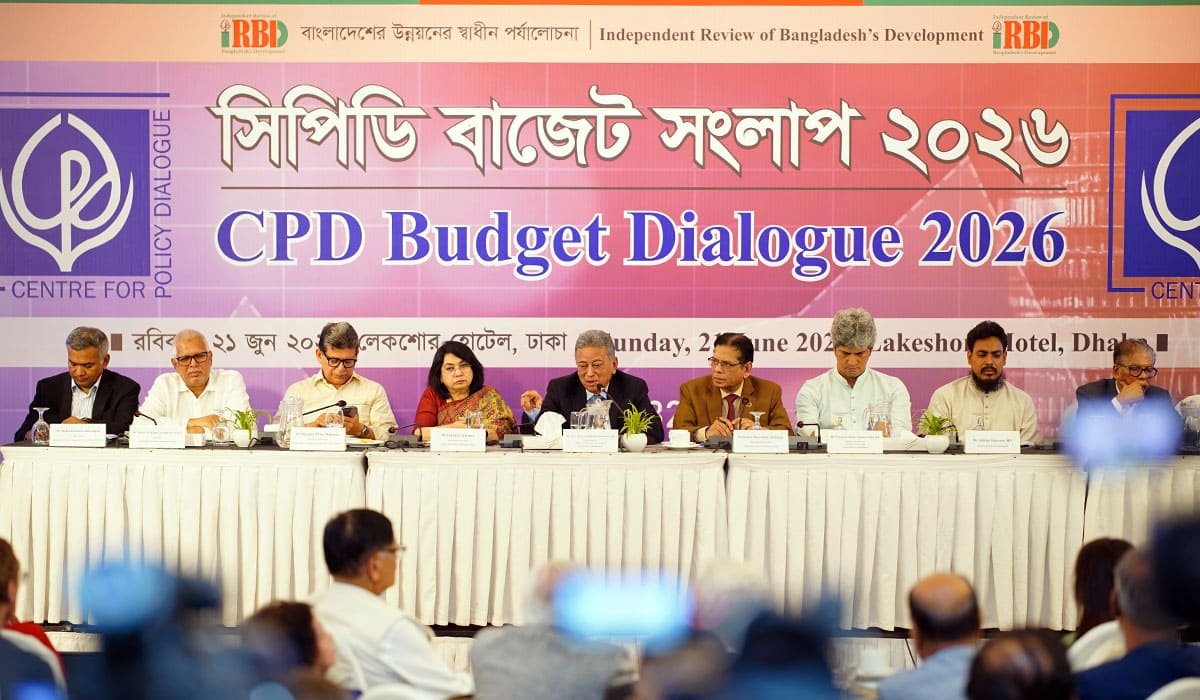
The proposed national budget for FY2026–27 comes at a critical moment for Bangladesh’s economy. After several years of macroeconomic stress, inflationary pressure, revenue shortfall, restrained public expenditure, low development implementation, low private investment and continuing pressure in the banking and external sectors, the first budget of the newly elected government has raised expectations for economic recovery, institutional reform and citizen-focused public spending.
These observations emerged at the CPD Budget Dialogue 2026 organised by the Centre for Policy Dialogue (CPD) on Sunday, 21 June 2026. Dr Fahmida Khatun, Executive Director, CPD, delivered the keynote presentation titled An Analysis of the National Budget for FY2026–27.
The session was chaired by Professor Mustafizur Rahman, Distinguished Fellow, CPD.
Mr Amir Khosru Mahmud Chowdhury, MP, Hon’ble Minister, Ministry of Finance and Planning, Government of Bangladesh, emphasised, ‘We need to look at the whole public finance architecture in a new way. Bangladesh cannot continue to depend only on loans from the IMF, World Bank or other development partners; we must move towards alternative financing, including market-based financing and bond issuance, while blending concessional resources in the best possible way.’
The Hon’ble Minister also highlighted the implications of domestic borrowing for private sector investment. ‘Heavy borrowing from local banks creates a major problem by crowding out the private sector, particularly when interest rates remain high. We are therefore gradually reversing the trend of dependence on bank borrowing and moving towards alternative financing and stronger tax-GDP mobilisation,’ he said.
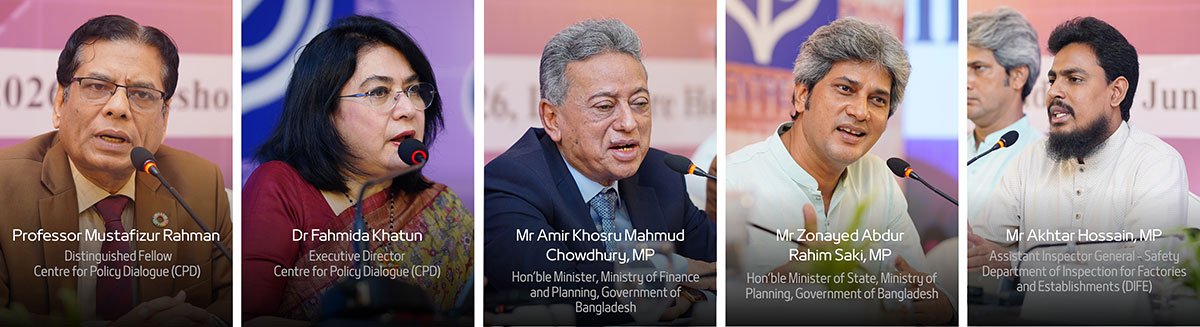
In her keynote presentation, Dr Fahmida Khatun said that while the FY2027 budget has been framed around the aspiration of a democratic, humane and inclusive economy, several targets appear optimistic. She noted that the 6.5 per cent GDP growth target, the revenue mobilisation target and the proposed expansion of public expenditure would be difficult to realise without stronger implementation, higher tax-GDP mobilisation, improved investment conditions and better institutional capacity.
Dr Fahmida Khatun also observed that the budget shows a visible shift towards human capital sectors, with higher allocations for education, health and social protection. However, she cautioned that higher allocation alone would not ensure better outcomes unless the government addressed weak utilisation, project delays, limited absorptive capacity and governance challenges in service delivery.
The budget, according to Mr Zonayed Abdur Rahim Saki, MP, Hon’ble Minister of State, Ministry of Planning, Government of Bangladesh, has to be assessed against the wider fiscal structure that the government has inherited. He emphasised, ‘The revenue shortfall and expenditure pressures are not new, but the important issue is whether we can gradually shift the direction of spending, reduce unnecessary pressure, and make public expenditure more accountable and effective.’
A consultative approach to the budget process was also highlighted by Mr Akhtar Hossain, MP, Hon’ble Member of Parliament. ‘If we can move forward by taking into account the views of the relevant organisations and stakeholders, we will be able to improve the quality of this process and use the larger opportunities it has created for the genuine welfare and upliftment of people,’ he observed.
‘The key question is not only whether resources have been allocated, but whether institutions have the capacity to implement programmes effectively and whether spending assumptions are aligned with development priorities,’ remarked Dr Hossain Zillur Rahman, Executive Chairman, Power and Participation Research Centre (PPRC). His observation reflected a broader concern that higher allocations must be matched by institutional readiness, accountability and delivery capacity.
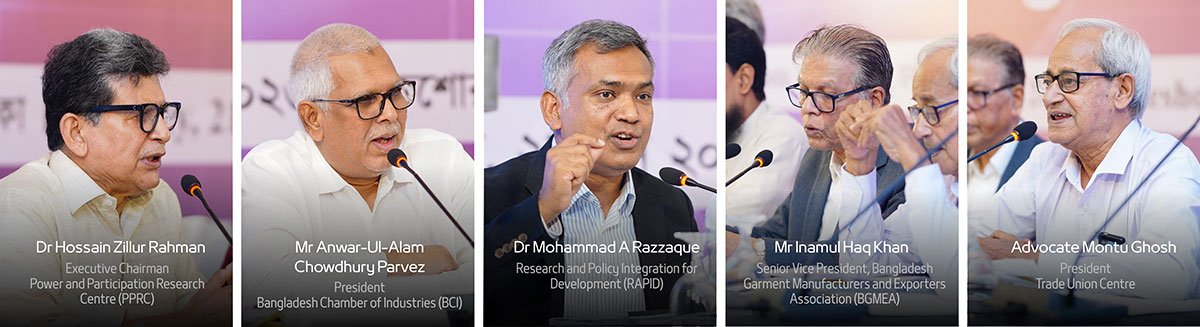
Speaking from the perspective of industry, Mr Anwar-Ul-Alam Chowdhury Parvez, President, Bangladesh Chamber of Industries (BCI), said, ‘The immediate priority is not simply accelerating growth but ensuring the survival of existing industries. Energy shortages, financing constraints and implementation challenges continue to undermine private sector investment and business expansion.’ His remarks pointed to the need for a business environment that can support both recovery and future investment.
The operational challenge of expanding social protection coverage was raised by Dr Mohammad A Razzaque, Chairman, Research and Policy Integration for Development (RAPID). ‘Expanding the family card to 41 lakh households in the current budget will be operationally challenging unless the government can accurately identify poor households,’ he remarked.
From the export-oriented business community’s perspective, the budget’s business orientation was recognised, but implementation remained the decisive issue. ‘From the business community’s perspective, we recognise this budget as quite business-friendly. However, the benefits will only be realised if the announced measures are implemented effectively and on time,’ said Mr Inamul Haq Khan, Senior Vice President, Bangladesh Garment Manufacturers and Exporters Association (BGMEA).
The importance of evidence-based policymaking and citizen welfare was highlighted from the labour perspective. Advocate Montu Ghosh, President, Trade Union Centre, underscored that ‘effective policy measures must be informed by evidence and research, while ensuring that the interests of vulnerable and low-income communities remain at the centre of decision-making.’
During the open-floor discussion, participants welcomed the scale and orientation of the proposed budget, particularly the increased allocations for education, health, social protection and SME development. At the same time, they raised concerns about the feasibility of revenue mobilisation, the 6.5 per cent GDP growth projection, the reliance on bank borrowing to finance the deficit, and the implications of these trends for private sector investment and employment generation.
Several participants observed that the target of creating 1 crore new jobs would be difficult to achieve without a stronger investment climate, skill development and effective support for youth employment. Speakers also noted that while higher allocations for education and health are positive, weak implementation and absorptive capacity may limit their impact.
Representatives from SME-related sectors called for preferential taxation and VAT relief for small entrepreneurs to help bring them into the economic mainstream. Participants from the health sector welcomed the higher allocation but emphasised the need for deeper reform, better utilisation of funds and stronger tobacco taxation measures. Concerns were also raised regarding the adequacy of old-age allowances, the continued VAT burden on English-medium education, and the need for transparent and accountable delivery mechanisms, particularly through local government institutions and access to information systems.
Concluding the session, Professor Mustafizur Rahman, Distinguished Fellow, CPD, noted, ‘The proposed FY2027 budget carries the philosophy of economic recovery through human development, private-sector-led growth and social protection. However, its success will depend on the quality of execution, institutional capacity and the ability to translate allocations into tangible outcomes for citizens.’