

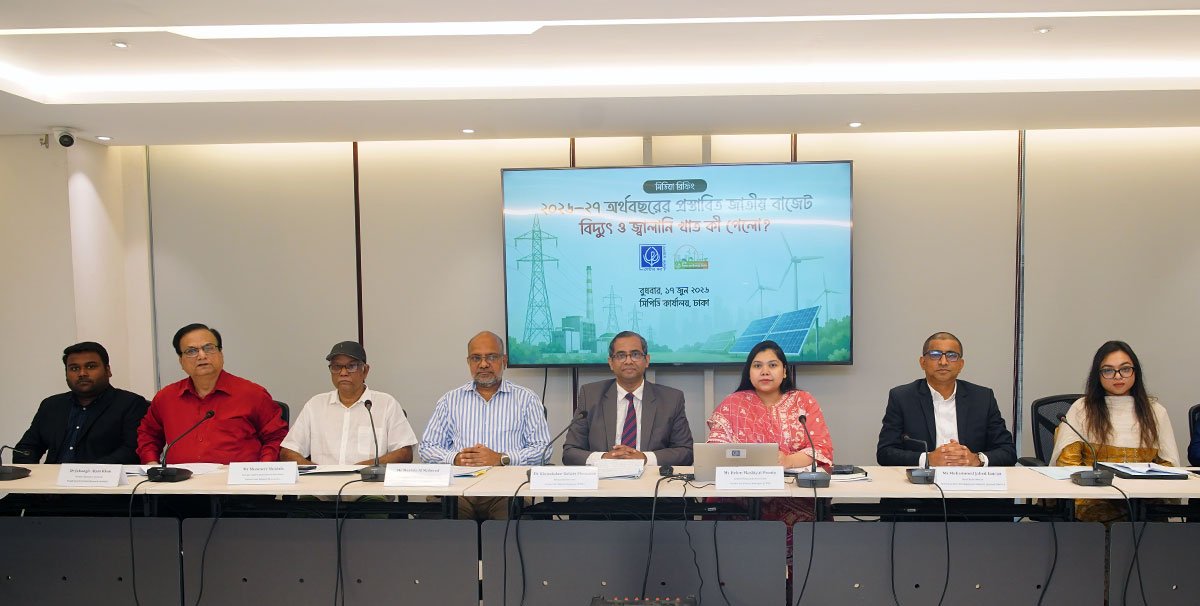
Bangladesh’s proposed national budget for FY2026–27 has recognised the need to reduce dependence on imported fossil fuels and move towards alternative energy sources. The budget has introduced several fiscal measures for solar power, electric vehicles, energy storage and selected renewable-energy-related components. However, the proposed measures still fall short of what is needed to support a faster, fairer and more credible energy transition.
These issues were discussed at a media briefing and discussion titled “Proposed National Budget for FY2026–27: What is there on the Power and Energy Sector?” organised by the Centre for Policy Dialogue (CPD) on Wednesday, 17 June 2026. The discussion focused on budgetary allocation, Annual Development Programme (ADP) priorities, fiscal treatment of renewable and fossil fuel-based energy, and the implications for Bangladesh’s power and energy sector.
Delivering the introductory remarks, Dr Khondaker Golam Moazzem, Research Director, CPD, said the power and energy sector was going through a multidimensional crisis shaped by imported fuel dependency, geopolitical uncertainty and weaknesses in the domestic supply chain. He noted that the government had shown an intention to move beyond conventional fossil fuel-based solutions and give greater attention to renewable energy.
Mr Mohammed Jabed Emran, Chief Risk Officer and SEVP, Infrastructure Development Company Limited (IDCOL), discussed the financing and implementation challenges of renewable energy projects. He said that renewable energy projects, particularly solar irrigation, require concessional finance, subsidy support and bankable project structures.
“Solar irrigation devices need to become more affordable for farmers,” said Dr Jahangir Alam Khan, former Director General, Bangladesh Livestock Research Institute (BLRI). “At least 50 per cent subsidy support should be considered, along with better after-sales services and awareness-building among farmers.”
Ms Farah Anzum, Bangladesh Lead, GSCC, highlighted the role of media in bringing Bangladesh’s fossil fuel dependency, energy-sector debt and energy crisis into public discussion. She noted that media reporting has become more open and clearer on these issues and has played an important role in shaping public understanding of the energy transition.
Mr Monower Mostafa, Energy Expert and General Secretary, Democratic Budget Movement, said the power and energy sector faces structural problems, including dependence on gas, mismatch between demand and supply, subsidy pressure and weak accountability. He noted that renewable energy can help Bangladesh gradually break this structure, but fiscal reform must show its real impact beyond headline incentives.
Mr Mostafa Al Mahmud, President, Bangladesh Sustainable and Renewable Energy Association (BSREA), said that Bangladesh should treat renewable energy transition as a national priority. He noted that global experience has already shown the viability of renewable energy, while Bangladesh still remains hesitant.
The keynote presentation was delivered by Ms Helen Mashiyat Preoty, Senior Research Associate, CPD. She said the FY2026–27 budget should be assessed not only by its allocation, but also by its ability to address the energy crisis and strengthen energy security.
The Ministry of Power, Energy and Mineral Resources received BDT 17,345 crore in the proposed budget, a 2.3 per cent increase from the revised budget of FY2025–26. However, the sector’s share in the total national budget declined from 2.15 per cent to 1.85 per cent.
The Power Division received BDT 14,996 crore, while the Energy and Mineral Resources Division received BDT 2,349 crore, marking a 72 per cent increase, largely due to higher development expenditure for gas-related projects. Ms Preoty noted that several generation, transmission and distribution projects remain in carry-over or concluding stages and should receive adequate allocation in the revised budget.
The presentation highlighted fiscal support for solar power, including a zero per cent tax rate until 2035, a 5 per cent tax rebate on solar electricity bills, and reduced duties on selected solar components. However, renewable energy remains under-prioritised in the ADP, with only five related projects receiving allocation and 11 projects, including 640 MW of solar capacity, remaining unapproved.
“With only 2 per cent allocation for renewable energy in the generation sector, Bangladesh cannot realistically move towards its 2030 energy transition target,” Ms Preoty said.
A Q&A session with journalists was held towards the end of the briefing. Journalists asked whether Bangladesh can rely on renewable energy to address the current power and energy supply gap, how the government should deal with existing power purchase agreements, and whether subsidy pressure may eventually increase the burden on ordinary consumers.
The CPD Power and Energy Team responded that renewable energy cannot solve the entire crisis overnight, but it must become a larger part of the medium-term solution. The team also said that contracts renewed more than once should be reviewed through negotiation, while subsidy reduction should come through reform of capacity payments and costly contracts, not through additional pressure on consumers.
The briefing recommended increasing allocation in the revised budget for projects that can be completed within FY2026–27, allocating at least 30 per cent of the power sector’s energy budget for renewable energy, approving more renewable energy projects in the ADP, reducing duties on grid infrastructure components, withdrawing complete VAT exemption on LNG imports, and introducing targeted incentives for solar irrigation.
The proposed budget has taken important first steps towards renewable energy and electric vehicles. A stronger green fiscal policy, higher public investment and fairer tax treatment across fuels will be needed to turn these signals into a credible energy transition pathway.