

Bangladesh’s ready-made garment (RMG) sector needs faster adoption of renewable energy, easier access to green finance, supportive taxation and regulation, and greater coordination among government, industry, financial institutions and global brands.
These priorities emerged at the dialogue “Industrial Decarbonisation in the RMG Sector: How to Take it Forward?”, organised by the Centre for Policy Dialogue (CPD) on 16 August 2026 at BRAC Centre Inn, Dhaka.The discussion highlighted that decarbonisation is no longer only an environmental concern for Bangladesh’s export-oriented RMG industry; it is increasingly linked with the sector’s competitiveness and ability to meet changing global sustainability requirements.
Speaking as a Special Guest, Barrister Vidiya Amrit Khan, Vice President, Bangladesh Garment Manufacturers and Exporters Association (BGMEA), stressed that the transition to renewable energy has become essential for the future of the garment sector. She drew attention to growing sustainability and reporting requirements and argued that taxation and energy policies must encourage, rather than discourage, investment in renewable energy. She also called for global brands to share the financial responsibility of the transition with manufacturers.
Access to finance was identified as another major barrier. Mr Fazlee Shamim Ehsan, Executive President, Bangladesh Knitwear Manufacturers and Exporters Association (BKMEA), noted that although green financing is available, obtaining it remains difficult for industries. He called for easier financing for machinery replacement and urged policymakers to consider renewable-energy and thermal-energy infrastructure while planning new industrial zones.
Regulatory bottlenecks and delays were also raised as obstacles to investment. Mr Mostafa Al Mahmud, President, Bangladesh Sustainable and Renewable Energy Association (BSREA), emphasised the potential of solar power, battery storage and merchant power arrangements, while calling for faster approvals, simpler financing processes and policy measures that would make renewable-energy investments more commercially viable.
Moderating the discussion, Dr Khondaker Golam Moazzem, Research Director, CPD, cautioned that the current energy crisis is unlikely to disappear quickly and said industries and policymakers need to make maximum use of the options already available. He stressed that improving energy efficiency, expanding electrification and renewable energy, and connecting factories with appropriate technologies and financing mechanisms must move forward together.
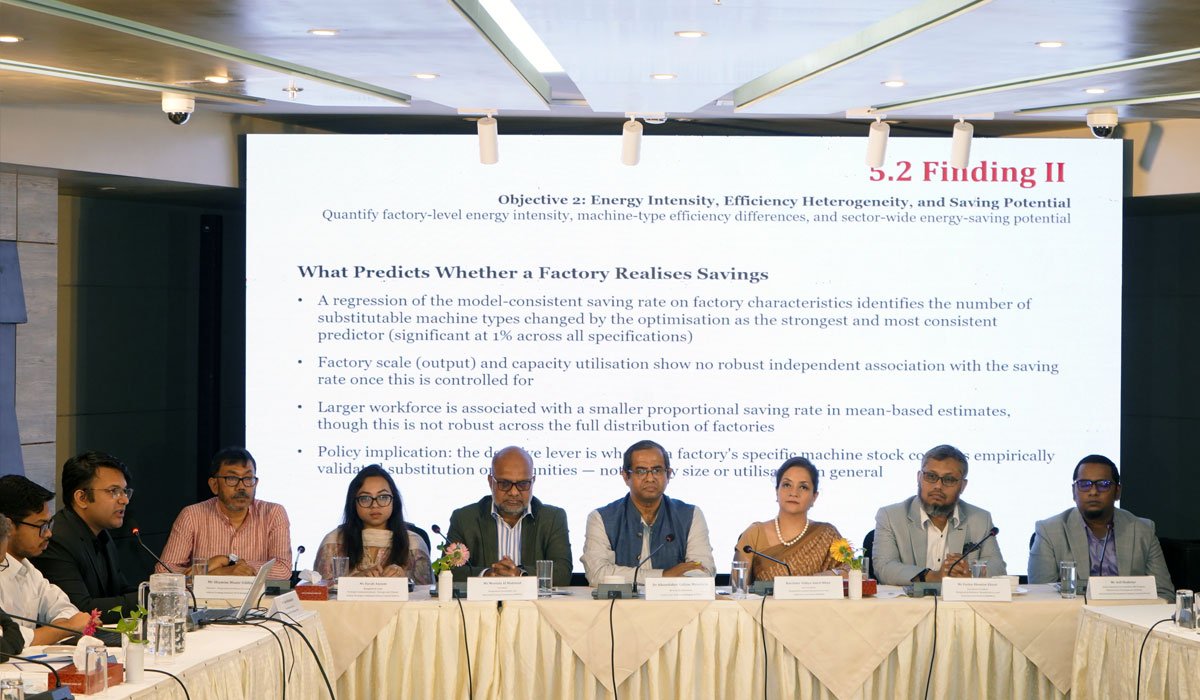
The dialogue featured a presentation by Mr Sami Mohammad, Programme Associate, CPD, based on the study “Renewable Energy as a Competitiveness Strategy for Industrial Decarbonization in Bangladesh’s RMG Sector”. The research team also included Dr Khondaker Golam Moazzem and Mr Atikuzzaman Shazeed, Research Associate, CPD. Drawing on data from 350 RMG factories, the study examined factory-level energy use, machinery, renewable-energy pathways and the financial and institutional barriers to decarbonisation.
The findings showed that the sector remains structurally locked into carbon-intensive production and that machinery replacement alone cannot achieve deep decarbonisation. Although sewing accounts for around 85 per cent of installed machine stock, cutting—with only around 5.5 per cent—could generate 27.3 per cent of total substitution-based energy savings. Washing and dyeing was found to be the most energy-intensive production stage.
The research further showed that smaller factories face substantially larger efficiency gaps, even though larger factories offer greater absolute saving potential. Rooftop solar can lower energy costs and reduce exposure to price volatility, but it cannot by itself replace gas-dependent thermal processes in washing and dyeing. CPD therefore recommended targeted machinery replacement, broader renewable electrification, blended finance for smaller factories, outcome-based regulation and stronger technical support for firms seeking financing.
Among the Distinguished Discussants, Mr Shamim Munir Uddin, Director – Programme Evidence & Learning, Ethical Trading Initiative (ETI) Bangladesh, described the research as timely and argued that the transition should not be treated as a technological issue alone. He highlighted the role of workers in improving factory-level energy and resource efficiency and emphasised that manufacturers, government, brands and other actors across the supply chain need to share responsibility for the transition.
Financing models suitable for smaller factories also received particular attention. Mr Asif Shahriar, Senior Assistant Vice President, SHS Program, Infrastructure Development Company Limited (IDCOL), highlighted rooftop solar as an important option and stressed the need for more accessible and standardised financing processes. He pointed to OPEX-based models and blended finance as possible mechanisms for bringing smaller factories into the renewable-energy transition.
The discussion underscored that Bangladesh’s RMG decarbonisation cannot be achieved through a single technology or policy measure. A faster transition will require coordinated action on renewable energy, energy-efficient technology, financing, taxation, regulation and shared responsibility across the supply chain.