

Presentations:
- Solar Rush in Pakistan: What’s Next and Who Follows? – Muhammad Basit Ghauri
- From Off-Grid to On-Grid: Solar Home Systems to Rooftop Solar – Atikuzzaman Shazeed
A solar revolution is not only about panels on rooftops; it is about whether a country can turn an energy crisis into an opportunity for affordability, resilience and cleaner growth. Pakistan’s rapid solar expansion has shown how households, businesses and farmers can move quickly when high energy costs, falling technology prices and enabling policies come together. For Bangladesh, the lesson is timely. As the National Budget for FY2026-27 places renewed attention on the power and energy sector, the country now has an opportunity to rethink how fiscal policy can support renewable energy rather than slow it down.
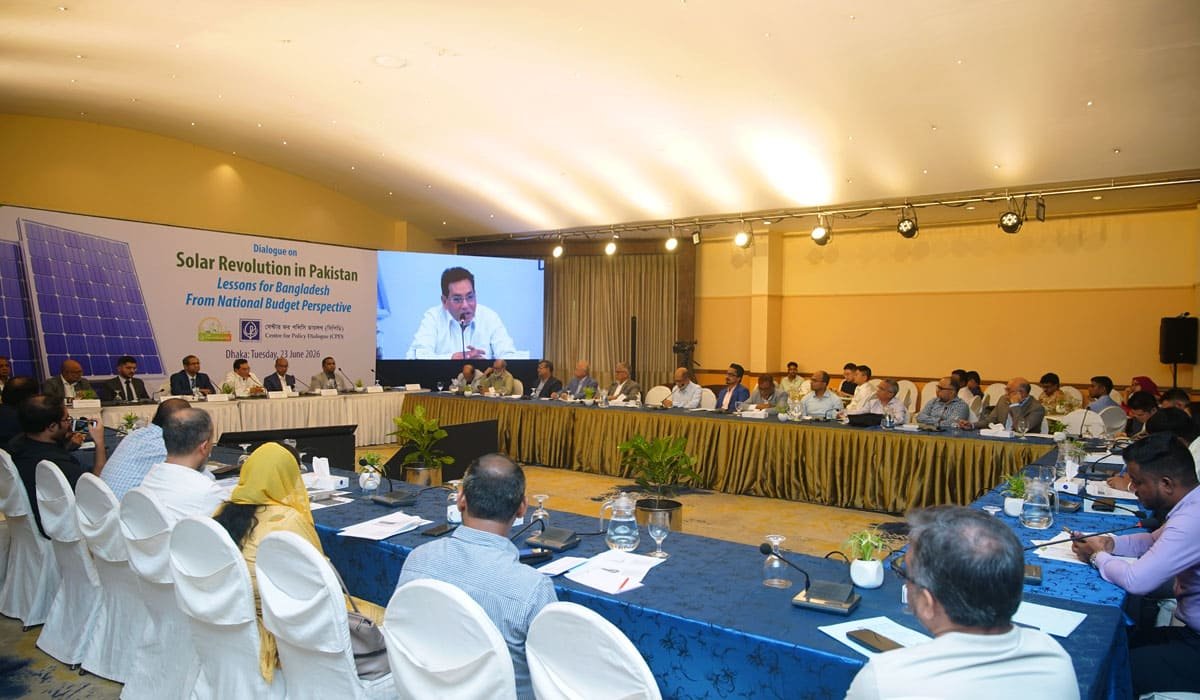
The Centre for Policy Dialogue (CPD) organised a dialogue titled ‘Solar Revolution in Pakistan: Lessons for Bangladesh from National Budget Perspective’ on Tuesday, 23 June 2026. The session was moderated by Dr Khondaker Golam Moazzem, Research Director, CPD.
The keynote presentation was delivered by Mr Muhammad Basit Ghauri, Manager Special Initiatives and China Program, Renewables First of Pakistan.
Speaking as the Chief Guest, Mr Nurul Islam Moni, MP, Hon’ble Chief Whip of Bangladesh Parliament, appreciated the experience shared from Pakistan and said, ‘It was very exciting and very interesting for me.’ He observed that the discussion was highly relevant for Bangladesh and encouraged wider use of the knowledge generated through the dialogue to support practical renewable energy solutions.
In his opening remarks, Dr Khondaker Golam Moazzem said, ‘The government has taken a political decision to give importance to renewable energy beyond conventional fossil fuels. We want to see these efforts continue in the coming days.’ He noted that the FY2026-27 budget has included several measures for renewable energy, electric vehicles and batteries. However, he stressed that agriculture and distributed renewable energy still need stronger policy attention.
Delivering the keynote presentation, Mr Muhammad Basit Ghauri explained that Pakistan’s solar expansion was not a centrally planned programme, but a people-led transition. He noted that solar imports increased sharply within a short period, with most of the capacity being deployed at the distributed level, including households, industries, commercial establishments and agriculture. According to him, the solar rush was driven by rising grid tariffs, falling solar panel prices and enabling policy conditions such as duty-free access and attractive net-metering arrangements.
He further highlighted that Pakistan’s transition was largely financed by consumers themselves rather than by banks, public funds or development partners. This, he observed, showed the strength of household and private capital when the economic case for solar becomes clear. He also cautioned that rapid solar adoption brings new challenges for utilities, grid planning and storage integration.
The discussion that followed focused on how Bangladesh can learn from Pakistan without simply copying its model. Dr Ashraful Alam, Joint Secretary and Member (Renewable Energy), Sustainable and Renewable Energy Development Authority (SREDA), emphasised the need for a level playing field in the import duty structure for solar equipment. He observed that facilities should not be limited to selected models or project developers, but should be made rational and accessible for all importers and users.
From the private sector perspective, Mr Mostafa Al Mahmud, President, Bangladesh Sustainable and Renewable Energy Association (BSREA), and Mr David Hasanat, President, Bangladesh Independent Power Producers’ Association (BIPPA), underlined the importance of policy consistency, bankable investment models and quality assurance.
The discussion also reflected on the role of institutions and financing, with Mr Asif Shahriar, Senior Assistant Vice President, Renewable Energy, Infrastructure Development Company Limited (IDCOL), highlighting implementation and financing issues, while Mr Hasan Mehedi, Chief Executive, CLEAN (Coastal Livelihood and Environmental Action Network), drew attention to the need for an inclusive transition that reaches households, farmers and smaller users.
Presenting the Bangladesh perspective, Mr Atikuzzaman Shazeed, Research Associate, CPD, said that Bangladesh’s solar journey has moved from off-grid Solar Home Systems to the emerging phase of on-grid rooftop solar. He noted that the Solar Home System programme electrified more than 20 million people, but many systems later became non-functional as the national grid expanded without a structured transition pathway. Bangladesh now has 4,551 net-metered rooftop solar installations with a combined capacity of 213.3 MW, while more than 60 per cent of installations are concentrated in Dhaka division.
He identified financing gaps, high tax incidence, slow net-metering approvals, institutional fragmentation, collateral rigidity, weak green refinancing and limited grid integration of solar irrigation pumps as key barriers. He recommended innovative financing mechanisms, simpler net-metering procedures, stronger institutional coordination, better access to green finance, local maintenance capacity and greater attention to retention rather than only installation.
The dialogue concluded that Bangladesh’s renewable energy transition will require more than targets and announcements. Speakers called for removing fiscal discrimination against renewable energy, rationalising duties on solar equipment, expanding grid-connected distributed solar, and ensuring predictable policy support. Pakistan’s experience shows that a solar transition can move fast when people and markets respond to clear incentives. Bangladesh’s task now is to create the fiscal, financial and institutional conditions that make solar affordable, reliable and accessible across households, industries and agriculture.