

Food prices remain one of the most immediate pressures on household welfare in Bangladesh. General inflation stayed mostly between 9 and 11 per cent from April 2023 to June 2026, while food inflation rose to around 14 per cent at its peaks. Food represents 59 per cent of the consumer price index basket, and more than 60 per cent of households spend at least half their income on food. The poorest 5 per cent allocate 59.8 per cent of consumption expenditure to food, compared with 28.9 per cent among the richest 5 per cent.
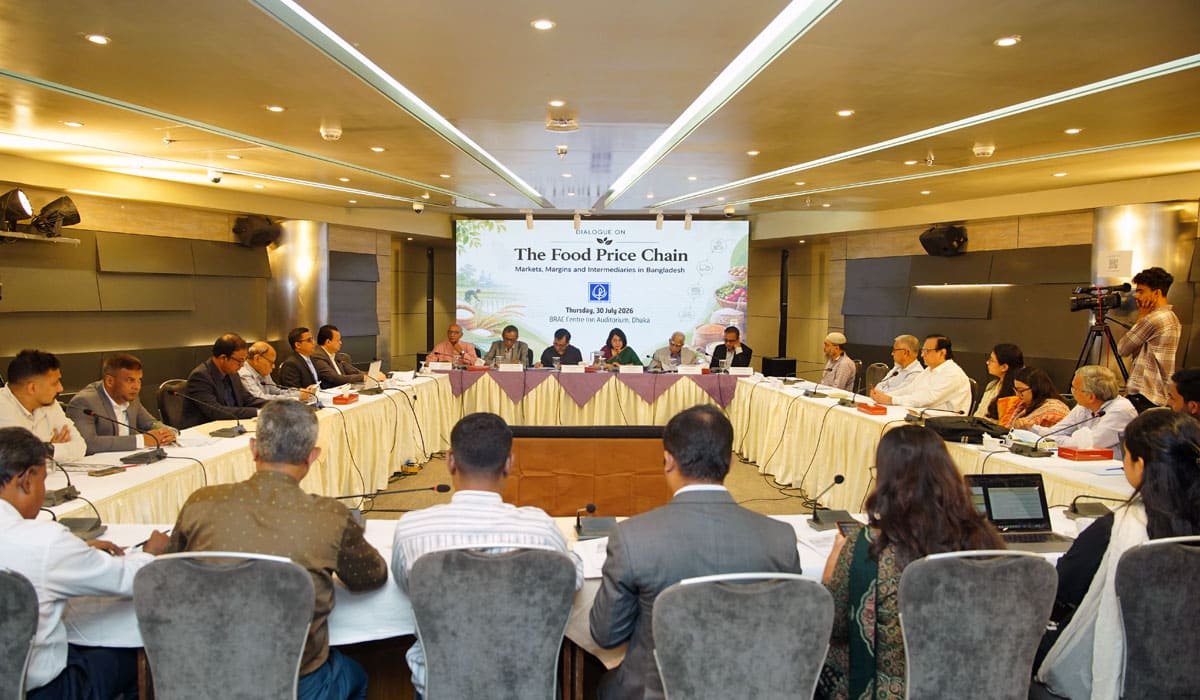
Against this backdrop, the Centre for Policy Dialogue (CPD) organised a dialogue titled “The Food Price Chain: Markets, Margins and Intermediaries in Bangladesh” on Thursday, 30 July 2026, at BRAC Centre Inn, Dhaka. Policymakers, economists, government officials, businesses, workers’ organisations and consumer advocates examined how costs, market structures and trading practices shape consumer prices.
Mr Khandakar Abdul Muktadir, MP, Hon’ble Minister, Ministry of Commerce, Government of Bangladesh, described inflation as “a pain for any economy—and an even greater pain for a struggling economy like ours—because it erodes purchasing power”. Noting that logistics costs are approximately 16 per cent of GDP in Bangladesh, against a global benchmark of around 10 per cent, he stressed reducing logistics and input costs, unaccounted-for expenses, and introducing traceability across supply chains.
Setting the context, Dr Fahmida Khatun, Executive Director, CPD, said, “For nearly four years, inflation has remained a major concern for the economy, and rising food prices create the most direct pressure because no household can avoid food expenditure.” The burden is heavier on poorer households and affects nutrition, savings, education and healthcare. The task, she observed, was not to blame a particular group but to understand where prices rise and whether monitoring and regulatory systems are effective.
Presenting the study, Mr Foqoruddin Al Kabir, Senior Research Associate, CPD, explained that CPD traced 10 domestically produced essential commodities backwards from retail markets to producers, covering 500 retailers and 820 market actors. Around 30 per cent of Bangladesh’s population remains food insecure, while nominal wage gains have not kept pace with price pressures. Longer supply chains were generally associated with larger farm-to-retail price increases, and supply shortages were the most frequently reported cause of high prices, followed by collusion and hoarding. However, intermediaries provide necessary transport, storage, processing and distribution services and should not automatically be blamed.
Professor Dr M. A. Sattar Mandal, Professorial Fellow of BIDS, said, “Even after coming this far, a very large share of income—around 50 to 60 per cent, and about 60 per cent for poorer people—is still spent on food.” He argued that farmers’ returns must be assessed against risks, perishability, waiting time and capital costs, while fragmented farms limit economies of scale and investment.
The distributional consequences were underlined by Ms Taslima Akter Lima, President, Bangladesh Garments Sramik Sanghati. “Whenever food prices rise, the real incomes of low-income people—farmers and workers—fall,” she said. She called for stronger social protection, accessible credit for farmers and transparent, accountable food-market management.
The study’s interpretation also drew constructive scrutiny. Dr Mohammed Helal Uddin, Executive Vice Chairman, Microcredit Regulatory Authority, warned that “a one-point, one-time study” could produce different results depending on seasonal disruptions: a farmer might receive Tk 70 for brinjal at one moment but fail to sell it for Tk 10 later. Price levels, volatility, concentration, speculation and cost drivers, he argued, should be assessed separately.
Dr M Asaduzzaman, Former Research Director, BIDS, similarly cautioned against an overly simple reading of margins. “If the actual farmers—the much larger group of small farmers—are left out, this is not the overall picture,” he observed. Sampling, marketable surplus, productivity, costs over time and consumers’ experiences required closer examination.
From the statistical perspective, Mr Md. Shahabuddin Sarker, Director (in charge), National Accounting Wing, Bangladesh Bureau of Statistics, noted that inflation moved from 8.71 per cent in March to 9.04 per cent in April, 9.42 per cent in May and 9.16 per cent in June. “It is fluctuating, and although there are reasons, many of them do not fully align,” he said, welcoming academic engagement as BBS revises the CPI and GDP frameworks.
Mr A. H. M. Shafiquzzaman, President, Consumers Association of Bangladesh, argued that “the people most affected are farmers” and that subsidies and institutional support often fail to reach actual producers. He urged earlier import and duty decisions, stronger inter-ministerial coordination, action against extortion and better organisation of farmers and consumers.
The discussion pointed to a combined agenda: better price and stock information, stronger competition oversight, timely policy intervention, improved storage and transport, lower input costs, greater traceability and closer government coordination. Protecting consumers while ensuring viable producer returns requires more efficient, transparent and accountable supply chains.