

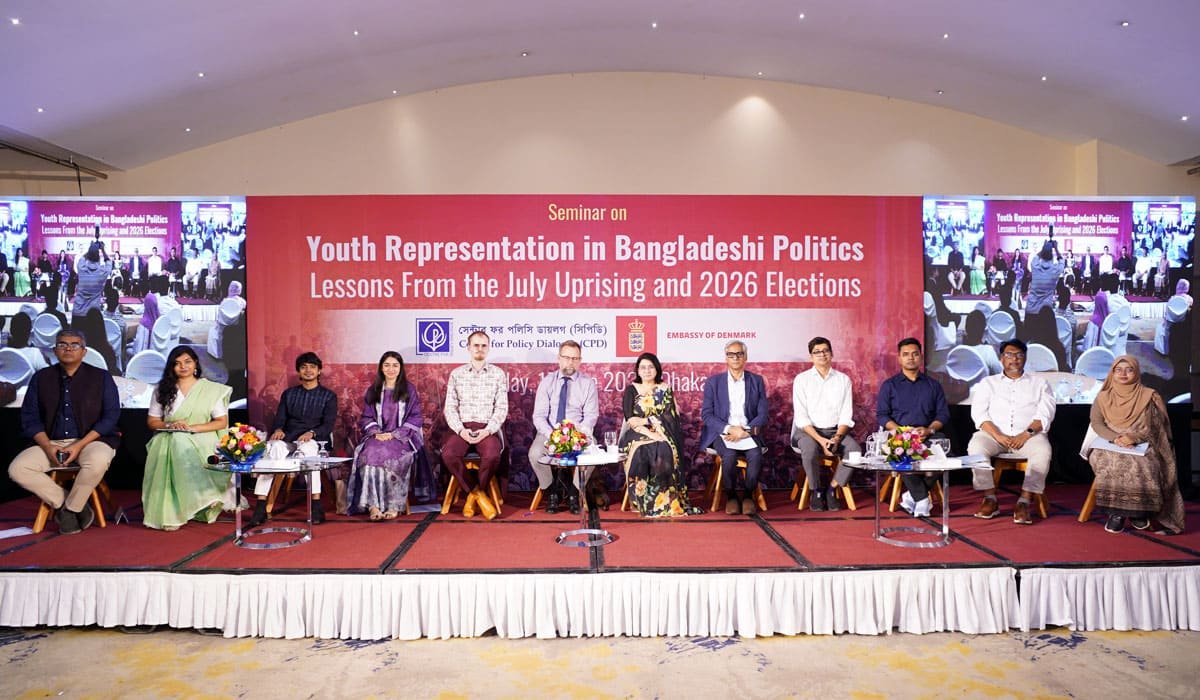
Since the July uprising of 2024, young people have moved from the margins to the centre of Bangladesh’s political conversation. But mobilisation alone cannot ensure representation. The next challenge is to create a political system where young people can organise, contest, participate safely, influence policy, and compete without being blocked by money, muscle or exclusionary institutions.
These observations emerged at a seminar titled ‘Youth Representation in Bangladeshi Politics: Lessons from the July Uprising and 2026 Elections’, organised by the Centre for Policy Dialogue (CPD), in partnership with the Embassy of Denmark in Bangladesh, on Monday, 15 June 2026, at Lakeshore Hotel, Gulshan 2, Dhaka. The seminar was moderated by Mr Avra Bhattacharjee, Additional Director, Dialogue Communication and Outreach, CPD.
Democratic transition, said H E Mr Christian Brix Møller, Ambassador, Embassy of Denmark in Bangladesh, must be built on inclusion, dialogue, accountability and strong institutions. Drawing on Denmark’s experience, he observed that democracy is both ‘a method and a culture’, where compromise should not be treated as weakness. He also noted that stability and accountability are essential not only for democratic practice but also for long-term investment and sustainable prosperity.
Dr Fahmida Khatun, Executive Director, CPD remarked that political and economic crises are closely connected, as inflation, weak public services, youth unemployment, skills gaps, education, health, agriculture, investment and accountability all shape young people’s everyday realities. Young people, she said, should build constituencies around concrete public concerns and offer practical solutions. ‘If you continue to raise these issues and show the way forward, politicians will be compelled to listen,’ she said.
Financing remains one of the most difficult structural barriers for young people, highlighted Advocate Manzur Al Matin, Advocate, Supreme Court of Bangladesh and Senior Presenter, Channel 24. Young political actors are often questioned about their income and livelihood, while established political parties benefit from opaque funding networks. He called for disclosure of party financing, reduced electoral expenditure and campaign arrangements that can create a more equal footing. Women, he added, face an additional layer of barriers and require safety both online and offline.
Bangladesh’s experience should not be compared mechanically with Nepal or Sri Lanka, said Mr Faisal Bin Majid, Project Manager a.i. and Research Analyst, United Nations Development Programme. In those countries, he noted, youth-led political momentum could enter electoral systems that had continued despite political crises. Bangladesh, by contrast, entered a transition with a weakened electoral process, where new youth-led actors had to compete with older and better-resourced political structures. Youth political participation in Bangladesh, he said, still has ‘a long way to go’.
A seat at the decision-making table is essential, observed Mr Mushfiq Us Salehin, Politician and Activist. He said the problem is not only within political parties, but also in public expectations, as voters often assess political credibility through visible power, resources and local influence. Young people are expected to commit full time to politics, but without sustainable and transparent financing, political engagement becomes difficult for them.
From the Danish experience, Mr Mads Christensen, Intern with the Trade Council, Embassy of Denmark in Bangladesh, said youth participation must be supported by civic education and institutions. In Denmark, young people are introduced to democratic practice from school and encouraged to understand both government and opposition. Institutional support for youth political organisations, he said, helps young people organise more sustainably.
Student politics should create space for ideas, debate and accountability, emphasised Mr Shameem Hossen, Youth Activist and Lecturer, Department of English Language and Literature, Northern University Bangladesh. He argued that basic student rights, including accommodation and campus services, should not depend on political affiliation. Campus politics, he said, must be reformed so that disagreement does not become a source of intimidation.
Women’s participation was visible during the July movement but became more difficult when politics moved towards formal representation, said Ms Sadia Akther, Youth Activist. She called for civic education, gender sensitivity, legal protection, cyber safety and stronger implementation of existing laws. Women, she said, should not be included only to fulfil quotas, but as decision-makers within parties and institutions.
Symbolic recognition is not enough, argued Ms Nasfin Mehanaz Azireen, Youth Activist. Young people and women need guaranteed participation, legal support, training, protection from threats and deepfakes, and safe spaces to work through political institutions. ‘Stop inviting us. Start including us,’ she said, adding that youth are not the future but the present.
The digital space has become inseparable from politics, noted Dr Din M Sumon Rahman, Professor and Dean, School of Social Science and Director, Critical and Qualitative Studies, University of Liberal Arts Bangladesh (ULAB). He said young people should not depend only on traditional platforms where rules are often set by existing elites. Instead, they need to build their own digital presence, communicate directly with citizens and shape political debate on their own terms.
Young people should organise through their own platforms if they feel unrepresented, said Ms Zyma Islam, Senior Reporter, The Daily Star. She urged youth actors to engage institutions such as the Election Commission and demand transparency in election spending. Women should not be discouraged by fear, she added, but institutions and communities must create conditions that allow them to participate safely.
Political power does not always require a parliamentary seat, observed Mr AKM Fahim Mashroor, Chief Executive Officer, Bdjobs.com Limited. Young people already have influence because political actors know they can mobilise when systems fail. However, he said Bangladesh’s constituency-based electoral system encourages patronage, money, muscle and local influence. Proportional representation, he suggested, should be discussed seriously to create space for issue-based political parties, including those focused on youth, women and the environment.
The open-floor discussion highlighted the need for a national youth parliament, stronger youth participation in standing committees and policy forums, transparent political financing, safer conditions for women candidates, and wider recognition of young people from both public and private universities. Participants also noted that electoral politics outside Dhaka is often shaped by local patronage, contracting networks, social authority and expectations of future returns, making reform more difficult at the constituency level.
The seminar ended with a single message: Youth representation will become meaningful only when the energy of mobilisation is translated into institutional space, political accountability and equal opportunity to participate.